Week 8. Wage-Setting, Retention, Outside Options, and Worker Voice
Learning Objectives
By the end of this week, students should be able to distinguish contractual wages, realized earnings, job value, and employer labor-supply elasticities; explain how internal pay comparisons differ from outside opportunities; formulate a wage–amenity and quit decision with explicit assumptions; interpret information and voice experiments without treating take-up as random; and design an incidence ledger that follows initial workers, entrants, leavers, and the firm.
The research deliverable is an incidence ledger covering the firm, incumbent workers, entrants, and workers who leave, attached to a two-page design that can distinguish two competing explanations for retention. Each proposal must include an independent job-quality or worker-welfare measure, not only an employer outcome.
Opening Orientation
Central question: How do internal pay rules and workplace power interact with external labor-market opportunities?
A firm raises its pay band, launches a salary-information page, or opens an anonymous complaint channel. Quits fall. That result could reflect a better job, improved matching, changing beliefs, a response to peers’ wages, fewer external offers, or greater barriers to leaving. Retention is an outcome worth studying; it is not a sufficient statistic for worker welfare or employer power.
This week connects internal organizational decisions to external labor markets. It asks how pay rules, information, amenities, and opportunities to influence working conditions jointly determine who enters, who stays, who leaves, and who captures gains. The point is not to choose a single universal explanation of wage dispersion. It is to construct comparisons that discriminate between explanations and make the relevant population visible.
Boundary with nearby weeks. Week 4 studied rewards and effort; Week 6 career opportunities; Week 7 joint production. Here the main object is the employment relationship’s value relative to alternatives, and workers’ ability to negotiate or improve that relationship. National collective-bargaining regimes remain in the institutions course. Full scheduling, hybrid-work, and AI reorganization evaluations belong in Week 9. Amenities enter here through valuation and incidence, not another work-redesign survey.
Core Points
Bridge
Consider two workers who stay after an employer opens a grievance channel. One expects a credible remedy if a problem arises. The other still believes outside jobs pay less, even though no conditions have improved. The same retention outcome can have different welfare meanings. Follow what each worker knows, which alternatives are feasible, whether the employer responds, and what happens to workers who leave. An employer’s saved recruitment cost is only one entry in that comparison.
Week 7 showed that a recipient’s gain need not equal the team’s net gain. Week 8 extends that accounting discipline to workers and employers. A firm’s lower turnover cost can coexist with better jobs, unchanged jobs, or workers remaining in jobs they incorrectly regard as their best option. The empirical task is to measure which situation is present. The organizing sequence is pay and options → information and comparisons → exit and voice → incidence.
Field Core
1. Four records before any wage regression
Start with a pay record: job grade, location, pay-band version, posted range, negotiated offer, contractual hourly rate, scheduled and realized hours, bonuses, benefits, and effective dates. These are not interchangeable outcomes. A band is a rule; an accepted wage is a selected realization; total earnings combine price, quantity, and employment duration.
Next build an opportunity and information record: search eligibility, applications, actual offers, rejected offers, expected alternative pay, information received, commuting constraints, and the timing of each observation. An observed wage at a similar firm is not necessarily an available offer to this worker. Lack of an offer record is not evidence that no offer occurred.
The employment record begins with the baseline roster and distinguishes continued employment, voluntary quits, dismissals, retirement, internal moves, and administrative disappearance. Record entrant cohorts separately. A return to the employer must not silently overwrite the previous exit. The voice record separates eligibility, awareness, contact attempts, complaints, acknowledgments, resolutions, and perceived safety. Anonymous mechanisms may make person-level linkage intentionally impossible.
An original arithmetic example motivates the ledger. A worker moves from 20 currency units per hour and 40 hours to 21 per hour and 35 hours. The hourly rate rises 5%, but weekly earnings fall from 800 to 735, or 8.125%. Neither number is sufficient for welfare without the value of hours, scheduling, and alternative opportunities. These are invented values, not findings from a paper.
Baker, Gibbs, and Holmström’s wage-policy paper uses a longitudinal personnel record to study internal wage patterns. It is a useful starting template for documenting rules, grades, entry cohorts, and individual wage paths. It is not the same paper as their companion analysis of the firm’s internal organization Baker et al., 1994.
Table 1:Pay, options, voice, and incidence: define the economic object
| Object | Record before estimation | Economically relevant contrast | Common mistake | A more informative display |
|---|---|---|---|---|
| Pay architecture | Band, grade, location, discretion, effective date, exceptions | The assigned rule versus a specific alternative rule | Treating a posted range as everyone’s realized wage | Band rules plus offers and actual hourly pay, separately |
| Compensation | Hourly wage, hours, bonuses, benefits, employment duration | Price of an hour versus earnings and total compensation | Reporting higher earnings as a wage increase | Decompose hours, rate, employment, bonuses and benefits |
| Reference pay | Pretreatment peer roster, comparison direction, what workers know | Own-only, peer-only, and common changes | Treating a unilateral raise as a firm-wide wage-policy elasticity | Own and peer wage changes plus exposure to salary information |
| Outside opportunities | Feasible destinations, offer dates, offer terms, switching costs | Realized offer, statistical benchmark, perceived option | Calling a similar worker’s wage an available job offer | Report how each benchmark is constructed and who is covered |
| Beliefs | Question wording, elicitation date, horizon, scenario | Information-induced updating versus baseline differences | Confusing expected wages after forced exit with expected best offer | Pre/post beliefs and separate search, offers and moves |
| Amenities | Exact bundle, delivery, eligibility, alternative wage gap | Valuation of an attribute with other conditions held fixed | Assuming WFH, flexibility, autonomy and predictability are one amenity | Choice support, attention, heterogeneous WTP and supply cost |
| Retention | Baseline cohort, horizon, all separation reasons, returns | Assignment effect on probability still at origin | Calling low quits proof of welfare or market power | Risks, counts, destinations and independently measured conditions |
| Voice access | Eligibility, availability, awareness, anonymity, receiver authority | Assignment to an available channel | Treating all workers as actual users | Access/awareness/use/response/remedy funnel |
| Voice use | Grievance occurrence/severity, attempts, recorded messages | Use decision given need and expected response | Comparing users with nonusers as if randomized | Selected-use description alongside access ITT |
| Remedy and safety | Acknowledgment, resolution, independent condition audit, perceived safety | Actual improvement versus increased willingness to report | Interpreting complaint counts as the incidence of harm | A reporting-process audit and separate conditions measure |
The mechanism need not be the same across workers. High retention can reflect attractive amenities for one group and inaccessible alternatives for another. Measure heterogeneity using baseline characteristics, not a post-treatment stay/quit label.
Table 2:Four-party incidence ledger
| Perspective | Population and outcomes | Counterfactual accounting rule |
|---|---|---|
| Firm | Output, independent quality, wage bill, recruiting/training resources, vacancies, service continuity | A lower replacement cost is not automatically higher output; wages paid to workers are transfers in joint accounting |
| Initial workers | Every worker present before assignment; earnings, hours, benefits, conditions, uncertainty | Include all baseline workers in an ITT; distinguish realized outcomes from imputed or model-valued amenities |
| Workers who leave | An explicitly labeled post-treatment subgroup of initial workers | Report composition and destination coverage; do not add them a second time to the initial-worker total |
| Entrants | New cohort with applications, offers, accepted pay and job value | Keep separate from initial-worker outcomes; entry composition may respond to the intervention |
This is the week’s proposal template, not a complete welfare formula. Specify horizon, price units, taxes/transfers where relevant, uncertainty, and unavailable cells. Replacing missing destination earnings with zero can turn a coverage gap into an invented loss. Contract records, job-choice designs, quit studies and voice interventions motivate these distinctions Mas & Pallais, 2017Dube et al., 2019Adhvaryu et al., 2026Kline et al., 2019.
2. Job value: wages, amenities, and constraints
For an intuitive, static benchmark, express all terms in comparable utility-equivalent units:
Here includes worker-specific valuation of job attributes; includes travel, schedule conflict, or switching costs appropriate to the comparison; and is the feasible set, not every job in the economy. This is an original organizer, not a claim that wages and amenity indices share units in raw data. In a dynamic model, expected paths and uncertainty also matter.
A lower-wage job can be preferred because of amenities. It can also be selected because a higher-value job is inaccessible or unknown. Observed wage–amenity correlations therefore do not automatically trace a competitive compensating-differential schedule. Productivity, sorting, employer policies, and the opportunity set may move both.
Mas–Pallais embed randomized wage differences between work arrangements in call-center recruitment and account for inattentive responses. The paper estimates a distribution of willingness to pay, not a single taste shared by all applicants. Its schedule-discretion treatment should not be relabeled a pure experiment on predictability: the work times involved also matter Mas & Pallais, 2017. Maestas et al. complement this application with evidence on working conditions and stated job preferences in a broader population; transferring either valuation distribution requires attention to respondents, choices, and implementation Maestas et al., 2023.
Original example: averages do not describe every worker. Four workers value an amenity at 0, 0, 0, and 8 per hour. Mean willingness to pay is 2, median is 0. At a wage sacrifice of 1, only one worker accepts. A mean of 2 neither means everyone accepts a cut of 2 nor says an employer can supply that amenity without cost. Selection into the amenity job changes the observed workforce.
In a log-utility illustration with and , gives an exact compensation ratio for a one-unit amenity gain:
Here is the exact log-wage change. The proportional wage change is ; replacing it by is a first-order approximation for small . For a valued amenity, the exact fractional wage sacrifice is . This formula additionally assumes the amenity is the only other changed attribute and the same worker is indifferent. It is not an average market-incidence formula.
3. Low quits: three different explanations
In a minimal one-period search benchmark, outside offers arrive with probability , their value has cumulative distribution , and the worker accepts an offer exceeding current job value :
The expression excludes layoffs and assumes the relevant outside values already incorporate switching costs. It separates arrival, acceptability, and current job value. Low quits may mean a valuable incumbent job, few offers, or pessimistic perceptions of alternatives. A wage increase can change acceptance while leaving arrival fixed; a search intervention can change both. An observed quit response is consequently a reduced-form response to a particular intervention, not automatically a structural preference parameter Manning, 2003Manning, 2021.
Original observational-equivalence example. Job A has offer-arrival probability .20 and ; Job B has .04 and . Both have quit probability .02. Give both offer distributions logistic scale 10 and evaluate at a current wage of 20 with fixed amenities. The local wage elasticity of quitting is : −1.8 for A and −1.0 for B. Equal quit levels therefore do not identify even the local quit elasticity, much less employer market power. The calculation relies on the invented offer distributions, not data.
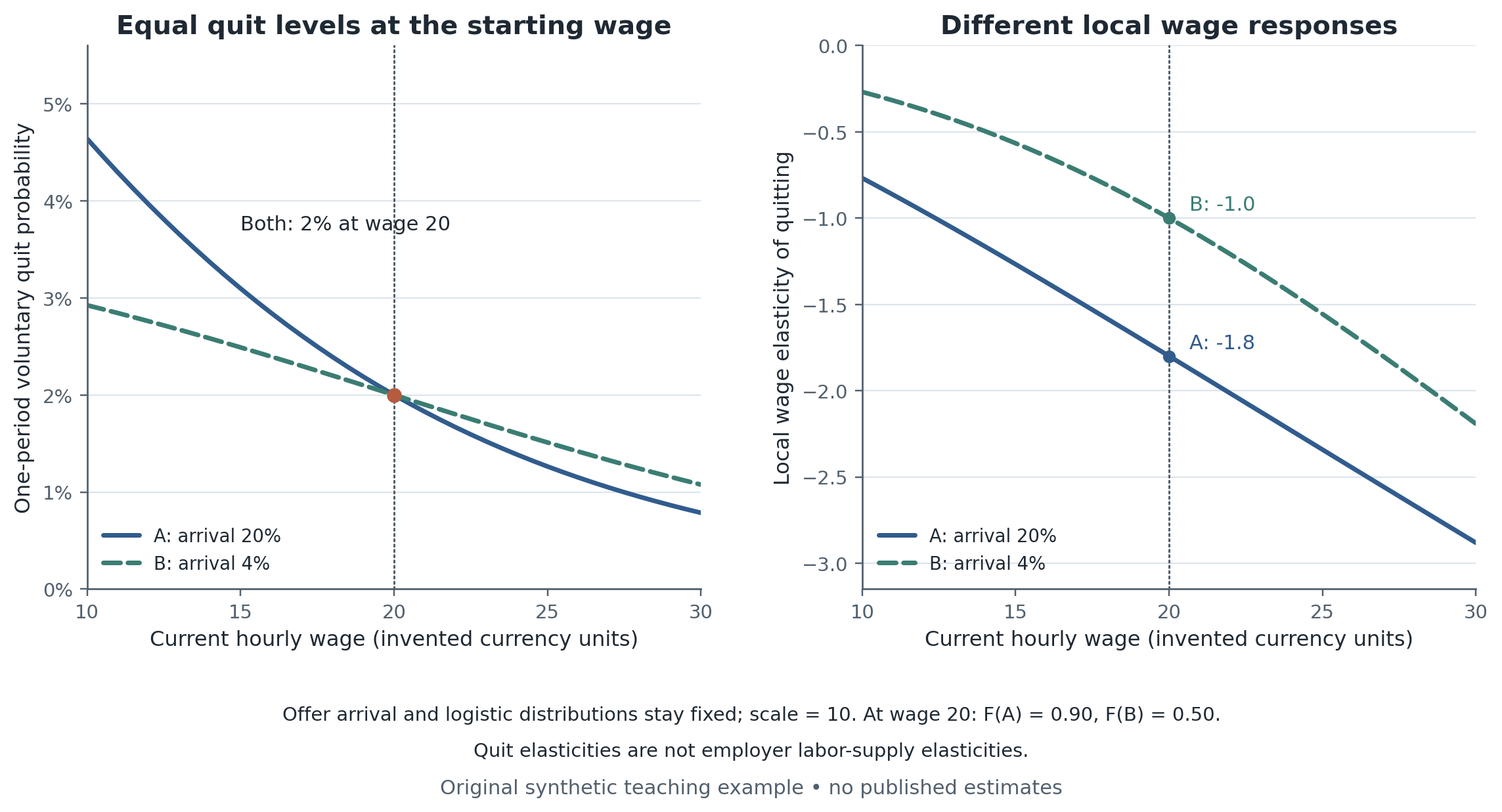
Figure 1:Original synthetic teaching example. Both environments have quit probability .02 at wage 20. Environment A has offer arrival .20 and acceptance-tail probability .10; B has arrival .04 and tail .50. Separate panels show quit probabilities and local wage elasticities as wages vary, holding each logistic offer distribution and arrival probability fixed. Equal quit levels do not identify the wage response or an employer labor-supply elasticity. The plot script reads the lab’s exact quit-curve CSV. No published estimate is plotted.
Jäger–Roth–Roussille–Schoefer compare German workers’ outside-pay beliefs to empirical benchmarks and randomize wage information. Respondents revise beliefs and job-search or negotiation intentions. Keep those endpoints distinct from realized mobility and earnings. Their equilibrium implications come from a separate model, and a benchmark wage is not an actual guaranteed offer Jäger et al., 2024.
Two complementary applications help students locate the assumptions. Caldwell–Danieli derive an outside-options index from a matching model incorporating workers’ skills, preferences, and geographic costs; its sufficiency is model-based Caldwell & Danieli, 2024. Hoffman–Burks connect truckers’ productivity beliefs to quitting and estimate a learning model with biased beliefs. Their welfare and profit counterfactuals are structural, not outcomes of a randomized belief-correction intervention Hoffman & Burks, 2020.
For a project, write the exact question asked to workers and the event the response predicts. Expected wages conditional on forced departure, expected best accessible offer, and intended asking salary are different objects. Repeated beliefs are valuable only if their dates precede the choices they are meant to explain.
4. From worker responses to employer wage-setting
A useful static benchmark makes the extra assumptions visible. An employer posts a common wage, faces differentiable labor supply , and earns constant marginal revenue product per worker:
Take , , and a positive local supply elasticity. The displayed ratio is a necessary interior first-order condition; further shape restrictions are needed to establish a global optimum. It assumes fixed amenities and outside environment, and no additional recruiting, training, adjustment, or wage-discrimination margins. It is an explanatory benchmark, not permission to estimate markdowns from average wages and headcounts. With invented , elasticity 2 implies wage 20, whereas elasticity 5 implies wage 25. The same observed wage could instead reflect a different , amenity cost, or wage rule.
In a stationary stock-flow illustration with hires and total separation rate ,
For a positive stationary stock and the stated convergence, require and , holding the wage and environment fixed. If separation elasticity is −1, hiring elasticities .5 and 2 imply stock elasticities 1.5 and 3. The negative separation elasticity alone is neither number. This example assumes stationarity and no changing composition or feedback into the offered wage distribution. In real settings, hiring, quits, involuntary separations, and transitions must be modeled or measured separately.
Bassier–Dube–Naidu use administrative worker moves to examine responses to firm wage policies, with design and model restrictions linking separation responses to employer labor supply. The work illustrates why mover histories and firm wage measures matter; it does not make every observed move random Bassier et al., 2022. Dube et al. provide an experimental online-task setting for labor-supply responses; the task-level horizon and switching environment must remain visible when discussing long employment relationships Dube et al., 2020. Card et al. connect employer wage heterogeneity and rent sharing to models with workplace preferences Card et al., 2018.
Students should ask for wage offers and recruiting outcomes as well as exits. Firm fixed effects do not identify pure rents, and headcount persistence does not establish an inelastic supply curve. Sorkin’s revealed-preference approach uses worker flows within an explicit framework to rank employer values; it is not simply a ranking of mean pay or a declaration that each realized move raises every worker’s welfare Sorkin, 2018.
5. Internal pay architecture and reference groups
A pay policy may set a band across locations, allow counteroffers to selected workers, compress new-hire salaries, or constrain managers’ discretion. The comparison group depends on that architecture. Hazell et al.'s National Wage Setting, cited here as the dated CEPR working-paper version, motivates measuring the organizational level at which wage policies are coordinated rather than assuming every establishment independently prices local labor Hazell et al., 2024.
Reference wages are distinct from outside offers. Dube–Giuliano–Leonard exploit own- and peer-wage discontinuities created by a retailer’s pay rules. The design helps distinguish the response to a worker’s relative position from comparisons with market alternatives Dube et al., 2019. It is a particularly useful warning against using an isolated raise to predict a uniform firm-wide raise.
Original local-response example. Consider the probability approximation
With , an own-only 10% raise changes the quit probability by about −.00953 (−0.953 percentage points), while the same proportional raise for both own and peer pay changes it by about −.00191 (−0.191 percentage points). These are probability changes, not percentage changes in quits. The formula is only a local approximation within a feasible probability range; outside wages and other conditions are held fixed. It proves no numerical fact about the retailer.
Breza–Kaur–Shamdasani experimentally examine pay inequality in a workplace setting, including whether productivity differences are visible. Their design motivates measuring perceived justification and the reference group, not declaring all unequal pay to have the same effect Breza et al., 2018. The question for a new paper is whether a band or disclosure changes the level of compensation, a reference comparison, or beliefs about fair process. Each implies different outcomes and comparisons.
6. Transparency: whose information, about which wages?
Distinguish horizontal information about peers, vertical information about career opportunities, and external information about other employers. Cullen’s review organizes transparency research around these distinct information channels Cullen, 2024. A payroll website, a manager-pay disclosure, and a posting with a salary range are not interchangeable treatments.
Cullen–Perez-Truglia randomize salary information and examine horizontal and vertical comparisons within one organization Cullen & Perez-Truglia, 2022. Card–Mas–Moretti–Saez randomize information about a salary website and measure satisfaction and search intentions Card et al., 2012. In a research design inspired by either, receipt, comprehension, belief updating, effort, actual search, and realized exit require separate dates and denominators. An intervention can reveal future advancement opportunities while also changing dissatisfaction with current rank.
The employer may respond as well. Cullen–Pakzad-Hurson combine a bargaining model with an event study of historical U.S. state laws protecting salary discussions. Their mechanism allows transparency to strengthen employers’ resistance to individual wage demands because concessions can trigger other negotiations. The empirical institutional treatment is not a randomized salary-posting requirement Cullen & Pakzad-Hurson, 2023. This is evidence about a particular environment and a model, not a universal verdict on transparency policies.
Roussille distinguishes asking salaries, employer bids, and agreed salaries in an online recruitment environment, including evidence around a platform change in salary guidance Roussille, 2024. It is useful for connecting entry negotiation to internal pay: information can change the ask without automatically establishing an equal change in final compensation. Conditioning on who receives a bid or starts a job changes the estimand.
Original compression example. Two wages fall from (30,50) to (30,40). The gap halves while mean pay falls from 40 to 35. Compression is a distributional statistic, not a welfare sign. Identify whose wages change, which workers enter or exit, and whether measured dispersion uses a fixed baseline population.
7. Voice: an option, an action, and an organizational response
Hirschman’s exit–voice distinction is a useful organizing framework: workers may respond to an unsatisfactory relationship by leaving or trying to change it. Its value here is to broaden the set of behavioral outcomes, not to impose a particular causal relationship between complaints and quits Hirschman, 1970.
A simple original option model lets a worker with a grievance use a channel when its expected remedy benefit exceeds private costs:
Here is perceived remedy probability, its value, communication cost, and expected retaliation or privacy cost. All are schematic utility units. Access can improve the ex ante option even for a worker who never has a grievance. Conversely, increased usage can signal worsening conditions, lower reporting costs, or increased trust. The formula does not identify any of these primitives without additional data or variation.
Adhvaryu–Molina–Nyshadham randomize an anonymous feedback survey following a disappointing wage increase and study subsequent retention and absence. The survey is the intervention; the wage hike itself is not randomized by that experiment Adhvaryu et al., 2022.
Adhvaryu–Gade–Molina–Nyshadham’s Sotto Voce, in the February 2026 journal issue, randomizes access to anonymous mobile communication with HR. Reported use is low while retention and attendance respond. The authors interpret the combination as suggestive of option value. Access is the randomized margin, not use or successful resolution Adhvaryu et al., 2026. A comparison of users and nonusers cannot isolate that option value, because grievance severity and expected remedies affect use.
This produces an important IV lesson. If access changes reassurance or expected future recourse even without use, access violates exclusion as an instrument for actual use. One-sided access and a strong first stage do not repair that violation. The lab makes it numerical rather than treating mediation as a verbal caveat.
Original reporting example. Underlying incidents decline from 100 to 80, but the reporting probability rises from .10 to .50. Recorded complaints rise from 10 to 40. An upward complaint series therefore does not establish worse conditions; a downward one does not establish better conditions. Independent condition measures and response/remedy records are essential.
8. Voice in production and representation: different objects
Voice can mean feedback to improve production, a channel for individual grievances, or formal representation in governance. These differ in who speaks, what is decided, and what authority the recipient has.
Nelson–Wilmers, published in the January 2026 ILR Review issue, link a large establishment survey on production voice to earnings and business outcomes. The evidence is observational; its productivity-versus-bargaining attribution depends on the empirical decomposition rather than separate randomizations of those mechanisms Nelson & Wilmers, 2026. It is useful for designing linked outcomes, not a license to label a conditional pay premium a causal bargaining parameter.
Jäger–Schoefer–Heining study board-level worker representation using a specific German institutional change. The design supplies a distinct comparison from an anonymous HR channel or production-suggestion program Jäger et al., 2021. A null or imprecise outcome for one form of representation does not identify the effect of every form of voice. This short comparison keeps governance visible without duplicating the institutions course’s national-regime analysis.
For each intervention, measure whose preferences can reach a decision-maker, whether anyone must respond, and whether workers can verify the response. Complaint records alone measure expressed concerns, not influence. Anonymous logs cannot be retroactively linked to payroll by assuming identity is available. Research feasibility includes consent, access restrictions, secure handling, and protection against retaliatory use of the data.
9. An incidence ledger, not a single success metric
Separate four perspectives: firm outcomes; all workers present at baseline; entrants; and destinations of workers who leave. Within the baseline cohort, stays and exits are post-treatment outcomes, not randomized subgroups. Workers who leave are already part of the initial-worker population: the destination perspective must not be added a second time to its welfare total. Report unconditional baseline-cohort effects first and label subgroup decompositions accordingly.
Kline–Petkova–Williams–Zidar link patent and tax records to examine how firm-level gains reach workers, with heterogeneous incidence across incumbent and other worker margins. The paper supplies a template for following the distribution of gains rather than assuming productivity growth is shared uniformly Kline et al., 2019.
Original selection example. Wages of four workers are (10,10,20,20). The two low-paid workers leave and the remaining wages are unchanged. Mean incumbent pay rises from 15 to 20, while the wage bill falls from 60 to 40. No person’s raise generated the higher mean. Earnings at the original employer may legitimately be zero after exit for an employer-specific outcome; total labor earnings must remain missing unless destination earnings are observed.
Original transfer example. Output value is 100, the wage bill 60, and profit 40. An otherwise pure transfer changes wages to 70 and profit to 30. Workers gain 10 and the firm loses 10; total resources do not rise by 10. Differential social weights, taxes, effort, amenities, recruiting savings, or product-market effects can change the welfare analysis, but those must be supplied rather than inferred from retention. A counteroffer can redistribute rent without creating the same resources as a reduction in wasteful replacement costs.
The ledger therefore reports output/quality, pay/hours/benefits, recruiting and training resources, uncertainty, commute/schedule burden, grievance resolution, and outside destinations. It marks which cells are observed, estimated under assumptions, or unavailable. Missing welfare evidence is a result to communicate, not a reason to substitute profits or satisfaction alone for welfare.
10. Research opportunities: interventions that separate explanations
The following are proposed projects, not established findings or claims that data access is already available.
Pay architecture and mobility. Study a documented change in band discretion across units. Retain the initial roster, applicant pool, offers, counteroffers, and destination links. A useful design separates own pay, peer comparisons, and other employers’ conditions; a clean band change is not automatically random.
Information plus feasible search. Combine wage-information assignment with a separately assigned reduction in application or travel costs. The interaction can distinguish inaccurate beliefs from difficulty acting on accurate beliefs. Establish delivered content and accessible jobs; do not equate a benchmark with an offer.
Voice access versus response credibility. Compare well-defined, ethically feasible changes in response procedures or guaranteed acknowledgment. Do not withhold safety protections. Predefine endpoints such as resolution time, independently measured conditions, baseline-cohort retention, and reported safety. The experiment should vary a concrete service feature rather than asking whether “voice works.”
Algorithmic HR triage. Study whether a triage tool changes detection, response prioritization, or actual remedies. Blind-review samples, record false negatives, and audit minority-language complaints. More resolved tickets can reflect easier case selection rather than improved conditions. Week 9 can expand the organizational-adoption problem; here the primary issue is which worker gains access to a remedy.
Retention with welfare follow-up. Track movers rather than deleting them. Compare origin-firm savings with earnings, hours, job quality, and uncertainty for the same initial workers. Even a small high-quality follow-up sample can discipline claims that are otherwise based only on payroll persistence.
Table 3:Research question → observable variation → warranted claim
| Paper | Data/design to study | Teaching use | Interpretation boundary |
|---|---|---|---|
| Baker–Gibbs–Holmström, Wage Policy Baker et al., 1994 | Longitudinal personnel and wage records | Reconstruct pay architecture before discussing wage dispersion | Internal patterns alone do not identify the response to an exogenous outside option |
| Mas–Pallais Mas & Pallais, 2017 | Job-arrangement choices with randomized wage differences in recruiting | Recover trade-offs for a defined choice set | Applicant WTP is not the entire workforce’s valuation or equilibrium provision cost |
| Maestas et al. Maestas et al., 2023 | Working-conditions survey and stated job choices | Compare heterogeneous amenity values | Attribute descriptions, attention and population determine interpretation |
| Jäger–Roth–Roussille–Schoefer Jäger et al., 2024 | Outside-pay beliefs, empirical benchmarks, randomized information | Separate perceived opportunities from measured benchmarks | Intentions are not realized moves; equilibrium claims add a model |
| Caldwell–Danieli Caldwell & Danieli, 2024 | Matching-based outside-options index and administrative data | Make skills, preferences and mobility costs explicit | Index sufficiency is conditional on the model, not a raw-offer identity |
| Hoffman–Burks Hoffman & Burks, 2020 | Repeated productivity beliefs and outcomes; structural quitting model | Connect beliefs, exits, firm profits and welfare | Belief–quit associations and debiasing simulations are different evidence layers |
| Dube–Giuliano–Leonard Dube et al., 2019 | Retail pay-rule discontinuities in own and peer wages | Separate absolute and reference comparisons | Do not apply the isolated own-raise elasticity to a uniform raise without assumptions |
| Bassier–Dube–Naidu Bassier et al., 2022 | Administrative movers and firm wage-policy variation | Study wage-sensitive separation with worker histories | Assignment/matching and stock-flow assumptions still matter |
| Dube–Jacobs–Naidu–Suri Dube et al., 2020 | Online-task labor-supply variation | Observe response to compensation in a bounded environment | Task response is not automatically a long-run full-time-employment elasticity |
| Cullen–Perez-Truglia Cullen & Perez-Truglia, 2022 | Randomized horizontal/vertical salary information | Compare peer rank with information about advancement | Information recipient and comparison target are part of the treatment |
| Card–Mas–Moretti–Saez Card et al., 2012 | Randomized salary-website notification | Link pay information to satisfaction and search intentions | Not a randomized raise or evidence of completed job changes |
| Breza–Kaur–Shamdasani Breza et al., 2018 | Experimental pay inequality and visibility of productivity differences | Distinguish unequal pay from perceived justification | A setting-specific comparison, not a universal effect of compression |
| Cullen–Pakzad-Hurson Cullen & Pakzad-Hurson, 2023 | Bargaining model plus historical salary-discussion-law event study | Employer responses can change the information intervention’s incidence | Not a randomized job-posting mandate; institutional comparisons have their own trend assumptions |
| Roussille Roussille, 2024 | Asking salaries, bids and salary-guidance change in recruiting | Locate information in the bargaining sequence | Selected bids and accepted offers must not be collapsed into all-applicant outcomes |
| Adhvaryu–Molina–Nyshadham Adhvaryu et al., 2022 | Anonymous survey randomized after a wage hike | The act of eliciting feedback can be an intervention | Wage hike is contextual, not the randomized treatment |
| Adhvaryu–Gade–Molina–Nyshadham Adhvaryu et al., 2026 | Randomized anonymous mobile-to-HR access | Distinguish access from actual use and remedy | Low use with an access effect suggests an option channel; it does not identify a pure use effect |
| Nelson–Wilmers Nelson & Wilmers, 2026 | Production-voice survey linked to earnings/business records | Put worker and firm outcomes together | Observational premium and decomposition do not separately randomize bargaining and productivity |
| Jäger–Schoefer–Heining Jäger et al., 2021 | Institutional variation in board representation | Compare a different authority/voice mechanism | Do not generalize one form of representation to every grievance channel |
| Kline et al. Kline et al., 2019 | Patent/application and business/worker tax linkage | Track heterogeneous incidence of firm-level gains | Read the source of allowance variation; gains to observed incumbents are not all workers’ gains |
Paper presentation rule: use one slide for assignment/variation, one for target and risk set, one for findings actually measured, and one for the remaining identification/welfare gap. Describe a result as a structural counterfactual when that is what it is. The methodological extensions in this course are proposals, not additional findings from these papers.
Table 4:Build the data request around a comparison, not an HR database name
| Needed object | Candidate records | Required fields and joins | Main coverage/access caveat |
|---|---|---|---|
| Wage-policy treatment | Pay-band manuals, amendment history, exception approvals | Version, announcement and effective dates, unit, grade, eligible employees | Current manuals cannot reconstruct past rules; grade changes may bundle tasks and benefits |
| Actual compensation | Payroll, scheduling, offer letters, benefits | Worker-period hours/rate/bonuses, zero pay versus no record, accepted offer | Payroll alone does not reveal rejected offers, commuting burden, or total job value |
| Outside opportunity | Search survey, applications, offers, linked employment histories | Offer date, wage, hours, destination, rejected offers, stated feasibility | A missing offer is not zero opportunity; accepted offers are selected |
| Beliefs | Predated elicitation and information assignments | Exact question, scenario, horizon, probabilities/point forecast, delivery and comprehension | Intentions may not turn into behavior; social desirability and attention matter |
| Reference comparison | Baseline team/job roster and information logs | Peer definition, own/peer pay changes, what is known and when | Realized team changes can be endogenous; leave-out does not establish exogeneity |
| Voice process | Channel eligibility, anonymous logs, aggregate response audit | Awareness, attempts, receipt, acknowledgment, issue category, resolution latency | Genuine anonymity may prevent worker-level merging; do not infer absent identities |
| Worker welfare | Independent surveys, schedule/commute records, leaver follow-up | Conditions, safety, uncertainty, hours, pay, satisfaction, response status | A grievance survey may itself be treatment; no single endpoint equals complete welfare |
| Retention and incidence | Baseline roster, separation reasons, outside employer linkage, business outcomes | Entry/exit/internal moves/returns, follow-up horizon, firm resources and quality | Stayer-only samples and uncertain destinations can generate misleading gains |
Table 5:Public starting points and access distinctions
| Resource | What is actually documented | Suitable student use | What is not promised |
|---|---|---|---|
| Mas–Pallais replication listing Mas & Pallais, 2019 | AEA-linked openICPSR project113162, version1 | Read the release’s codebook and license, then identify a precise reproducible choice/valuation object | Original files were not downloaded or executed here; verify contents and dependencies before claiming replication |
| Caldwell–Danieli archive Caldwell & Danieli, 2023 | Zenodo v2 listing with Stata/R code and replication/data-access instructions | Learn how the outside-options index is constructed and where restricted data enter | Public code does not grant unrestricted access to German linked microdata |
| IAB LPP/LPP-ADIAB Institute for Employment Research, Research Data Centre, n.d. | Official linked personnel/administrative-data documentation and access routes | Develop a field-level data plan for pay practices, workers and establishments | Research access has conditions; documentation or a teaching file is not a full microdata release |
| Census LEHD products U.S. Census Bureau, 2026 | Public workforce analytics and job-to-job-flow products | Describe flow patterns and feasible population/industry comparisons | Aggregates do not identify individual counteroffers, grievances, preferences or worker–firm bargaining |
Freeze source version, extraction date, geographic and employment coverage, linkage rates, and confidentiality rules. Never include confidential complaints in a public lab or transmit them to a service without authorization. Code that builds a statistic and data that permit it to be identified are different assets.
A useful pilot is a small feasibility join across one pre-period roster, one pay-rule revision, one outcome panel and a documented follow-up sample. Count unmatched records by treatment and baseline risk. If privacy prevents a proposed linkage, redesign the estimand at a legitimate aggregate level rather than assuming hidden person IDs are available. The synthetic lab demonstrates logic; it does not create external validity or real access.
Research Lab
Reproduce — an access experiment with explicit treatment boundaries
The primary design anchor is Sotto Voce; Mas–Pallais and the outside-option studies provide contrasting measurement applications. The guaranteed route is an original synthetic reconstruction of an access-versus-use identification problem, not the paper’s microdata, parameters, assignment protocol, or empirical estimates.
Twenty invented workers form ten baseline matched pairs; one worker in each pair is assigned access. The complete randomization space has assignments. A fixed-follow-up condition score is observed for every initial worker, including those who leave. This complete observation is an assumption of the teaching environment, not a claim about a real anonymous channel. Retention is a separate binary endpoint. Potential outcomes are fixed before assignment; use is endogenous.
Estimate access ITTs and a design-based variance estimate from pair contrasts. Enumerate the allowed assignments while holding observed outcomes fixed for a two-sided Fisher sharp-null test. The instructor audit separately recomputes potential outcomes to verify unbiasedness; that oracle exercise is not empirical inference.
Diagnose — low use does not license a use-effect IV
In the toy score model, channel access has a .6-unit direct effect for everyone, and actual use has an additional .8-unit effect for workers with a grievance. Twenty percent would use the channel if assigned access. The average access effect is therefore .76, but the population Wald ratio is , not .8. The access instrument fails exclusion for use. No test of first-stage strength can remove the .6 direct effect. These are invented teaching parameters.
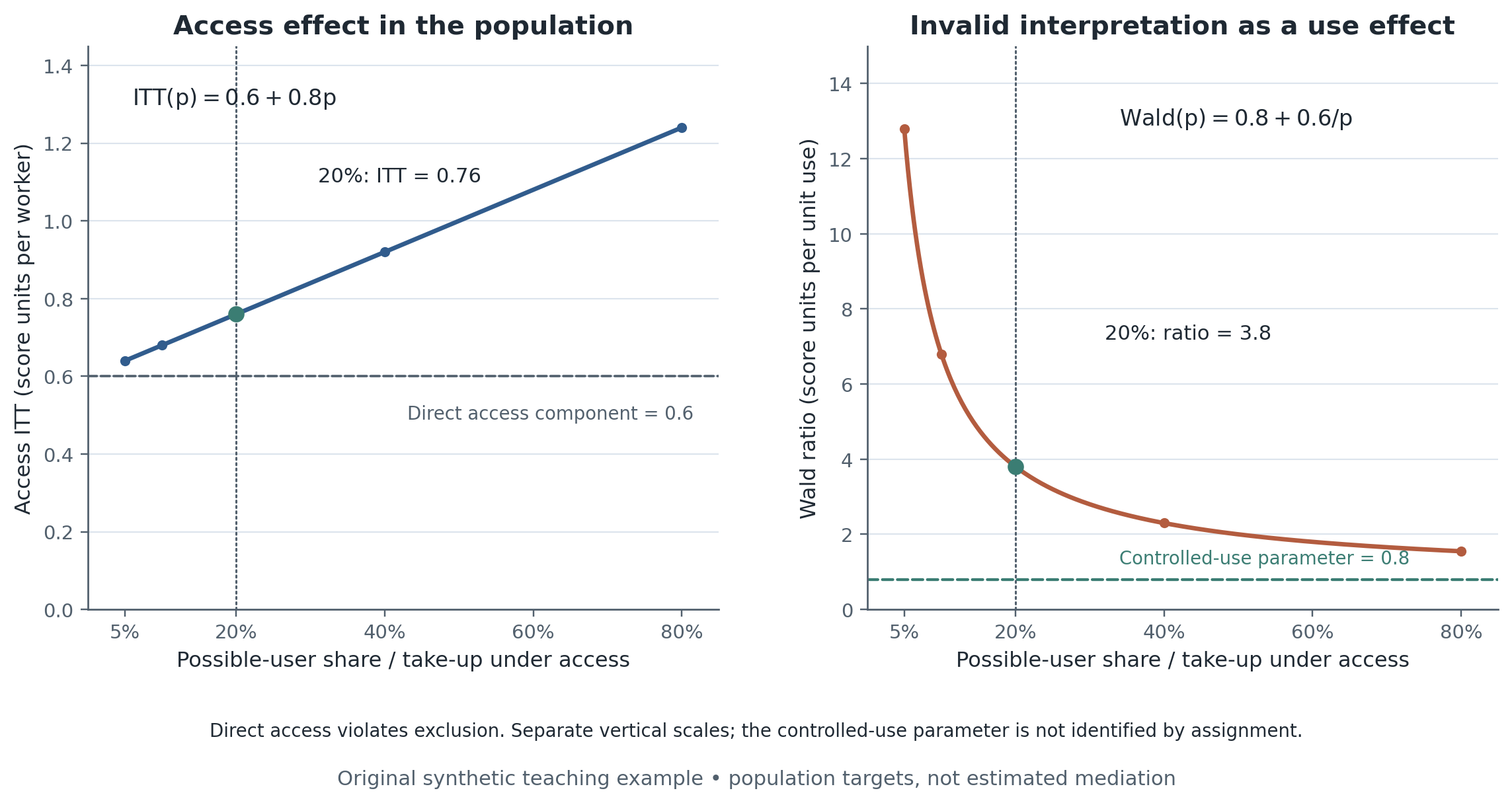
Figure 2:Original synthetic teaching example. Access directly improves the condition score by .6; use adds .8. The left panel shows the population access ITT ; the right shows the invalid-use Wald target for possible-user share . The panels use separate vertical scales and distinct units. At , the targets are .76 and 3.8, while the controlled-use parameter remains .8. The ratio fails as a use-effect interpretation because exclusion is false; the curve is not estimated mediation. The plot script uses the lab’s exact sensitivity CSV.
Compare this with the observed user/nonuser association, which is additionally confounded by grievance severity. Then use independent arithmetic diagnostics on own-versus-peer raises, wage-versus-earnings changes, low-quit observational equivalence, survey selection, and the complaint-recording process. The core example does not build spillovers into the toy DGP; a real HR intervention may create them and require a different design.
Transfer — the incidence proposal
Submit a two-page proposal plus the four-party incidence ledger. Specify the treatment and counterfactual, eligibility and timing, which information is available to whom, the actual assignment unit, and how workers who leave remain represented. Include an independent job-condition measure, uncertainty assessment, and two competing mechanisms with distinguishable predictions. State what the project cannot infer about welfare or employer power.
Optional original-data replication is a separate mode. Start with an official archive, verify files and permissions, name the exact object reproduced, and document unavailable microdata. A public software archive or abstract is not an executed replication.
Methods Box
A. Treatment, timing, and first-stage interpretation
Record the announcement, eligibility, delivery, awareness, receipt, and behavior dates. Pay-band publication is not a realized raise; access to voice is not use; information receipt is not an actual offer. In an experimental design, report assignment ITT before selected receipt comparisons. A valid receipt-IV additionally needs exclusion, monotonicity, and a defensible treatment definition. In this week’s lab, exclusion deliberately fails.
For endpoint (the condition score or the retention indicator), let be the observed treated-minus-control contrast in pair , and let :
The estimated standard error is . Under the independent pair lottery, its variance estimator is conservative in expectation when pair-average effects differ; the realized standard error need not exceed the oracle standard deviation in every draw. It neither reveals effect heterogeneity nor produces an exact Fisher confidence interval. Report score effects in score units and retention risks in probability units or percentage points. Ten independently randomized pairs remain ten pairs despite the 1,024 enumerated allocations.
The Fisher calculation holds the observed endpoint fixed under the global sharp null of no access effect on that endpoint. The separate instructor audit changes outcomes under alternative assignments: its average score ITT is .76 and retention ITT .15, known only because both potential outcomes are invented. That oracle variance is not available from an actual experiment. No significance threshold is an acceptance test.
For staggered organizational changes, construct cohort-time comparisons using unaffected or not-yet-affected units when the corresponding trend restrictions are defensible. Inspect anticipatory wage negotiation and quits around announcements. Moving the event date to payroll implementation can incorrectly classify responses to an earlier announcement as pretrends.
B. Pay discontinuities and reference groups
A tenure, wage, or grade rule may create variation, but document whether other benefits, promotion eligibility, or job duties change at the same threshold. Examine manipulation and measurement precision. An institutional rule is not automatically an RD. For own/peer comparisons, define peers before treatment using a defensible roster and job relation, exclude the focal wage mechanically, and record whether recipients actually know the relevant salaries. A leave-out mean removes self-inclusion, not endogenous reference groups.
Define the counterfactual carefully: increasing one worker’s pay, increasing the team’s pay, and changing the firm’s pay policy expose workers to different relative-pay and labor-market environments. Report all outcomes in levels or percentage points before converting to elasticities, with the wage and quit-rate denominators stated.
C. Elasticities, moves, and inference
A wage-policy study needs the horizon, affected population, wage concept, and alternative-employer environment. Moving from a separation response to a firm labor-supply elasticity requires assumptions about recruitment, involuntary exits, steady state, and composition. Estimate or bound missing components rather than silently imposing a convenient multiplier. Firm wage effects and value rankings are different constructed objects with different assumptions.
Cluster or randomize at the intervention’s assignment/dependence level, not the data-row level. Branches subject to one central wage policy are not automatically independent clusters. Standard errors cannot fix common demand shocks, endogenous retention raises, or sorting. Few independent units require a design-specific plan; arbitrary reshuffling of individual records is not randomization inference Cameron & Miller, 2015.
D. Exits, selection, and absent destination data
Define the initial population before the intervention. A retention rate should specify horizon and whether internal transfers, retirement, dismissals, or returns count. Use fixed-horizon risks and, when useful, cause-specific transitions; do not treat every competing exit as benign censoring. “Not in payroll” can be a missing linkage, not a quit.
For a wage or satisfaction outcome available only among stayers, report response/observation rates by assignment and baseline risk. Weighting requires a defensible missingness model. Lee bounds require monotone selection and their other identifying restrictions; they are not automatic merely because response rates differ Lee, 2009. Voice can encourage some workers to stay and others to leave, making a common-direction selection claim substantively doubtful. Include leaver follow-up when feasible and keep its response process visible.
E. Beliefs, amenities, and measurement validation
Match elicited beliefs to the exact event: a comparable-worker benchmark, expected next offer, or expected forced-move wage. Use independent benchmark construction and separate data used to estimate opportunities from data used for validation when practical. Good predictive fit does not show each opportunity is feasible.
For WTP, specify the choice set, wage support, bundle of attributes, attention model, and population. A salary–amenity regression is not a randomized job-choice contrast. Report heterogeneity only within observed choice support and distinguish applicant, incumbent, and population valuations.
F. Voice and the recording process
Audit awareness, attempted contact, recording, response, remedy, and independent workplace conditions. An anonymous channel may preclude person-level mediation; do not invent links. A survey that elicits voice may itself affect outcomes, so “measurement-only control” assumptions require thought. Complaint volume is a joint function of conditions and reporting. Safeguard data against managerial retaliation and do not send private complaints to external services without authorization.
G. Minimum empirical display
A research paper should show: the pay/voice rule and timeline; baseline roster and follow-up ledger; assignment or identifying comparison; wage/earnings/condition endpoints; receipt and missingness rates; outside-option measurement; peer and central-policy exposure; uncertainty at the correct unit; and the four-party incidence table. Label model-dependent welfare calculations and avoid claims of universal worker benefit or power from one outcome.
Table 6:Choose the comparison before choosing the estimator
| Research problem | Useful design/method | Implementation requirement | What remains unsolved |
|---|---|---|---|
| Value of an amenity | Randomized wage differences across clearly specified job bundles | Preserve choice support, attention model, randomization unit and applicant denominator | Applicant choices do not identify all workers’ values, firm provision costs, or welfare under rollout |
| Information about outside options | Randomized content with pre/post beliefs and behavior | Separate benchmark construction, actual offer availability, receipt and follow-up | Updated intentions do not prove completed mobility or gains |
| Endogenous retention raise | Administrative rule or other defensible wage-policy variation | Document the rule, eligibility, co-treatments and assignment/timing | A raise awarded to likely quitters is selected; fixed effects alone do not solve it |
| Own versus peer wages | Distinct own/peer discontinuities or experimental variation | Define reference group before treatment and measure information | A uniform raise changes references and possibly other firms’ choices |
| Employer labor-supply elasticity | Wage-policy/mover design with explicit recruitment–separation link | State wage measure, time horizon, total separations, hires and stationarity assumptions | A quit coefficient alone is not a markdown or the firm’s full supply elasticity |
| Staggered organizational reform | Explicit cohort-time comparisons under justified trend assumptions | Use announcement and implementation dates, unaffected comparisons, no post-treatment controls | Common shocks, anticipation, spillovers and changing bundles can invalidate the comparison |
| Voice access | Assignment-based ITT | Baseline roster; actual assignment unit; awareness/use/response distinctions | Access may affect nonusers; instrumenting use needs more than a first stage |
| Voice mediation | Separately justified variation in receipt/response, or transparent mediation assumptions | Explain each exclusion, timing and selection condition | Users self-select by grievance and expected remedy; one-sided use does not guarantee exclusion |
| Selective observation | Follow all baseline workers; explicit bounds or missingness model | Report survey/destination coverage by treatment; test sensitivity | Lee monotonic-selection assumptions can fail; weighting needs an adequate missingness model Lee, 2009 |
| Shared wage policy/interference | Design-aligned clustering or randomization inference | Identify shared policy/HR units and plausible spillover boundaries | More worker rows do not create more independently assigned units Cameron & Miller, 2015 |
| Recorded complaints | Reporting/detection-process audit | Independent condition sample, attempts, receipts, acknowledgments and remedies | Complaint counts can move because reporting becomes safer, not because harm increases |
| Incidence and welfare | Baseline-cohort ledger plus entrants and firm accounts | Separate cash transfers, real resources, amenities, uncertainty and destinations | Retention, compression, profit or satisfaction alone cannot complete welfare accounting |
Three checks students must perform. First, draw the sequence from eligibility to outcome and mark every variable selected after treatment. Second, state what the treatment changes for peers, employers and outside options; do not call a generic “pay effect” invariant across these changes. Third, enumerate missing ledger cells and identify whether they require more data, a maintained assumption, or an honest limit on the claim.
Exact inference in the teaching lab. Randomization is one access assignment per matched pair. Enumerating all1,024 assignments while keeping observed outcomes fixed tests a global sharp null of no access effect on that endpoint. Recomputing potential outcomes in the separate instructor audit checks estimator properties using known toy truth. It is not the same calculation and is not available in real data. The pair-contrast variance estimate is distinct from oracle variance; it does not make treatment-effect heterogeneity known.
No mechanical checklist can certify a design. A first-stage statistic cannot validate exclusion; balance cannot prove all assignments are ignorable; a cluster correction cannot remove endogenous raises; and a stayer restriction does not identify an “incumbent effect” for the same people under both treatments. Specify the institutional counterfactual that makes each procedure meaningful.
Reading Ladder And References
Three required papers: Mas–Pallais (2017) for revealed trade-offs in recruitment; Jäger et al. (2024) for beliefs, information, and outside options; Adhvaryu et al. (2026), Sotto Voce, for access, use, and voice Mas & Pallais, 2017Jäger et al., 2024Adhvaryu et al., 2026. Read their design/measurement sections closely; do not assign every appendix in one week.
Rotating empirical presentations: Dube–Giuliano–Leonard versus Bassier–Dube–Naidu for wage-response interpretation; Cullen–Perez-Truglia versus Cullen–Pakzad-Hurson for information and employer response; Nelson–Wilmers versus Jäger–Schoefer–Heining for types of voice; and Kline et al. for incidence. Each presentation must separate observed outcomes, causal variation, and model-dependent claims.
Foundations and research resources: selected excerpts from Manning and Hirschman; Card et al.'s employer-inequality framework; Baker et al.'s wage records; Caldwell–Danieli and Sorkin on opportunities/job value; Maestas et al. on valuation; and Hoffman–Burks on beliefs and quitting. These are routes into projects rather than additional compulsory readings.
The data-access route is explicit: Mas–Pallais have an official replication listing; Caldwell–Danieli’s archive provides code and access instructions; the IAB Linked Personnel Panel offers rich linked-data documentation under access conditions; Census LEHD products provide public aggregates distinct from restricted person-level research data Mas & Pallais, 2019Caldwell & Danieli, 2023Institute for Employment Research, Research Data Centre, n.d.U.S. Census Bureau, 2026. None automatically supplies confidential complaint records or all rejected outside offers.
Table 7:Three required readings, not a bibliography-length assignment
| Role | Reading | Prepare before class | Main question in discussion |
|---|---|---|---|
| Required1: job value | Mas–Pallais2017 Mas & Pallais, 2017 | Draw the alternatives and wage variation; list the population and attention issues | What valuation object is recovered, and which bundle is being compared? |
| Required2: outside options | Jäger et al.2024 Jäger et al., 2024 | Separate measured benchmark, belief, information assignment and intentions | Which results come from data, randomization and the equilibrium model? |
| Required3: voice access | Adhvaryu et al.2026 Adhvaryu et al., 2026 | Draw access→awareness→use→response→outcome | What is randomized, and why is the effect of actual use a different question? |
Table 8:Rotating presentations and project pathways
| Pathway | Pair or cluster | Assignment |
|---|---|---|
| Wage-response interpretation | Dube–Giuliano–Leonard; Bassier–Dube–Naidu; Manning review | Compare own/peer/firm-policy changes and map separation responses to the desired elasticity under explicit assumptions |
| Pay information and negotiation | Card et al.; Cullen–Perez-Truglia; Cullen–Pakzad-Hurson; Roussille | Identify recipient, wage reference, first stage, employer response and selection into bids or employment |
| Pay architecture and job value | Baker et al.; Hazell et al.; Sorkin; Maestas et al. | Contrast observed pay rules, flow-based value measures and elicited amenity preferences |
| Voice across institutions | Adhvaryu et al.2022; Nelson–Wilmers; Jäger–Schoefer–Heining; Hirschman | Distinguish feedback, grievance access, production input and board authority; compare causal and observational evidence |
| Incidence and beliefs | Kline et al.; Caldwell–Danieli; Hoffman–Burks; Card et al.2018 | Follow who captures gains and specify the role of models in opportunities, rents and welfare |
The instructor may choose one presentation pathway, not all. Each presentation ends with a feasible two-outcome data request and one unresolved mechanism. The 2026 voice papers are published studies; National Wage Setting is explicitly a working paper in the cited2024 CEPR version.
Table 9:Research lab: reproduce → diagnose → transfer
| Phase | Guaranteed teaching output | Interpretation boundary |
|---|---|---|
| Reproduce design logic | Original synthetic access lottery, baseline cohort, ITT, pair uncertainty and exact sharp-null reference | This is not Sotto Voce’s protocol, microdata or estimates |
| Diagnose access/use | Compare ITT, first stage, selected use and invalid Wald interpretation | Toy direct access effect violates exclusion; significance of a first stage does not repair it |
| Diagnose wage/retention measures | Hourly wage versus earnings, equal quits with different offer environments, own/peer raises | Original numerical examples, not empirical elasticities |
| Diagnose incidence | Stayer-mean composition, recorded-complaint reversal and transfer accounting | Missing destinations or welfare objects are not set to zero |
| Transfer | Two-page proposal plus firm/initial-worker/entrant/leaver ledger | Name the assignment, alternative explanation, feasible follow-up, privacy boundary and unavailable welfare components |
Resource route. Use the official Mas–Pallais listing to investigate a feasible original-data alternative, and the Caldwell–Danieli software/access archive to understand how a model-based opportunity measure is implemented. LPP and LEHD documentation help with real data planning but impose different access and aggregation limits Mas & Pallais, 2019Caldwell & Danieli, 2023Institute for Employment Research, Research Data Centre, n.d.U.S. Census Bureau, 2026. Original microdata/code were not downloaded or executed for this pack.
Bridge to Week9. A reorganization is not justified by retention alone. Bring the same outcome and incidence discipline to changes in practices, schedules, technology, and work arrangements, without reteaching this week’s wage-information and voice comparisons.
Exercises And Discussion Prompts
Two employers have identical quit rates. Construct two different offer-arrival and offer-value environments consistent with those rates. What additional variation would distinguish them?
A wage-band reform raises hourly pay but lowers earnings. Which worker and firm outcomes are needed before interpreting incidence?
Explain why an own-pay discontinuity and a uniform firm-wide raise need not identify the same wage elasticity. Specify the peer group and outside environment.
Access to a grievance channel raises retention although few workers use it. State the access estimand, why a users comparison is selected, and why access may fail exclusion for use.
A salary-information treatment changes reported search intentions. Design a feasible follow-up that distinguishes applications, offers, moves, and earnings without assuming they all occur.
Complete the incidence ledger for a reform with higher stayer wages, more quits, and lower firm recruiting costs. Identify missing information and avoid adding transfers twice.
Reproducibility And Code Lab Note
Download the teaching repository (ZIP), or clone the repository. Keep its folder structure and open books/special-topic8-organizational/labs/08-wage-setting-retention-outside-options-and-worker-voice/; the lab README supplies the run instructions. Weeks 1–3 use the shared plotting module supplied with the repository.
The Week 8 lab handout and lab README implement original synthetic design reconstruction, with empirical_replication false. All workers, pairs, access effects, use decisions, outcomes, and diagnostic numbers are invented. No original study’s microdata, estimation code, protocol, or empirical estimates were reproduced. Public archive listings are optional starting points; actual files, terms, dependencies, and a named reproduction target still require inspection.
From the course root, run the lab and regenerate both figures:
ENV_NAME=research bash labs/08-wage-setting-retention-outside-options-and-worker-voice/smoke.sh
conda run -n research python assets/scripts/build-week8-voice.py
The standard-library lab preserves all 65 supplied numerical/design assertions. Its smoke compiles Python, compares two fresh default-seed runs with identical manifests, runs seed 88771, and verifies exit-2 refusal to overwrite a nonempty directory without modifying its files. A separate staging installer preserves authored documentation. The core route needs no internet, credentials, private data, external API, or new package. Potential outcomes and latent types stay in data/instructor/; student records contain observed information only. Complete initial-worker follow-up and no interference are explicit toy assumptions. Stayer-only scores are a separate, selected field, blank for leavers.
The transfer memo template asks for two pages plus a firm/initial-worker/entrant/leaver incidence ledger. Include two explanations, an independent conditions or welfare endpoint, actual assignment/dependence units, and destination coverage. Leavers are part of the initial cohort, not an extra population to add twice. Figure generation uses installed Matplotlib and preserves exact exported CSVs; all figures are original synthetic teaching examples.
Slide Companion Note
The Week 8 slide deck (PDF) and Beamer source develop pay and opportunity records, wage–amenity choices, outside beliefs, quit versus supply elasticities, reference pay, transparency, voice, incidence, methods, and the research proposal. The three required papers receive explicit design discussion. Empirical settings, variation, targets and limitations stay beside each paper; long maps remain readable chapter handouts.
Compile from the course root:
conda run -n research latexmk -cd -pdf -interaction=nonstopmode slides/week8/08-wage-setting-retention-outside-options-and-worker-voice.texThe deck uses the completed course’s Beamer style and both generated figures. Access effects, selected-use comparisons, structural counterfactuals, and original arithmetic remain distinct.
Bridge Forward
Week 8 establishes who values, understands, can leave, and can influence a job. Week 9 asks how organizations change that job through complementary practices, technology, schedules, and work redesign. The bridge is not that every retention improvement warrants rollout; it is that organizational change must be evaluated with explicit worker, firm, implementation, and distributional outcomes.
- Baker, G., Gibbs, M., & Holmström, B. (1994). The Wage Policy of a Firm. The Quarterly Journal of Economics, 109(4), 921–955. 10.2307/2118352
- Mas, A., & Pallais, A. (2017). Valuing Alternative Work Arrangements. American Economic Review, 107(12), 3722–3759. 10.1257/aer.20161500
- Dube, A., Giuliano, L., & Leonard, J. (2019). Fairness and Frictions: The Impact of Unequal Raises on Quit Behavior. American Economic Review, 109(2), 620–663. 10.1257/aer.20160232
- Adhvaryu, A., Gade, S., Molina, T., & Nyshadham, A. (2026). Sotto Voce: The Impacts of Technology to Enhance Worker Voice. The Economic Journal, 136(674), 798–812. 10.1093/ej/ueaf063
- Kline, P., Petkova, N., Williams, H., & Zidar, O. (2019). Who Profits from Patents? Rent-Sharing at Innovative Firms. The Quarterly Journal of Economics, 134(3), 1343–1404. 10.1093/qje/qjz011
- Maestas, N., Mullen, K. J., Powell, D., von Wachter, T., & Wenger, J. B. (2023). The Value of Working Conditions in the United States and the Implications for the Structure of Wages. American Economic Review, 113(7), 2007–2047. 10.1257/aer.20190846
- Manning, A. (2003). Monopsony in Motion: Imperfect Competition in Labor Markets. Princeton University Press. https://irs.princeton.edu/monopsony-motion-imperfect-competition-labor-markets
- Manning, A. (2021). Monopsony in Labor Markets: A Review. ILR Review, 74(1), 3–26. 10.1177/0019793920922499
- Jäger, S., Roth, C., Roussille, N., & Schoefer, B. (2024). Worker Beliefs About Outside Options. The Quarterly Journal of Economics, 139(3), 1505–1556. 10.1093/qje/qjae001
- Caldwell, S., & Danieli, O. (2024). Outside Options in the Labour Market. The Review of Economic Studies, 91(6), 3286–3315. 10.1093/restud/rdae006
- Hoffman, M., & Burks, S. V. (2020). Worker Overconfidence: Field Evidence and Implications for Employee Turnover and Firm Profits. Quantitative Economics, 11(1), 315–348. 10.3982/QE834
- Bassier, I., Dube, A., & Naidu, S. (2022). Monopsony in Movers: The Elasticity of Labor Supply to Firm Wage Policies. Journal of Human Resources, 57(S), S50–S86. 10.3368/jhr.monopsony.0319-10111R1
- Dube, A., Jacobs, J., Naidu, S., & Suri, S. (2020). Monopsony in Online Labor Markets. American Economic Review: Insights, 2(1), 33–46. 10.1257/aeri.20180150
- Card, D., Cardoso, A. R., Heining, J., & Kline, P. (2018). Firms and Labor Market Inequality: Evidence and Some Theory. Journal of Labor Economics, 36(S1), S13–S70. 10.1086/694153
- Sorkin, I. (2018). Ranking Firms Using Revealed Preference. The Quarterly Journal of Economics, 133(3), 1331–1393. 10.1093/qje/qjy001