Week 4. Pay, Incentives, Multitasking, and Relational Contracts
Learning Objectives
By the end of this week, students should be able to distinguish the level, slope, timing, and credibility of compensation; use a compact principal–agent model to explain incentive and insurance tradeoffs; separate changes in worker behavior from changes in who enters or remains; and design an evaluation that measures both the rewarded activity and an independently meaningful outcome. They should also distinguish formal enforcement, repeated-relationship incentives, reciprocity, and self-commitment, and explain what evidence would discriminate between them.
The research deliverable is an incentive-reform design that separates at least two competing mechanisms, with a contract dictionary, an assignment/observation timeline, a credible comparison, an independent quality outcome, a worker-welfare measure, and a result that would contradict the preferred mechanism. Students are not expected to identify every preference parameter or write an optimal contract from one reform.
Opening Orientation
Central question: How do formal pay rules and informal commitments change effort, risk, selection, and cooperation?
A firm introduces a bonus. Measured output rises, some workers earn more, and quits change. Did the bonus increase effort per hour, extend working time, attract different workers, redirect attention from quality to quantity, change customer allocation, or make a previously unreliable promise credible? These are different mechanisms with different implications for the next policy the firm might adopt.
This week moves from measuring performance to attaching consequences to it. The contract is not just the column called “bonus” in a payroll file. It is the complete rule workers understand before acting: eligibility, thresholds, rates, measurement windows, peer comparisons, payout dates, exceptions, and what happens when the employer does not honor a promise. The same average payment can be generated by very different marginal incentives.
Gibbons and Prendergast provide complementary guides to the economic logic of compensation; Hoffman and Stanton connect that logic to the contemporary personnel-economics evidence Gibbons, 1998Prendergast, 1999Hoffman & Stanton, 2025. We use three required research readings to organize the week: Leaver and coauthors on separating recruitment and post-entry incentives, Friebel and coauthors on a team-bonus intervention, and Brown–Falk–Fehr on relational enforcement in a laboratory market. Other readings supply mechanisms, counterexamples, and feasible designs for student projects rather than a compulsory reading marathon.
The compact models and numerical examples below are original teaching constructions, not exact reproductions or calibrations of any cited author’s full model. Each comparative static depends on the stated assumptions.
Core Points
Bridge
Imagine two shops whose staff receive the same average weekly pay. In one, that amount was guaranteed before work began. In the other, staff knew they would receive a bonus only if sales crossed a target. Equal payroll does not imply equal incentives: the second contract changes the reward to an additional sale near the target, exposes earnings to customer demand, and may redirect effort from service quality. To evaluate a reform, first reconstruct what staff knew and could influence; then follow sales, hours, independent quality, and who enters or leaves.
Week 3 separated production from recording and employer beliefs. We now ask how workers respond to rewards based on those records. Treat information quality as a starting point, not a solved nuisance: a newly rewarded metric can become a less faithful signal after people adapt to it.
Week 2’s selection problem reappears because contracts help determine who applies and who stays. We recap it only to design incentive evaluations. Detailed managerial allocation belongs in Week 5, training and promotion paths in Week 6, team formation and communication in Week 7, bargaining and outside-option incidence in Week 8, and comprehensive organizational change in Week 9. Full mechanism-design derivations from the labor-design course are background; this week’s distinctive contribution is to connect contracts to actual work, data, and competing empirical explanations.
Field Core
1. Read the contract before reading the regression
Write down the promised pay schedule before analyzing realized compensation. A useful generic representation is
where indexes workers, their group, and the work period; is the group target; is guaranteed pay, a piece rate on individual measured performance , a threshold bonus based on a group-period measure , and a discretionary component depending on the history . This is an organizing template, not a claim that every employer uses all four terms. Caps, floors, delayed commissions, returns, clawbacks, and eligibility restrictions can change its shape substantially.
The researcher needs the rule that was available when work occurred. A payout file tells us who received money after outcomes were realized. It does not establish which reward was expected, when it became known, or which alternatives a worker faced. A zero bonus may mean that the worker was ineligible, missed the target, left before payout, or was denied an earned award. Preserve those categories.
For each contract version, request the announcement date, effective work dates, measurement window, target-setting date, eligible roster, actual payout date, and amendment history. Link those records to tasks, hours, quality, and exits. Reconcile the contractual payment against the realized payment, retaining a reason code for discrepancies. Do not silently overwrite promises with payroll outcomes.
A signing bonus changes the value of entry or staying until a vesting date. A piece-rate increase changes the return to another unit. An unexpected gift arrives after an earlier work decision. A promised discretionary bonus depends on beliefs about payment. Calling all four “higher incentives” erases the economic treatment.
Read the announced rule at the time of action, not only the realized payment. The entries below are a research-design map; they are not interchangeable treatments.
Table 1:Contract terms, margins, and mechanisms
| Contract dimension | Behavioral margin and intuitive mechanism | Records needed before estimation | Strong starting reference; principal caveat |
|---|---|---|---|
| Guaranteed pay / signing bonus | Participation, liquidity, entry, and staying until vesting; not necessarily the marginal return to output | Offered base pay, announcement, eligibility, vesting, worker awareness, take-up and exits | Cai et al., 2025. Signing-bonus experiment is not a piece-rate intervention. |
| Individual piece rate | Marginal return to another unit; insurance versus effort, plus possible worker selection | Rate schedule, units and quality, task difficulty, hours, base guarantee, and worker panel | Lazear, 2000Shearer, 2004. A change in output per worker mixes intensity, hours, and composition unless separated. |
| Threshold or nonlinear bonus | Incentives depend on expected distance to a threshold and the time left; possible sales timing or reporting | Frozen targets, all kinks/caps, performance calendar, revisions, returns, discounts, and payout calendar | Oyer, 1998Larkin, 2014. Bunching around a target is not by itself causal RD or proof of harmful manipulation. |
| Rank / tournament pay | Own effort changes relative standing; peers’ actions affect the probability of a prize | Contest rules, comparison pool, prize spread, opponent composition, ranks and independent outcomes | Lazear & Rosen, 1981Bandiera et al., 2013. A tournament changes externalities, not only pay intensity. |
| Team bonus | Joint return can induce cooperation, task allocation, or free riding | Team roster histories, shop assignment, workload allocation, hours, customers, payroll and quality | Friebel et al., 2017. Team-level success does not establish peer pressure as the mechanism. |
| Subjective / discretionary reward | Evaluator uses noncontractible information, but payment depends on judgment and credibility | Promises, evidence available to rater, award discretion, exceptions, appeals, payment histories | Baker et al., 1994. Separate informative evaluation from influence and selective payment. |
| Relative incentive | An individual’s choices may change colleagues’ rewards | Exact relative-pay denominator, work group and observability of actions | Bandiera et al., 2005. Do not assume workers ignore effects on colleagues. |
| Gift / unexpected generosity | Reciprocity or social preferences after a surprise, rather than a known ex ante piece rate | Timing of gift, expected compensation, productivity per hour and voluntary extra work separately | DellaVigna et al., 2022. Different work margins need not respond in the same direction. |
| Self-commitment option | Worker voluntarily restricts future choices to address self-control problems | Menu offered, choice timing, availability assignment, work timing, realized penalties and exits | Kaur et al., 2015Kaur et al., 2022. Choosing commitment is selected; omit the corrected anecdotal quotation. |
| Relational promise | Repeated surplus supports a payment or action not fully externally enforceable | Promise/fulfillment history, outside options after breakdown, relationship survival, independently observed work | Levin, 2003Brown et al., 2004Gibbons & Henderson, 2012. Long relationships do not uniquely identify self-enforcement. |
Interpretive discipline. Effort, gross output, quality-adjusted output, revenue, contribution margin, total profit, and worker welfare are separate objects. An accounting measure can improve while a welfare measure deteriorates. A contract’s risk and hours implications should be measured rather than presumed.
Hypothetical threshold example. Pay is . Moving from 98 to 99 measured units adds 0.10; moving from 99 to 100 adds 5.10; moving from 100 to 101 adds 0.10. The discontinuity creates a potentially large return near the threshold but not a universally high marginal reward. With uncertainty, the incentive to act earlier depends on the chance of crossing the target, not the eventual payout category. These are invented amounts for teaching, not a firm’s contract.
2. A compact principal–agent benchmark: incentive intensity versus insurance
Use a one-task model to clarify the mechanism before adding organizational complications. Output is , effort costs with , and the contract is . Noise is normal with mean zero and variance . A risk-neutral firm values output at per unit; noise is independent of chosen effort. The worker has constant absolute risk aversion , and the normal-linear environment gives the certainty equivalent
The worker chooses . The first part is familiar: a larger marginal return increases effort under the specified technology. The second is equally important: stronger performance pay exposes the worker to more income risk. If the firm can adjust guaranteed pay freely and the participation constraint binds at , then
With , noise variance one gives and effort 0.5. Noise variance four gives and effort 0.2. This is a teaching derivation conditional on operating the employment relationship, under unrestricted fixed transfers, an interior optimum, known parameters, and no selection, limited liability, minimum pay, or multitasking. It is not a calibration of a real compensation system. Maximized profit is . If this is below the firm’s outside profit (zero in the simplest shutdown comparison), the conditional optimum does not imply that the firm hires the worker. Binding worker participation is not the same as firm viability.
Three lessons translate into research. First, lower-powered pay need not reveal managerial incompetence: it may insure workers against noise. Second, an observed correlation between job risk and pay sensitivity does not identify the formula above; firms also choose measurement, task allocation, supervision, and whom they employ. Third, an intervention that raises while holding fixed is not the same intervention as the model’s optimal contract adjustment. Distinguish an exogenous change in one contract term from movement along an equilibrium menu Gibbons, 1998Prendergast, 1999.
Research use. Record the full distribution of payments, downside exposure, guarantees, hours, and worker choices. A willingness to choose variable pay can reflect ability, risk tolerance, liquidity, beliefs, or outside options. Do not read one latent preference directly from that choice. A higher wage is also not itself a welfare estimate when work intensity and risk change.
3. Incentives versus selection: three empirical designs, three claims
Lazear studies the switch to performance pay at Safelite using personnel data. The paper links the compensation change to productivity and workforce composition; it is not a randomized assignment of workers to pay regimes Lazear, 2000. The teaching value is the distinction between changes among observed workers and changes in the workforce itself. Worker fixed effects do not automatically remove time-varying assignment, learning, or selective retention.
Shearer’s tree-planting field experiment observes individual workers under piece rates and fixed wages, making the within-worker incentive comparison especially tangible. The paper separately uses structural assumptions to extrapolate beyond experimental planting conditions Shearer, 2004. The contrast is a template for distinguishing evidence inside an experiment from a model-based external-validity exercise; it does not establish a universal piece-rate effect across occupations.
Leaver and coauthors use two stages of experimental variation: recruitment markets (district × subject-family cells) receive different advertised contracts, and schools receive an unexpectedly re-randomized realized contract after teachers have been placed. That design separates recruitment and post-entry incentive margins more directly than a single before/after reform Leaver et al., 2021. Keep the two assignment units and their timing visible. Do not label a pupil-learning contrast as direct observation of teachers’ latent effort, or mechanically reproduce a selection decomposition from a survivor-only sample.
A simple accounting identity makes the composition issue explicit. Let be the share of worker type in regime and its mean output. Then
The identity is exact for the stated weighting convention. Neither term becomes causal merely because it has a label. Types may be latent, output may be measured only among stayers, and alternative decomposition weights reallocate interaction terms.
Worked illustration. Initially, 30% are high-output workers producing 12 units and 70% produce 8, giving 9.2. Under the new regime, the share is 60% and outputs are 14 and 9, giving 12. The increase of 2.8 equals 1.3 from within-type changes at old shares plus 1.5 from composition at new outputs. In real data, those counterfactual type means require evidence; in the lab they are known only because the instructor generated them.
A student’s design should choose its target population before estimating: baseline incumbents, entrants, all eligible positions, or the firm’s current workforce. Output per current worker, total firm contribution from baseline workers, and earnings of former workers are different objects. Preserve people who leave in a baseline-cohort outcome when that outcome remains well defined and observed; do not set unknown post-exit well-being to zero.
4. Multitasking: increasing the target can lower the value of work
Holmström–Milgrom show why imperfectly balanced incentives across tasks can matter for compensation and job design Holmström & Milgrom, 1991. The empirical problem is not simply noisy output. It is that workers can redirect effort toward the dimension receiving the reward.
Use an original, risk-neutral, two-task teaching model. Both tasks are observed perfectly here, deliberately isolating task reallocation from Week 3’s measurement noise. Let marginal rewards be , and
At an interior solution, . Positive makes the tasks compete through effort costs. Negative produces the opposite comparative static. Check nonnegativity constraints before using the interior formula.
For , rewards produce effort . Raising only the quantity reward to produces . If the firm values work at , value falls from 1.5 to 1.375 despite a large increase in the first task. Balanced rewards instead produce and value 1.875. These are gross-value examples, not profit comparisons: payroll, effort disutility, and the cost of measuring the second task still matter.
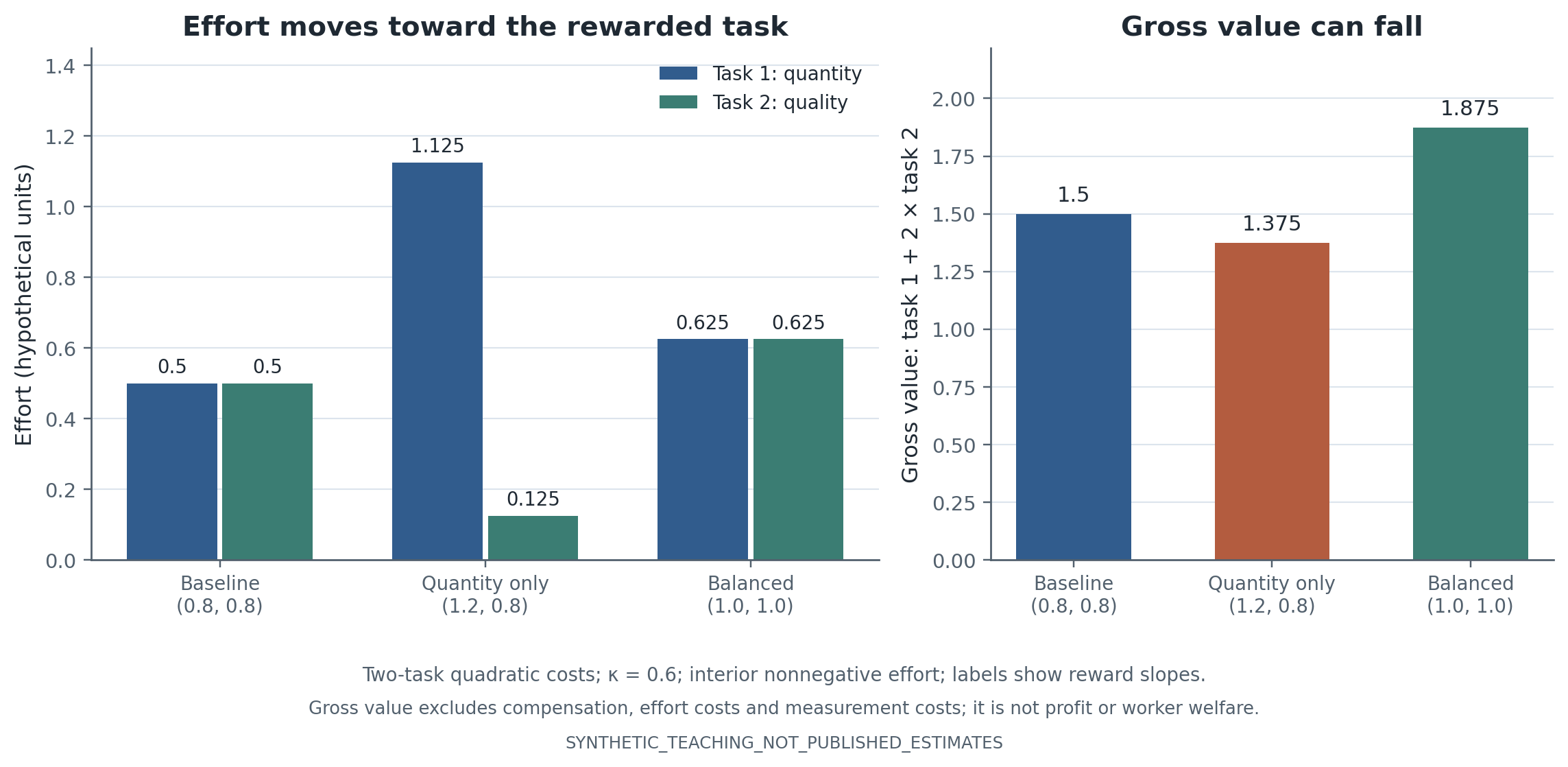
Figure 1:Synthetic two-task teaching model. Quadratic effort costs with , interior nonnegative efforts, and reward slopes , , and . Gross value uses invented weights and excludes compensation, effort disutility, and measurement costs; it is not profit or worker welfare. SYNTHETIC_TEACHING_NOT_PUBLISHED_ESTIMATES. The plot script reads the lab’s generated CSV, preserved as figure input.
Design implication. Pair the incentivized metric with outcomes outside its definition: product returns, rework, independently audited quality, safety, customer retention, or help to coworkers. Use prespecified definitions and follow-up windows so that a short-run gain cannot hide a later loss. If task assignments change after the reform, the total policy effect includes that reallocation. Controlling for the new task mix changes the estimand rather than “cleaning” it automatically.
Larkin studies nonlinear sales incentives and the timing and prices of enterprise-software transactions. The paper is useful because it follows economic consequences beyond recorded sales: the timing of deals and discounts can move with incentives Larkin, 2014. Oyer supplies broader evidence on fiscal-year patterns consistent with nonlinear incentives Oyer, 1998. Neither paper should be described as an RD merely because a compensation schedule has a threshold. Sales near a threshold are chosen, and fiscal timing can share confounders with inventory, customer demand, and accounting rules.
5. Thresholds, tournaments, and the incentives to move someone else’s outcome
A tournament pays for rank rather than absolute output. In a simple two-person teaching case, assume a risk-neutral worker, effort costs measured in money, and a prize spread . An interior best response satisfies
The slope depends on the opponent and on noise. Common shocks may cancel in rank comparisons, but unequal territories, handicaps, field conditions, or prior ability can make the contest very uneven. Lazear–Rosen provide the classic analytical starting point Lazear & Rosen, 1981. Ordinal ranking is a contract component, not a complete welfare criterion.
A worker can sometimes improve relative standing by withholding help or making someone else’s job harder. The same prize that rewards production may therefore discourage cooperation. Conversely, a team bonus may reward helping a colleague even when individual output falls. To study this, record coworker outcomes, transfers of tasks, customer assignment, and time spent supporting others—not only the focal worker’s score.
Bandiera–Barankay–Rasul’s 2005 comparison changes relative incentives to piece rates and links responses to social relationships and observability Bandiera et al., 2005. Their 2013 study adds rankings and then monetary tournament prizes to an existing team-piece-rate environment, allowing team composition to change Bandiera et al., 2013. Crucially, the latter uses sequential within-subject regimes, not simultaneous random assignment of different teams to regimes. Its interpretation requires addressing seasonal change. It is also not a comparison of individual versus team pay.
Research template. A rank intervention can change information, status, money, and competition at once. A better design separates a rankings-only arm from a rankings-plus-prize arm where feasible, while acknowledging any shared information or spillovers. Measure who competes against whom and whether that set changes. A stable average effect can mask redistribution across workers or teams. Keep full team-production and endogenous team-formation analysis for Week 7; here the object is the externality introduced by the pay rule.
6. Team bonuses: the treatment is the opportunity to earn, not the bonus received
Friebel and coauthors randomize team-bonus eligibility in a retail chain. The study reports effects on shop outcomes and compensation and investigates mechanisms including effort complementarities; it does not establish peer pressure as the dominant explanation Friebel et al., 2017. This is the week’s main lab anchor because it makes the assignment unit, group production, and realized-payout problem concrete.
Suppose indicates an offered shop bonus and indicates receiving it. Regressing sales on compares successful treated shops with a mixture of other shops. A positive association can be created by the payment rule even when has no effect on production. The first causal estimand should therefore be assignment-based:
A participation or receipt effect requires an additional identification argument. Using eligibility as an instrument for payout can fail exclusion because an offer may change effort even among shops that narrowly miss payment. “Did not receive a bonus” is not synonymous with “untreated.”
A team-level treatment need not produce an equal gain for all workers. Compare total sales, customer counts, unit prices, payroll, hours, complaints, and staff turnover. Follow the allocation of the bonus among members and document whether non-recipients share workload or help meet targets. To infer complementarities rather than pressure, seek separate variation or mechanism measures; a team-level treatment effect alone cannot identify the production function.
For a matched-pair shop experiment, let be shop ’s mean post-period outcome minus its mean pre-period outcome in pair . Label the offered and control shops and . The equal-pair-weighted teaching estimator is
Its reference SE is the sample standard deviation of the pair contrasts divided by . Inference reflects the number and assignment of shops or pairs, not the number of cash-register transactions. With 12 independent randomized pairs, there are assignments to enumerate for an appropriate sharp-null test. This is the synthetic lab’s design, not a claim about the published study’s exact randomization algorithm. The exact test conditions on that paired assignment and no cross-shop interference, and tests zero assignment effect for every shop. It does not test every heterogeneous zero-average-effect null. The primary outcome is gross sales; secondary p-values are unadjusted.
7. Reciprocity and commitment: beyond the contemporaneous piece-rate slope
An unexpected wage increase can change how workers feel toward their employer without changing the return to the next unit. DellaVigna and coauthors vary private incentives, the employer’s return, and gifts in field experiments. Their findings distinguish productivity from extra work, illustrating why the response margin must be measured rather than assumed DellaVigna et al., 2022. This is not equivalent to a repeated self-enforcing contract: one-shot reciprocity can operate without a future relationship.
Davies–Fafchamps provide a recent online experiment framed as employment. The experiment varies the feasible contract sets; employers then choose offers, and workers accept and choose effort across samples recruited in different locations Davies & Fafchamps, 2025. Its role here is to ask which predictions and behavioral motives travel. It is not a representative comparison of national workplaces, and randomizing the feasible contract set is different from randomizing employers’ realized offers or participants’ national culture.
Kaur–Kremer–Mullainathan study self-control using a field experiment with data-entry workers, including voluntary commitment contracts and payday variation Kaur et al., 2015. The teaching distinction is between the causal effect of an offered opportunity and the selected group choosing a restrictive contract. Payoff-dominated at a fixed output is not necessarily utility-dominated when the worker values changed future behavior. Payday responses can also motivate questions about liquidity and payment timing; they are not a universal diagnostic for present bias. The associated correction concerns an anecdotal quotation rather than the empirical estimates; do not repeat the corrected anecdote Kaur et al., 2022.
Design implication. Separate: promised from surprise pay; amount from marginal incentive; delayed from immediate payment; freely chosen from imposed restrictions. Document what participants knew when they chose and when outcomes were produced. A commitment device that helps a voluntary chooser does not justify imposing it on everyone. A worker may value discipline, dislike coercion, and face liquidity constraints simultaneously.
8. Relational contracts: credible promises have an enforcement constraint
Some valuable actions cannot be specified or verified cheaply by an external enforcer. A firm may promise to reward judgment, protect time for learning, credit help to coworkers, or avoid revising targets opportunistically. The promise matters only if the worker expects it to be honored.
Levin supplies a formal account of self-enforced incentive contracts Levin, 2003. Baker–Gibbons–Murphy explain why explicit and subjective incentives can be substitutes or complements: an improved formal contract changes not only performance measurement but the parties’ fallback positions Baker et al., 1994. Gibbons–Henderson add a useful organizational distinction between credibility and clarity—keeping a promise and sharing an understanding of what the promise entails are not the same problem Gibbons & Henderson, 2012.
A deliberately simplified enforcement calculation is enough for the opening intuition. At the payment node, the firm can save a promised bonus by reneging. Cooperation provides per-period profit above the punishment outcome of . Let , with , where discounts time and is an assumed exogenous probability that the relationship continues. Honoring the promise requires
With and , the minimum effective continuation factor is 0.75. At the future surplus available is 4; at 0.6 it is 1.5. The calculation illustrates the firm’s payment incentive under a particular punishment and stationary continuation value. It is not sufficient to establish a full equilibrium: worker participation, effort incentives, off-path behavior, and the credibility of punishments also need to hold. If separation is an endogenous response, multiplying by an exogenous survival probability is no longer an adequate model.
A practical identification problem follows. Long tenure and high effort can reflect good matches, worker selection, learning, or credible promises. They do not uniquely reveal relational enforcement. Stronger evidence distinguishes what was promised, which action was noncontractible, who could verify fulfillment, how future opportunities changed, and what happened after a perceived breach.
Brown–Falk–Fehr compare enforcement environments in a laboratory market and study the relationships that emerge Brown et al., 2004. Use it as controlled evidence about market interactions under those environments, not as a field estimate of the effect of tenure. The repeated setting can support several motives; do not identify every cooperative action with a single textbook mechanism.
A researchable contrast. Consider a change in the person authorized to approve discretionary awards while formal rates stay fixed. A panel could track promised and paid awards, prior relationships, complaints, and independently measured output. But supervisor reassignment may also change skill, tasks, and customer allocation. A credible design needs an assignment argument or more targeted variation in enforcement, not merely a dummy for “new manager.” Week 5 will develop that manager-assignment problem.
9. Recent evidence: separate channels rather than declaring contracts good or bad
Cai–Luo–Wang’s 2025 working paper experimentally varies signing bonuses and monitoring for new hires at a Chinese automobile manufacturer. Its primary-source summary distinguishes hours, manager-evaluated performance, and quits rather than treating both interventions as the same output mechanism Cai et al., 2025. This is an especially useful bridge from Week 3: a signing bonus is not a piece-rate increase, and a manager assessment is not direct latent effort. Keep the working-paper status explicit; the pack does not claim to have executed the original data.
Cai–Prat–Yu’s 2026 working paper combines merger events with employee reviews to study noncontractible benefits. The authors interpret patterns in satisfaction and review text as consistent with breaches of implicit commitments Cai et al., 2026. Review participation, workforce turnover, organizational disruption, and correlated firm changes remain important competing explanations for a new project. A text label for a perceived breach is evidence about reported experience, not a directly observed enforcement parameter.
Herkenhoff and coauthors’ 2025 working paper contrasts implicit-contract, market-power, and reallocation predictions in US private-equity buyouts using linked worker records, finding patterns they interpret as consistent with reallocation Herkenhoff et al., 2025. This is not a direct refutation of the review-based merger study: populations, events, and outcome domains differ. The pair teaches students to specify a mechanism’s observable implications and resist fitting every ownership change into the same story. Full ownership-change and reorganization analysis remains Week 9 material.
10. From compensation records to an incentive-reform design
Begin with an eligible roster defined before the intervention. Link the assignment rule to the contract workers knew, not just what they received. Define outcomes over enough time to observe returns, corrections, effort shifts, and exits. Maintain distinct work-date and pay-date records. Match the inference unit to the randomization or shock; a larger personnel panel does not create more independent interventions Cameron & Miller, 2015.
Selection requires its own strategy. A stayer-only comparison conditions on a possible response to the pay reform. Follow baseline cohorts, compare entry and exit explicitly, and use bounds only under defensible restrictions. Lee-style trimming requires monotone selection, which an incentive reform can violate if some workers stay while others leave in response to risk or competition Lee, 2009. Equal retention rates across arms are not proof that the same people would remain in both regimes.
For nonlinear contracts, reconstruct every rate, reset, eligibility window, and cap. Check alternative explanations for threshold bunching, such as rounding, reporting rules, or customer timing. For rankings, define the comparison pool. For team pay, state the interference structure and distinguish unit-level ITT from within-unit mechanisms. For promises, record fulfillment histories and alternatives after breakdown. Those tasks precede a sophisticated estimator.
Each row links a research question to the variation used and a claim students should not infer automatically. Published status is distinguished from working-paper status in the bibliography and source-verification file.
Table 2:Paper, design, and evidence map
| Paper and setting | What varies / what is observed | Main teaching use | Limitation or implementation requirement |
|---|---|---|---|
| Lazear — Safelite Lazear, 2000 | Firm switches compensation regime; personnel records track productivity and workforce composition | Open the effort-versus-selection decomposition | Not a randomized reform; within-worker estimates still require an argument about other changes and selective observation. |
| Shearer — tree planting Shearer, 2004 | Field experiment observes workers under piece rates and fixed wages | Distinguish within-worker incentive response from a broad regime change | Match the comparison to the experimental assignment and work conditions. Structural extrapolations are a separate evidentiary step. |
| Leaver et al. — Rwandan teachers Leaver et al., 2021 | Recruitment-market contract assignment followed by school-level rerandomization | Separate recruiting and post-entry contract effects | Two assignment levels require distinct analysis. Pupil learning is an outcome, not direct observation of latent teacher effort. |
| Friebel et al. — retail teams Friebel et al., 2017 | Randomized team-bonus eligibility; sales, customers, compensation and firm outcomes | Estimate a policy ITT and investigate complementary effort | Actual payout depends on target attainment; recipient-versus-nonrecipient comparison is selected. Team mechanisms require more than a positive ITT. |
| Bandiera et al. — relative incentives Bandiera et al., 2005 | Personnel data around relative versus individual incentive regimes and social relationships | Show that workers may internalize effects on colleagues | Be explicit about regime changes and observability; social ties are not independently randomized. |
| Bandiera et al. — teams and prizes Bandiera et al., 2013 | Team piece rates with sequentially introduced rank information and rank prizes | Separate information and tournament rewards | Not simultaneous team-level randomization. Do not describe baseline as fixed pay or individual piece rates. |
| Oyer — fiscal-year incentives Oyer, 1998 | Fiscal-year patterns associated with nonlinear compensation incentives | Teach timing as a potential response to contract shape | Calendar patterns need controls for demand/production seasonality; not a pure randomized bonus experiment. |
| Larkin — enterprise software sales Larkin, 2014 | Sales compensation, deal timing and discounts | Make the difference between recorded sales and value concrete | Behavioral timing and pricing evidence do not turn an endogenous threshold into a valid RD. |
| DellaVigna et al. — field experiments DellaVigna et al., 2022 | Private pay, employer returns, and unexpected gifts varied | Distinguish productivity from extra work and discriminate social-preference accounts | Outcome margins differ; generosity is not the same as a promised future bonus. |
| Kaur et al. — data-entry work Kaur et al., 2015 | Commitment availability/choices and work timing | Bring self-control into contract demand | Choice is not random; use the actual experimental variation. Erratum corrects an anecdotal quotation, not the estimated results. |
| Brown–Falk–Fehr — laboratory market Brown et al., 2004 | Enforceability environment and ensuing repeated relationships | Study endogenous relational trade under controlled rules | Laboratory evidence, not a firm field RCT or a unique decomposition of all cooperative motives. |
| Cai–Luo–Wang — automobile workers, WP Cai et al., 2025 | Signing-bonus and monitoring interventions | Revisit money versus information using hours, ratings and quits separately | Abstract/metadata-verified frontier reference. Ratings are not latent effort; inspect full protocol before adding numerical claims. |
| Cai–Prat–Yu — mergers/reviews, WP Cai et al., 2026 | M&A events and employee reviews of noncontractible benefits | Turn implicit promises into observable, contestable hypotheses | Reviewer selection, attrition, and organizational disruption may change measured sentiment. |
| Herkenhoff et al. — private-equity buyouts, WP Herkenhoff et al., 2025 | Linked worker outcomes evaluated against competing model predictions | Compare implicit-contract, market-power, and reallocation mechanisms | Different population/outcomes from the merger-review paper; neither settles all ownership-change questions. |
| Davies–Fafchamps — online cross-country experiment Davies & Fafchamps, 2025 | Experimentally varied feasible contract sets; employer-chosen offers and worker effort in participating samples | Discuss heterogeneity and portability of incentive responses | Nationality is not randomized and platform samples need not represent national populations. |
Use the theory readings to state predictions, not to treat empirical assumptions as proved: Gibbons, 1998Prendergast, 1999Holmström & Milgrom, 1991Baker et al., 1994Levin, 2003.
11. Open questions that follow from the evidence
Rewarding quality when technology makes quantity cheaper. A proposed study could vary quantity-only versus balanced rewards after a common technology change, with independent quality audits and stable prices. The contribution would be evidence on reward alignment, not another adoption-versus-nonadoption comparison. The main threats are post-treatment auditing, differential task assignment, and quality outcomes observed too late.
Promise credibility versus contract generosity. Hold the announced schedule fixed and exploit credible variation in guarantee or adjudication mechanisms. Measure beliefs before performance, fulfillment afterward, and independent outcomes. A higher expected payment can be generated by a more generous schedule or a more believable promise; separating them is the research opportunity. Any employer intervention must respect participants’ actual commitments and avoid manufacturing harmful breaches.
The value of incentives when opportunities differ. Some workers have little discretion over customer traffic, machine uptime, or assigned cases. A project can study whether an incentive is effective only when workers can change an outcome, using predetermined opportunity measures rather than realized success. A high baseline score need not identify high responsiveness.
Dynamic target resetting. Workers may anticipate that strong current output raises next period’s quota. A credible study would document both the explicit bonus and the target-update process, with unexpected or randomized update rules if institutionally feasible. The key data are forecasts, target versions, and behavior across several reset cycles, not one period’s bunching.
Pay reform and welfare beyond the wage. Pair payroll and retention with uncertainty, hours, schedule control, effort burden, and independently collected well-being measures. Measure those outcomes for an interpretable population, not only enthusiastic survivors. This supplies the incidence ledger that Week 8 will develop rather than assuming firm profit and worker welfare move together.
Research Lab
Reproduce
Primary anchor: Friebel et al. (2017). The official AEA-linked repository is identified in the resource bibliography Friebel et al., 2017. Repository listings were verified; original microdata were not downloaded or executed for this pack. An original-data replication is optional and must begin with access, file, assignment, and dependency checks.
The guaranteed route is a synthetic design reconstruction, not a reproduction of published estimates. The supplied standard-library starter constructs a shop panel with an offered bonus, a frozen target, realized payout, sales, returns, payroll, and a margin-accounting outcome. It generates 24 shops in 12 randomized pairs over 12 weeks. All units, schedules, parameter values, and outcomes are invented. Students reconstruct payout mechanically, estimate a pair-weighted ITT, and perform assignment-aligned sharp-null inference.
Diagnose
First compare assignment to realized payout. A separate zero-effect simulation shows why bonus recipients can have higher observed sales even when the offer has no causal effect on sales. Next examine an invented two-task response in which measured quantity rises while gross quality-adjusted value falls. Finally use a two-type accounting exercise to separate a known synthetic within-type change from a known composition change. In observational personnel data those latent components are not handed to the researcher.
The lab also computes the principal–agent examples and a relational-enforcement grid. Students must state that the latter is an employer-side necessary condition under the specified model, not an empirical estimate of trust or a proof that all equilibrium constraints are satisfied.
Transfer
Use Leaver et al. as the design comparison for distinguishing recruitment and post-entry incentives; its separate archive is provided Leaver et al., 2021. Propose a reform with two observable competing mechanisms, a prespecified randomization or comparison unit, an independent quality measure, and a worker-welfare measure. The submission is a two-page memo plus a contract/data dictionary—not a claim to have designed a universally optimal compensation system.
Methods Box
Table 3:Incentive-reform methods and identification checklist
| Research problem | Implementable design or diagnostic | Estimand / required assumptions | Reference and limitation |
|---|---|---|---|
| Pay schedule versus payout | Replay the announced schedule using frozen targets and eligible roster; compare predicted and actual pay with reason codes | Contract exposure is defined before the outcome; payment deviations are separately recorded | Friebel et al., 2017Larkin, 2014. Actual receipt is generally post-treatment. |
| Incentives versus selection | Separate recruitment terms from post-entry terms when design permits; retain baseline cohorts and entrants | Assignment at recruiting and workplace stages identifies different margins | Leaver et al., 2021. Two randomization levels cannot be replaced with one individual-level regression. |
| Within-worker response | Randomized within-worker pay regimes with assignment/order and workload accounted for | Effect for workers and tasks covered by the experiment | Shearer, 2004. Beware carryover, anticipation and transport to a permanent regime. |
| Quantity versus quality | Prespecify independent quality, delayed returns and hours; compute documented accounting margins | A separate outcome is needed to establish beneficial production rather than metric improvement | Holmström & Milgrom, 1991Larkin, 2014. An arbitrary weighted index is not welfare or profit. |
| Threshold manipulation | Map marginal rewards, time to reset, opportunities, returns and price concessions | Timing patterns support specified mechanisms only under a credible comparison | Oyer, 1998Larkin, 2014. Threshold crossing chosen by workers is not automatically an RD assignment rule. |
| Team incentives / interference | Randomize at the relevant team/shop; document membership and cross-shop transfers | Unit-level policy effect under the assignment and spillover environment | Friebel et al., 2017. Interference within teams is part of the policy; cross-team interference can invalidate simple controls. |
| Few assignment units | Analyze cluster or pair-level outcomes; replay actual randomization for a stated sharp null | Assignment-based inference conditions on the real design, not independent worker rows | Cameron & Miller, 2015. Row count is not cluster count. Generic permutations are invalid if they violate the design. |
| Survivor-only outcomes | Follow baseline workers; report missingness/exit; sensitivity/bounds if assumptions support them | Always-observed or other target population must be named | Lee, 2009. Monotone selection is not guaranteed by equal retention or by randomization. |
| Social preferences versus marginal reward | Vary private rates, employer returns, or gifts with appropriate timing; observe extra work separately | Comparison distinguishes selected preference channels within the experiment | DellaVigna et al., 2022. Positive work does not uniquely identify altruism. |
| Demand for self-commitment | Distinguish randomly offered options from workers’ selected take-up | Availability effects versus selected contract demand | Kaur et al., 2015. Do not interpret a take-up coefficient as the causal effect of commitment. |
| Credibility versus generosity | Hold announced amounts fixed while measuring or varying enforcement/guarantees; record expectations and fulfillment | Separate changed expected payment from changed nominal contract | Levin, 2003Brown et al., 2004. Tenure, trust surveys, and high effort alone do not identify a repeated-game enforcement parameter. |
| Dynamic or staggered reforms | Start from assignment or institutional variation; prespecify comparisons, horizons and anticipation | A pay reform’s total effect may include reassignment and entry/exit | Lazear, 2000Hoffman & Stanton, 2025. Worker fixed effects do not remove time-varying selection; refer to the empirical-methods course for an estimator suited to the timing. |
| Many outcomes | Name a primary outcome and meaningful secondary families before inspection | Report uncertainty and multiplicity strategy with effect magnitudes | Cameron & Miller, 2015. Five unadjusted p-values are not five independent confirmatory tests. |
Required memo ledger: intervention → information available before action → behavioral margin → competing mechanism → comparison → outcome population → inference unit → welfare limitation. The student must name a result that would contradict their preferred mechanism.
A useful empirical contract contains four linked but distinct records: offered terms, worker awareness/eligibility, performance and production, and realized payments. A fifth record tracks participation, exits, and missing outcomes. Merging them into a single “treatment” indicator discards the very variation needed to distinguish mechanisms.
The data map separates reading links and repository listings from genuine microdata access. The IAB Linked Personnel Panel offers a relevant employer–employee perspective, but research versions and the teaching-oriented Campus File are different products; neither should be inferred from a paper’s appendix Institute for Employment Research, Research Data Centre, n.d.. The DellaVigna et al. archive is a separate candidate for students interested in the distinction between productivity and extra work DellaVigna et al., 2022.
Table 4:The empirical contract ledger
| Data component | Minimum useful fields | Link / timing rule | What missingness would obscure |
|---|---|---|---|
| Announced contract | Version, base rate, marginal rate, thresholds, caps, vesting, eligibility, announcement/effective dates | Preserve the version available before action; store amendments rather than overwrite | Contract generosity versus actual fulfillment |
| Eligible population | Stable worker/shop ID, baseline roster, applicants, hires, exits, leave | Freeze pre-treatment populations; keep entrants separately | Selection, survival, and participation |
| Production opportunities | Task/case/customer ID, assignment, equipment availability, traffic, hours | Record opportunities before realized performance where possible | Effort versus assigned demand or task difficulty |
| Output and independent quality | Units, defect rates, returns, corrections, customer outcomes, safety incidents | Align windows; follow delayed quality outcomes consistently across arms | Measured quantity versus value or harm |
| Realized payments | Work period, calculation period, paid date, pay components, exceptions | Recompute promised payment from contemporaneous rule; record discrepancies | Earned, expected, and paid compensation |
| Team / contest composition | Group membership history, peer set, ranking pool, transfers | Use the information and peers relevant at decision time | Spillovers, relative incentives, endogenous group composition |
| Beliefs / welfare | Expected payout, risk, hours burden, liquidity, satisfaction, ability to decline | Independent survey timing and follow-up including exits where feasible | Higher pay versus higher welfare; generosity versus credibility |
Table 5:Starting resources and access boundaries
| Resource | Verified entry point | Useful for | What is not established here |
|---|---|---|---|
| Friebel et al. AEA-linked archive Friebel et al., 2017 | openICPSR project 113141, version V1; DOI in bibliography | Main paper-oriented reproduction route for team incentives | No microdata were downloaded or original code executed for this pack. Inspect actual files/license, assignment, and dependencies first. |
| Leaver et al. AEA-linked archive Leaver et al., 2021 | openICPSR project 121941, version V1 | Recruitment versus post-entry incentives as the transfer design | Repository visibility is not a claim that every original input is unrestricted or that a clean-machine run passed. |
| DellaVigna et al. AEA-linked archive DellaVigna et al., 2022 | openICPSR project 148481, version V1 | Separate productivity, extra work, and social-preference variation | Do not pool experimental tasks/arms or claim measured utility without consulting design documentation. |
| IAB Linked Personnel Panel Institute for Employment Research, Research Data Centre, n.d. | Official IAB FDZ product documentation | Employer–employee practices, pay and worker outcomes | Research files require their stated access process; the Campus File is a separate teaching product, not unrestricted equivalent microdata. |
| Supplied offline starter | source/04-offline-lab-starter.py in this editing pack; install at canonical lab src/offline_lab.py | Guaranteed no-network contract replay, assignment ITT, and mechanism diagnostics | Every observation and parameter is synthetic; not evidence about the cited workplaces. |
No access application, data-provider contact, login workaround, or download of restricted data is authorized by the editing prompt. Link to original papers instead of bundling copyrighted PDFs. Store confidential payroll/personnel records outside public teaching assets.
Minimum reporting standard. Report the assignment/contract timeline, eligibility denominator, announced and realized reward schedule, primary ITT, independent outcome family, wage and hours distribution, participation/attrition, inference unit, and explicit limits on mechanism claims. Report transformations and aggregation weights. Any conditional estimate must explain what post-treatment selection it conditions on. A difference in statistical significance across outcomes is not a statistically significant difference between effects.
Reading Ladder And References
Three required research readings
Leaver et al. (2021): draw both stages of randomization and identify the population relevant to each contrast. Friebel et al. (2017): distinguish an offered team contract from a payout and separate shop performance from individual incentives. Brown–Falk–Fehr (2004): identify the enforcement environment and explain which findings are experimental and which interpretations invoke a model.
Foundations and optional derivation route
Gibbons and Prendergast orient the field. Holmström–Milgrom motivates multitasking; Lazear–Rosen motivates relative rewards; Baker–Gibbons–Murphy, Levin, and Gibbons–Henderson organize subjective and relational incentives. Lazear and Shearer provide contrasting empirical incentive designs. These readings support selective preparation, not seven additional compulsory full papers.
Rotating empirical and frontier presentations
Choose among nonlinear incentives (Oyer; Larkin), social and team pay (the two Bandiera papers), reciprocity and self-commitment (DellaVigna et al.; Kaur et al., with correction), and contemporary mechanisms (Cai–Luo–Wang; Davies–Fafchamps; the two ownership-change working papers). Every presentation must state a comparison, an outcome, a mechanism not identified, and a feasible extension. Working-paper status is part of the citation.
Table 6:Three required research articles
| Article | What students prepare | Connection to the lab / memo |
|---|---|---|
| Leaver et al. Leaver et al., 2021 | Draw the recruitment and workplace randomization timeline; distinguish who selects into which contract | Transfer: design two sources of variation to separate entry and post-entry response |
| Friebel et al. Friebel et al., 2017 | Reconstruct promised terms, assignment unit, measured outcomes, and proposed mechanisms | Reproduce/Diagnose: eligibility ITT versus endogenous payout and outcome accounting |
| Brown–Falk–Fehr Brown et al., 2004 | Explain what changes across enforcement environments and why repeated relations can emerge | Interpret the relational-constraint toy model without claiming it is the experiment’s full model |
Foundations and rotating presentations
Intuitive theory: Gibbons and Prendergast, followed by selected sections of Holmström–Milgrom, Baker–Gibbons–Murphy, Levin, and Lazear–Rosen Gibbons, 1998Prendergast, 1999Holmström & Milgrom, 1991Baker et al., 1994Levin, 2003Lazear & Rosen, 1981. The local teaching models summarize a mechanism; they are not exact replicas of every cited model.
Effort and sorting: Lazear and Shearer Lazear, 2000Shearer, 2004. Contrast quasi-experimental personnel data, within-worker experimental variation, and structural extrapolation.
Externalities and nonlinear rewards: the two Bandiera papers, Oyer, and Larkin Bandiera et al., 2005Bandiera et al., 2013Oyer, 1998Larkin, 2014. A team or tournament regime changes who benefits from another worker’s action.
Reciprocity, self-commitment and portability: DellaVigna et al., Kaur et al. with the erratum, and Davies–Fafchamps DellaVigna et al., 2022Kaur et al., 2015Kaur et al., 2022Davies & Fafchamps, 2025. Separate the work margin, experimental population, and mechanism.
Relational capability and current applications: Gibbons–Henderson plus three clearly labeled working papers Gibbons & Henderson, 2012Cai et al., 2025Cai et al., 2026Herkenhoff et al., 2025. Compare observable implications, rather than presenting every organization as evidence for the same theory.
Methods and data follow-up: cluster inference, selection bounds, personnel-economics synthesis and IAB documentation Cameron & Miller, 2015Lee, 2009Hoffman & Stanton, 2025Institute for Employment Research, Research Data Centre, n.d..
Table 7:Reproduce → Diagnose → Transfer
| Stage | Required output | Evidence status |
|---|---|---|
| Reproduce | Contract replay, pair-level ITT in outcome changes, exact assignment test in the supplied invented shop panel | Synthetic design reconstruction motivated by Friebel et al.; not original microdata estimates |
| Diagnose | Assignment-versus-receipt null example; two-task quantity/quality comparison; within-type/composition accounting; enforcement constraint | Known synthetic mechanisms allow checking implementation and interpretations |
| Transfer | Two-page incentive-reform memo, contract dictionary, prespecified quality and worker-welfare outcome, identified competing mechanisms | Student design proposal, not a completed causal finding |
| Optional original-data route | A bounded table/figure after checking actual archive files, license, design and dependencies | Only claim replication after the specified target has actually been reproduced Friebel et al., 2017Leaver et al., 2021DellaVigna et al., 2022 |
A suggested extended meeting uses roughly 25 minutes for contract/model foundations, 35 for experimental and quasi-experimental comparisons, 25 for multitasking/team/relational mechanisms, and 20 for a design clinic. The offline lab is separate. Select rotating readings rather than compressing every paper into an unreadable deck.
Exercises And Discussion Prompts
Two contracts have the same expected payment. One pays a fixed amount; another pays for each measured unit. State which assumptions make effort differ and which data would reveal the risk borne by workers.
Derive the one-task optimal slope and identify the assumptions needed to treat the fixed payment as freely adjustable. Explain why a fixed-pay laboratory comparison need not trace the optimal-contract formula.
Recompute the two-task example with . Does raising the first reward still crowd out the second task? Check whether effort remains feasible.
Explain why regressions on bonus receipt can be misleading even in a randomized bonus-offer experiment. Propose a valid assignment-based comparison.
In the workforce decomposition, change the order of weights used for composition and behavior. Why does the accounting allocation change, and what would identify causal components?
Construct a timeline for a sales quota that resets each month. Name three ways to reach the target other than increasing total annual value, and specify an outcome that distinguishes each.
A firm reneges on a discretionary payment after a demand collapse. Which observations distinguish a credibility channel from the direct consequences of the demand shock?
Explain the difference between a reciprocal response to an unexpected gift, a voluntary commitment device, and a relational contract. Design one test that separates two of them.
A team bonus increases sales and retention. Give two explanations other than peer pressure and identify the additional data required to test them.
Write an incentive-reform memo with a worker-welfare outcome. State what evidence would cause you to reject your preferred mechanism even if the headline performance effect is positive.
Reproducibility And Code Lab Note
Download the teaching repository (ZIP), or clone the repository. Keep its folder structure and open books/special-topic8-organizational/labs/04-pay-incentives-multitasking-and-relational-contracts/; the lab README supplies the run instructions. Weeks 1–3 use the shared plotting module supplied with the repository.
The Week 4 lab handout and lab README distinguish three routes: optional authorized original-data replication, mandatory synthetic design reconstruction, and analytical teaching calculations. The executed route combines the latter two; empirical_replication is false. The optional original-data route is omitted because actual archive files, permissions, dependencies, and the original assignment protocol have not been inspected. Original data must never be silently replaced while retaining a replication label.
From the course root, run the lab and then regenerate the chapter figure:
ENV_NAME=research bash labs/04-pay-incentives-multitasking-and-relational-contracts/smoke.sh
conda run -n research python assets/scripts/build-week4-multitask.py
The core reconstruction and smoke use the Python standard library; figure generation uses the installed Matplotlib environment. The smoke executes the actual code, checks shop/period keys, contract timing and frozen targets, paired assignment, bonus and accounting formulas, and 4096-assignment inference. It compares two fresh same-seed runs and executes an additional seed. It requires no credentials, API, proprietary data, network, or GPU. Synthetic estimates are teaching results rather than evidence about actual retail workers. The transfer memo template requires competing predictions, an independent quality outcome, and a worker-welfare measure.
Slide Companion Note
The Week 4 slide deck (PDF) and Beamer source provide a substantial lecture plus lab or a two-meeting route. They cover the contract ledger, risk–incentive model, recruitment and post-entry designs, multitasking, nonlinear and group rewards, gifts and commitment, relational enforcement, contemporary evidence, and the paired-assignment lab. Model assumptions accompany the main comparative statics; long evidence maps remain in the chapter.
Compile from the course root:
conda run -n research latexmk -cd -pdf -interaction=nonstopmode slides/week4/04-pay-incentives-multitasking-and-relational-contracts.texThe deck uses the finished course’s Beamer style and the generated teaching figure. Numerical constructions are hypothetical; no article figure or unpublished instructor result is reused.
Bridge Forward
Contracts delegate part of the organization’s response to workers, but managers still choose assignments, targets, discretion, coaching, and exceptions. Week 5 turns to those managerial contributions and the allocation of authority. Carry forward this week’s question: when a measured outcome changes, which organizational decision and which behavioral margin actually produced it?
- Gibbons, R. (1998). Incentives in Organizations. Journal of Economic Perspectives, 12(4), 115–132. 10.1257/jep.12.4.115
- Prendergast, C. (1999). The Provision of Incentives in Firms. Journal of Economic Literature, 37(1), 7–63. 10.1257/jel.37.1.7
- Hoffman, M., & Stanton, C. T. (2025). People, Practices, and Productivity: A Review of New Advances in Personnel Economics. In Handbook of Labor Economics (Vol. 6, pp. 729–818). Elsevier. 10.1016/bs.heslab.2025.07.005
- Cai, J., Luo, S., & Wang, S.-Y. (2025). Money or Monitoring: Evidence on Improving Worker Effort (Techreport No. 33977). National Bureau of Economic Research. 10.3386/w33977
- Lazear, E. P. (2000). Performance Pay and Productivity. American Economic Review, 90(5), 1346–1361. 10.1257/aer.90.5.1346
- Shearer, B. (2004). Piece Rates, Fixed Wages and Incentives: Evidence from a Field Experiment. The Review of Economic Studies, 71(2), 513–534. 10.1111/0034-6527.00294
- Oyer, P. (1998). Fiscal Year Ends and Nonlinear Incentive Contracts: The Effect on Business Seasonality. The Quarterly Journal of Economics, 113(1), 149–185. 10.1162/003355398555559
- Larkin, I. (2014). The Cost of High-Powered Incentives: Employee Gaming in Enterprise Software Sales. Journal of Labor Economics, 32(2), 199–227. 10.1086/673371
- Lazear, E. P., & Rosen, S. (1981). Rank-Order Tournaments as Optimum Labor Contracts. Journal of Political Economy, 89(5), 841–864. 10.1086/261010
- Bandiera, O., Barankay, I., & Rasul, I. (2013). Team Incentives: Evidence from a Firm Level Experiment. Journal of the European Economic Association, 11(5), 1079–1114. 10.1111/jeea.12028
- Friebel, G., Heinz, M., Krueger, M., & Zubanov, N. (2017). Team Incentives and Performance: Evidence from a Retail Chain. American Economic Review, 107(8), 2168–2203. 10.1257/aer.20160788
- Baker, G., Gibbons, R., & Murphy, K. J. (1994). Subjective Performance Measures in Optimal Incentive Contracts. The Quarterly Journal of Economics, 109(4), 1125–1156. 10.2307/2118358
- Bandiera, O., Barankay, I., & Rasul, I. (2005). Social Preferences and the Response to Incentives: Evidence from Personnel Data. The Quarterly Journal of Economics, 120(3), 917–962. 10.1093/qje/120.3.917
- DellaVigna, S., List, J. A., Malmendier, U., & Rao, G. (2022). Estimating Social Preferences and Gift Exchange at Work. American Economic Review, 112(3), 1038–1074. 10.1257/aer.20190920
- Kaur, S., Kremer, M., & Mullainathan, S. (2015). Self-Control at Work. Journal of Political Economy, 123(6), 1227–1277. 10.1086/683822