Week 6. Training, Internal Mobility, Promotions, and Career Ladders
Learning Objectives
By the end of this week, students should be able to distinguish skill accumulation, learning about workers, and productive reassignment; explain who pays for training and who captures its returns; separate promotion as a reward from promotion as an allocation decision; construct a career-transition panel with explicit eligibility and opportunity sets; and design an evaluation that separates at least two competing mechanisms. The practical endpoint is a research memo specifying eligibility, training, application, promotion, and exit denominators, not merely a regression of pay on a promotion indicator.
Opening Orientation
Central question: How do organizations build skills and reallocate talent, and what prevents productive internal career moves?
A worker can become more productive without being promoted, receive a promotion without becoming more skilled, and acquire useful skills through a lateral move that initially lowers measured output. Those possibilities make internal careers a central organizational research problem. The firm is simultaneously a producer, a training environment, an information system, and an allocator of scarce opportunities.
The organizing question is: when a worker advances, what changed—skills, employer beliefs, access to openings, job assignment, or the supply of promotion slots? We will use the same distinction for training programs, manager release decisions, promotion criteria, rotations, and internal talent markets. The objective is to turn an appealing career story into a design with a well-defined population and counterfactual.
Core Points
Bridge
Consider two workers who finish the same course. One remains in the same job and applies the new skill every day. The other moves into a supervisory role, where different skills matter. Their later pay and output can diverge even if both learned equally. A third qualified worker may never apply because the opening was not visible or the current manager would block release. To evaluate the course, begin with everyone eligible for an offer, then follow skill, opportunity access, assignment, and exit separately.
Week 3 studied performance signals and employer learning; Week 4 studied rewards; Week 5 studied managers and authority. This week asks how these systems build skills and shape careers over time. Minni’s manager-rotation evidence returns here for its connection to allocation and career development, rather than for a second general lecture on manager effects. Week 7 will develop horizontal peer interactions; Week 8 will develop bargaining and retention; Week 9 will address broader organizational change. Those topics enter here only where they change training investment or access to a career opportunity.
Field Core
1. Start with a career-and-opportunity ledger
A personnel panel should distinguish worker, position, job family, grade, manager, establishment, and legal employer. These are not interchangeable identifiers. A title can change while tasks remain constant; a worker can acquire authority without a title change; a move between establishments may remain inside the same firm. Define the organizational boundary and freeze a defensible role crosswalk before examining outcomes. Preserve effective dates and announcement dates separately.
The first ledger records the worker’s career history. The second records opportunities: positions created, opened, advertised, frozen, filled, or cancelled. The third records access: who was eligible, informed, nominated, permitted to apply, interviewed, offered, released, and actually started. A panel of successful moves alone cannot distinguish low demand for mobility from hidden barriers to applying.
For training, keep offer, nomination, enrollment, attendance, completion, assessment, and certification as separate events. A learning-management-system completion flag can measure compliance with an administrative requirement rather than mastery. Build a common assessment where feasible, and record whether supervisors can observe the certificate. That distinction makes it possible to separate a skill intervention from an information intervention.
The classic personnel-data analysis by Baker, Gibbs, and Holmström provides a descriptive foundation for studying careers within a firm’s hierarchy. It shows the value of observing movements and pay inside an organization rather than relying only on changes of employer. Its setting is not a universal template for every firm’s hierarchy Baker et al., 1994.
A practical application ledger is:
Here is eligibility, application, offer, and a completed promotion through that route. The equality requires nested events, a common observation horizon, and positive probabilities for the conditioning stages. If no one reaches a stage, report its count and mark its conditional rate undefined rather than dividing by zero. Appointments without an application must be represented as another route, not silently forced into the identity. A worker who exits before applying is still part of the baseline policy cohort, even though the worker may no longer belong in a later conditional risk set.
Original denominator example. A reform and comparison group each contain 100 initially eligible workers. Applications are 40 versus 20 and promotions 10 versus 8. Advancement is higher per initially eligible worker, 10% versus 8%, but lower per applicant, 25% versus 40%. Neither statistic is erroneous. They answer different questions, and the latter compares applicant pools partly created by the reform. It is not automatically evidence that screening became worse.
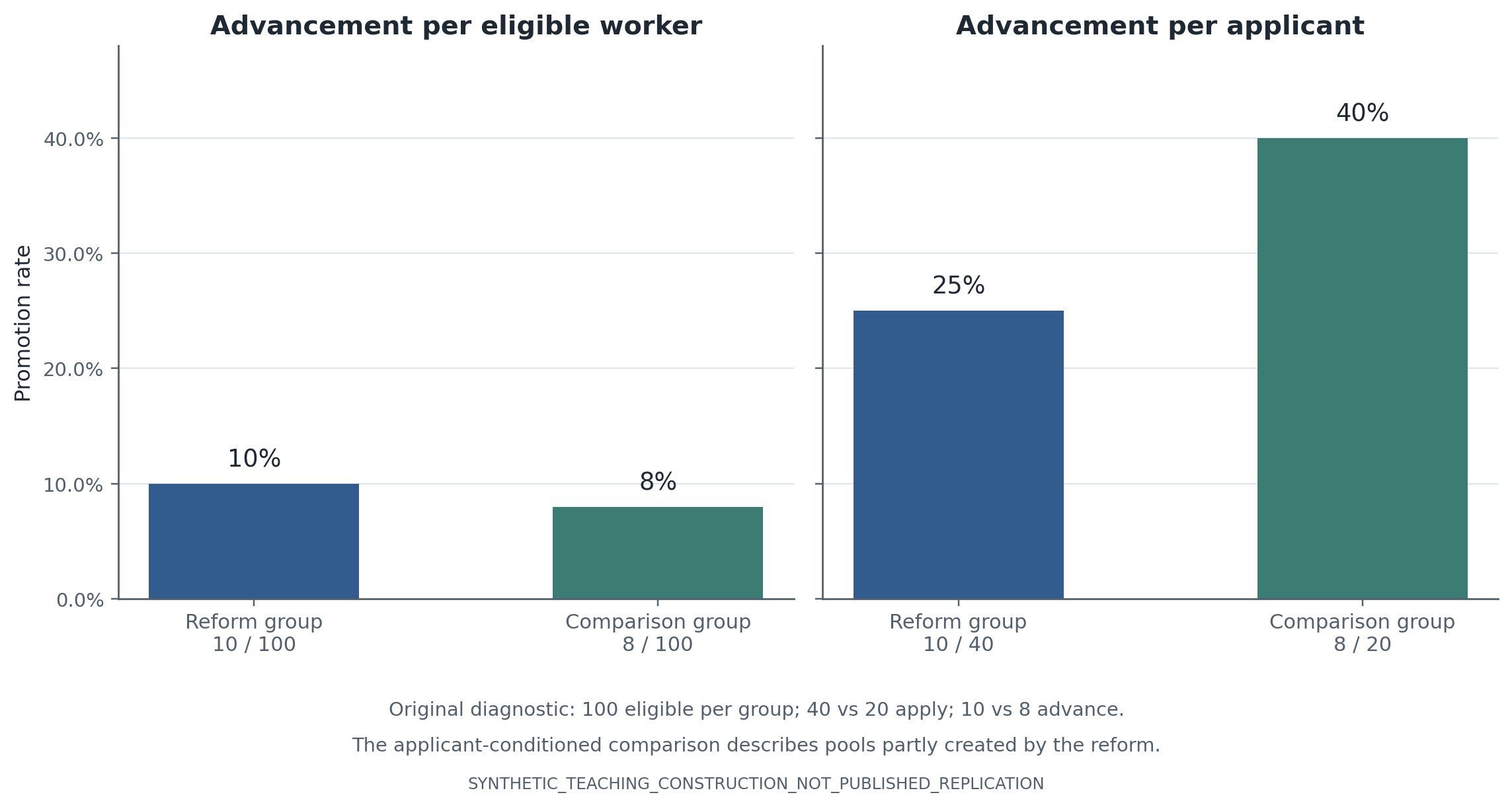
Figure 1:Original synthetic denominator illustration. Each group starts with 100 eligible workers. The reform group has 40 applicants and 10 promotions; the comparison has 20 applicants and 8 promotions. Changing the denominator reverses the ordering because the applicant pools differ. These are invented diagnostic counts, distinct from the lab’s 18-worker lottery and from any published estimate. The plot script reads the generated diagnostic inputs.
Table 1:Career transitions and risk sets
| Event or state | Appropriate denominator / unit | Minimum timestamps and fields | Interpretation trap |
|---|---|---|---|
| Eligibility for training | Baseline employees meeting a prespecified rule | Hire, grade, tenure, location, leave, eligibility-rule version | Selecting ever-completers or eventual promotees creates future-conditioned cohorts |
| Training offer / nomination | Eligible employees at the assignment date | Offer, nomination, manager, rule, randomization stratum | Manager nomination and worker demand are not random assignment |
| Enrollment and completion | Offers for take-up; enrollees for completion; all baseline workers for policy outcomes | Start, attendance, completion, withdrawal, reasons | Completion is post-treatment; its mean outcome is not the offer ITT |
| Independent skill assessment | Prespecified eligible assessment sample, ideally including leavers | Test form, blind scoring, assessment date, tool availability | A certificate, a rating and a skill test measure different things |
| Vacancy opportunity | Position-opening spell | Creation, posting, visibility, freeze/cancel, close, job content | A cancelled opening is not a worker rejection; missing openings distort choice sets |
| Internal application | Eligible worker–opening pairs; also baseline workers for cohort incidence | Notice, application, confidentiality, eligibility, prior manager | No application can reflect inaccessible information or anticipated barriers |
| Shortlist / offer | Applicants to that opening | Score, evaluator, shortlist, offer and rejection dates | A changed applicant pool changes conditional selection rates |
| Release and acceptance | Offered workers / approved moves, separately | Origin release decision, acceptance, effective start | A realized promotion combines employer offers and worker acceptance |
| Promotion | At-risk workers for hazard; baseline cohort for cumulative incidence | Grade plus tasks, authority, pay; announcement vs start | Reclassification is not always more authority; survivor-only rates can mislead |
| Lateral move | Workers eligible for the specific type of move | Old/new task vectors, team, location, supervisor | Same grade can hide development, accommodation, or a demotion in responsibilities |
| Exit / re-entry | All active spells; keep baseline cohort membership | Voluntary/involuntary/retirement/unknown, destination if permitted | Treating exit as ordinary censoring changes the career question |
| Post-promotion performance | Explicitly selected observed sample; separate universal assessment target | New team/resources, common-task outputs, task mix | Performance of rejected candidates in that role is generally missing |
| Succession chain | Position network and organizational unit over time | Rank-specific openings, retirements, replacements, headcount | A worker gaining a fixed slot need not increase total promotions |
Data discipline: preserve unknown vs zero, reason codes, event and recording dates, and versioned role definitions. Freeze the baseline cohort before estimating downstream outcomes. Conditional stages describe different populations and should not be presented as interchangeable treatment effects. Institutional templates: Baker et al., 1994Benson et al., 2019Haegele, 2026Bianchi et al., 2023.
2. A compact model of skills, learning, and assignment
Use an original teaching model with a vector of skills , training inputs , and job assignment :
indexes workers and time; is the identity matrix and a skill innovation. represents depreciation, training effectiveness, learning through the work performed in job , and the skill weights relevant to that job. Effort and production noise remain distinct. Employers also form beliefs about from imperfect signals, as in Week 3. Changing a belief is not itself an increase in the underlying skill vector.
This notation organizes competing explanations; it does not claim that payroll and output data identify all terms. A productivity gain following training could reflect increased skills, increased effort, better tasks, complementary technology, or changed recording. Measuring output on a common task can reduce one source of ambiguity, but can miss skills valuable only in the new role.
Becker supplies the foundation for general and specific investment. Acemoglu and Pischke show why wage compression and labor-market frictions can permit firms to finance technologically general training. Lazear’s skill-weights approach explains how generally useful skills can become firm-specific in combination. Thus, employer payment is not proof that training has no value elsewhere Becker, 1962Acemoglu & Pischke, 1999Lazear, 2009.
Gibbons and Waldman integrate assignment, learning, and human capital in models of wage and promotion dynamics. Their later extension adds schooling and task-specific accumulation. These models explain why the same observed promotion pattern may admit more than one mechanism; a student’s empirical design must supply additional information or variation Gibbons & Waldman, 1999Gibbons & Waldman, 2006.
Original dynamic-assignment example. A lateral developmental role costs three units of current production but yields five extra units next period. With discount factor .9 and no exit or other costs, the net gain is . If the organization expects to retain only half the future gain, its private value becomes . This is not a universal optimal-rotation formula: learning, survival, wages, and replacement are fixed here. It illustrates why a beneficial career investment can be unattractive to the unit bearing its initial cost.
3. Who pays for training, and which return is measured?
Separate technological returns from who captures them. In a deliberately simple two-period example, let be the additional monetary value of production, additional compensation, the firm’s initial cost, and the probability that the worker remains available to the firm; is the discount factor:
This is a private present-value calculation, not an identified treatment effect or social-welfare measure. It omits spillovers, replacement costs, taxes, and returns after exit. Expected retention may itself respond to training or financing, so it should not normally be treated as an externally fixed number.
Original numerical example. With , , , annual production gain 80 and compensation gain 25, the expected firm return is 17.231375. Expected additional pay while employed is 39.650625. Combined net production value is 56.882. These unrounded values add up; the figures are hypothetical monetary units. Worker welfare additionally depends on time costs, mobility, risk, outside earnings, and preferences. A high firm return cannot establish that the worker is better off; a zero wage response cannot establish no worker benefit.
Hoffman and Burks study training contracts, employee turnover, and employer-sponsored general training using trucking data. The selected reference is their NBER working-paper version. It combines evidence on quit responses with structural counterfactuals; those are different evidentiary layers. Its training-repayment setting motivates measuring financing and mobility together, not giving advice about current contract enforceability Hoffman & Burks, 2017.
Design implication. A training evaluation should report costs borne by both sides, common output and quality outcomes, wages, assignments, exits, and subsequent opportunities where observable. Do not evaluate returns solely among workers who remain long enough to complete training; that changes the population and can select on the intervention’s consequences.
4. Training papers as competing research designs
4.1 Administrative training records: valuable, but assignment remains a question
Bartel links company training records to wage growth and job-performance measures. This is a useful administrative-panel design, not a lottery assigning every worker to training Bartel, 1995.
Research exercise. Reconstruct how nomination works. Are workers trained because a promotion is anticipated, because their performance deteriorated, or because their supervisor has a budget? Worker fixed effects remove stable differences, not the time-varying reasons for nomination. Put nomination, training, assessment, role change, and compensation on a common timeline. A pre-training output decline can change the interpretation of apparent recovery. These are design questions to ask of a new application, not a claim that the original paper ignored them.
4.2 Randomized training: treatment effects and spillovers
de Grip and Sauermann combine a training field experiment with worker-productivity records, studying effects on trainees and coworkers Grip & Sauermann, 2012. Their design makes training and peer exposure a useful pair of empirical objects.
Design translation. When participants share a team, an untreated coworker may not be an unaffected control. Record treatment saturation and interaction opportunities, and specify whether the target is the direct effect of an offer or the overall effect of introducing the program. A quality measure helps distinguish faster service from better service. Peer channels are revisited in Week 7; here their role is to clarify the training estimand.
4.3 Soft skills: productivity, promotion, and capture of returns
Adhvaryu, Kala, and Nyshadham’s published study randomizes access to on-the-job soft-skills training among garment workers in India. The paper finds productivity and promotion gains, while finding no statistically detectable wage or retention effects. It also studies collaborative production and spillovers Adhvaryu et al., 2023. Use the 2023 published version rather than older working-paper magnitudes.
Design translation. This is not an invitation to rename every productivity change “human capital.” The program can change communication, confidence, effort, and allocation as well as tested skills. Distinguish the randomized bundle’s effect from mechanism evidence. To isolate certification, one could separately randomize whether supervisors receive assessment results; to study portability, one could use a common task or follow movement to different roles. These are proposed extensions, not treatments claimed to occur in the paper.
The three designs create a useful ladder: richer administrative records reveal career timing; randomized access improves the treatment comparison; independent assessments and carefully designed disclosure or exposure variation sharpen mechanisms. No single dataset automatically does all three.
5. Promotion: reward for the old job or allocation to the next one?
A promotion often changes tasks, authority, coworkers, and evaluation. A worker can be excellent at the old role and comparatively less productive in the new one. It can nevertheless be useful for an organization to promise advancement as a reward. Week 4’s incentive logic and Week 5’s assignment logic therefore meet here.
Original two-worker example. Worker A produces 12 in the frontline job and would contribute 13 as manager. Worker B produces 10 in the frontline job and would contribute 18 as manager. With one frontline and one managerial position, promoting A yields ; promoting B yields . The current-output ranking selects A, whereas productive assignment selects B. The relevant incremental values are 1 and 8. This calculation holds skills, effort incentives, wages, and willingness to accept fixed. Once those respond to the rule, it is not a complete optimum.
Benson, Li, and Shue connect sales performance and promotion to subsequent managerial performance in the published sample of 131 firms. Their evidence distinguishes predictors of promotion from predictors of managerial performance and considers the organizational tradeoff. The data observe realized promotions, not promotion offers, so acceptance is part of the observed transition Benson et al., 2019.
The paper also goes beyond comparisons of average promoted workers: it uses a firm-month promotion-rate instrument, leaving out the focal worker and teammates, to compare marginally promoted candidates. Its managerial-value-added construction absorbs common firm-time conditions. The interpretation still requires exclusion and the relevant local-effect assumptions; leaving observations out removes a mechanical link, not every source of endogeneity Benson et al., 2019.
Implementation lesson. Specify the performance measure for the new job independently of the old one. Subordinate sales can be useful but can reflect team reassignment, resources, or joint output. Future managerial outcomes are unavailable for many non-promoted candidates. A prediction exercise among promoted workers does not reveal everyone’s counterfactual managerial productivity. A randomized trial role, rotation, assessment center, or shadow assignment might provide additional evidence, but each changes the intervention and its external validity.
Avoid using “Peter Principle” as a residual explanation for disappointing managers. The empirical question is which observable criterion drives selection and what value would change under another rule, including the incentive cost of breaking the old promise.
6. Internal search and the gate before the application
Internal mobility is a search problem even when worker and employer already know one another. Openings may not be visible, applying may reveal dissatisfaction, managers may control endorsements or release, and candidates may anticipate retaliation or reduced support. An applications database begins after several such decisions.
Haegele combines personnel and survey evidence to study talent hoarding. The published 2026 paper uses quasi-random variation in exposure to hoarding and documents its connection to internal applications. The accessible earlier manuscript makes the timing issue especially clear: responses can precede an actual manager rotation Haegele, 2026. Do not replace the institutional design with a claim that manager identity was randomly assigned.
Original local-incentive example. A move raises destination output by 8, reduces origin output by 3, and costs 1, giving firm-wide net value 4. If the origin manager bears the loss of 3 and receives none of the destination benefit, blocking is locally attractive. A transfer credit of 4 would reverse that particular payoff. This example does not establish that a credit system is optimal: it excludes gaming, replacement choices, worker utility, and future links.
The research lesson is to observe the full opportunity set, including eligible non-applicants, manager departure announcements, vacancy dates, endorsement requirements, rejected release requests, and realized starts. A rise in applications around a rotation can reveal a barrier, but its interpretation depends on anticipated reassignment, future openings, and changing promotion beliefs. Compare anticipation-compatible windows and explain precisely which contrast the institution supports.
For a new design, a randomized notification can identify the effect of information delivery. A randomized confidential-application rule can target disclosure risk. Neither automatically identifies the effect of releasing workers or the total production gain from their moves. Distinguish application encouragement, actual movement, and destination assignment as different interventions.
7. Lateral moves, external hires, and developmental matches
An internal move need not raise grade. It may develop skills, improve fit, create contacts, expose ability, accommodate life constraints, or prevent exit. Classify moves using job content, authority, compensation, and location rather than assuming that every same-grade move is horizontal and every new title is advancement.
Bidwell compares external hires and internal movers using personnel data. The contrasts in compensation, performance, and exits illustrate the value of observing entry route and subsequent outcomes in comparable jobs. These remain observational comparisons, not random assignment to an internal versus external pipeline Bidwell, 2011.
Design translation. Define the opening as well as the worker. External hiring can occur because internal candidates are unavailable or an unusual skill is required. Conditioning on the filled position helps define comparability but need not eliminate the private information behind the hiring decision. Distinguish filling an identical slot differently from creating different kinds of slots.
Cowgill and coauthors combine a model with evidence from an internal talent market, contrasting firm-led and preference-based assignment. Their analysis separates the firm’s preferred quality metric from workers’ rankings and the use of existing expertise from skill growth Cowgill et al., 2025. These are different objectives, not interchangeable measures of social welfare.
Original empirical opportunity. Evaluate a developmental assignment with both current production and performance on a later, different task. Record whose preference was elicited and when; a ranking collected after the outcome is not an ex ante preference. A match simulation can compare feasible assignments under its model, but does not independently identify how new skills would develop under assignments that never occurred.
Gathmann and Schönberg’s task-based approach to transferable human capital helps motivate measuring the distance between old and new work, rather than equating any employer change with loss of all skills Gathmann & Schönberg, 2010. Occupational measures are only a starting point: within-firm tasks and tools may differ within the same occupational code.
8. Opportunity supply, succession, and career congestion
Promotion chances depend on who leaves the next rung, which positions the firm creates, and which jobs are filled externally. Model a ladder as a system of positions, not only as a series of individual hazards. One promotion may open a lower-level vacancy, but an organizational freeze or outside hire can stop that chain.
Bianchi and coauthors exploit unexpected retirement delays induced by an Italian pension reform, using heterogeneous exposure across firms. The paper finds career spillovers for younger colleagues where promotion opportunities are limited Bianchi et al., 2023. This is evidence about career constraints in that setting, not a general evaluation of retirement policy.
Design translation. An age-composition instrument or exposure measure requires a substantive exclusion argument. Firms with older workforces may differ in technology, demand, or retirement planning. Reconstruct the eligibility rule and predetermined workforce before calculating exposure, examine competing predictions, and track position creation and worker exits. Do not control automatically for post-reform staffing choices that are part of the mechanism.
Original fixed-slot example. A department has one vacancy and two candidates. Under the old rule A wins; after a training or visibility reform B wins. The number promoted remains one. B’s gain coexists with A’s loss, and the observed post-promotion sample changes in both directions. This illustrates displacement and why a monotone-observation assumption for selection bounds can fail. It does not imply that reassignment has no value: output, fairness, or welfare may change despite an unchanged count.
A rise in the promotion rate can also result from fewer eligible workers after exits. Report both counts and denominators; track total service or production alongside average productivity. Different horizons can reverse the conclusion when initial vacancies launch longer succession chains.
9. Career signals, unequal access, and current research
The recent paper on “potential” ratings by Benson, Li, and Shue examines differences in performance ratings, potential assessments, and promotions. It provides an application of the distinction between current performance and forecasts of later-role performance Benson et al., 2026. The chapter uses it to study the gatekeeping record, not to repeat the gender special topic.
Cullen and Perez-Truglia connect manager–employee interaction to advancement using administrative and survey evidence and managerial transitions Cullen & Perez-Truglia, 2023. This motivates asking whether information and access differ before the final promotion comparison. Interaction, skill formation, endorsement, and preferential treatment should be separated in the research design rather than treated as synonyms.
Minni’s published 2026 study links managers to the allocation of workers across jobs. The Week 6 lesson is to connect manager transitions to a worker’s subsequent roles and trajectory, not only contemporaneous output Minni, 2026. Persistence is consistent with learning, but can also arise from durable assignments, networks, and selection. Independent skill measurements or job changes that differentially use skills help distinguish these channels.
Finally, Generative AI at Work provides a contemporary example of productivity effects, heterogeneous experience profiles, and evidence relevant to learning Brynjolfsson et al., 2025. The opportunity is not to declare that AI’s learning effects are unstudied. A sharper project asks whether gains persist without the tool, transfer to new tasks, change access to training, or alter advancement. Task-specific testing, carefully justified outages or withdrawals, and long-run career records can make that question operational. The general adoption and organizational-reform agenda remains for Week 9.
10. Data resources and research opportunities
Hoffman and Stanton’s review is the broad entry point for organizing these personnel questions Hoffman & Stanton, 2025. The empirical frontier should be stated as unresolved mechanism distinctions, not a list of fashionable outcomes.
Proposed project 1: learning versus certification. Pair a training-access intervention with independent assessments and, where feasible, separately randomized information disclosure. Track changes in tasks and promotions. Exclusion fails if disclosure itself changes effort or supervisor support; measure those responses rather than defining them away.
Proposed project 2: latent demand for internal mobility. Observe eligibility and vacancy visibility, then vary private notifications or application confidentiality. Measure applications, releases, actual starts, origin disruption, and destination performance. An application effect without more feasible slots is not a total job-creation effect.
Proposed project 3: developmental versus immediate-match assignments. Use constrained lotteries among acceptable rotations, documenting refusal and ex ante preferences. Test performance in a later task that was not used for selection. The policy target includes the cost of current lost production and workers’ assignment preferences.
Proposed project 4: bottlenecks and opportunity chains. Link retirements and vacancy creation to subsequent openings at multiple ranks. Exploit credible exposure variation but distinguish within-firm reallocation from gains that spill across firms through exits. Saturation designs can help detect displacement.
Proposed project 5: portable learning under new technology. Measure skill retention and career mobility following access to a tool, not only simultaneous output. Benchmark against conventional training and distinguish productive capability from model assistance at test time.
Public data can start a project but rarely reproduce a full internal career ledger. NLSY training documentation describes program timing, completion and providers, with changing question universes and respondent-defined categories National Longitudinal Surveys, 2026National Longitudinal Surveys, 2026. O*NET provides occupational task and skill descriptors, not individual skill assessments National Center for O*NET Development, n.d.. LEHD public products provide aggregated job-flow and workforce information, not confidential worker-level internal applications U.S. Census Bureau, 2026. Exact access, release, and coding need verification before an empirical specification is finalized.
Table 2:Data and measurement map
| Source | What it can contribute | What must be requested / reconstructed | Access and interpretation limit |
|---|---|---|---|
| Human-resources job histories | Grades, assignments, manager IDs, employer spells | Stable person/position IDs; effective and recorded dates; grade and title crosswalks | Usually employer-held. Titles are not invariant tasks or authority. |
| Learning-management system | Offers, enrollment, time, completion, test results | Assignment mechanism, nomination pool, absences, test versions, who observes results | Logs of completion do not by themselves identify skills acquired. |
| Internal applicant tracking | Openings, applications, scores, offers | Eligible non-applicants, visibility rules, release, withdrawals, cancelled vacancies | Successful-move data miss the main access margin. |
| Independent task tests / work samples | Comparable capability measures | Blind scoring, pre/post forms, tool availability, assessment coverage of leavers | Test effort and measurement transport require validation. |
| Production, service and quality records | Output, errors, rework, customer outcomes | Task difficulty, team resources, role changes, costs | Raw output across roles may be incomparable; rankings can be a pay-rule input. |
| Payroll and worker surveys | Pay, risk, satisfaction, learning costs, career preferences | Base vs bonus; hours and effort; mobility constraints; external offers if ethical | Neither a pay rise nor retention alone establishes welfare. |
| National Longitudinal Surveys, 2026 | Worker-level training histories and employment context | Match question universe and training definition across rounds | Official documentation flags respondent-defined categories and changing universes; not a firm’s complete roster. |
| National Longitudinal Surveys, 2026 | Training episodes, dates, completion and certificates | Program roster, age eligibility, survey timing and employer-spell mapping | Self-reported training and cohort coverage; no complete internal-applicant risk set. |
| National Center for O*NET Development, n.d. | Occupational tasks, skills and related-work descriptors | Release version, occupation crosswalk, task-distance construction | Public descriptors of occupations, not tests of an individual worker’s skill. |
| U.S. Census Bureau, 2026 | Public workforce statistics and job-flow aggregates | Relevant public product and geographic/industry cell definition | Public aggregates do not expose individual internal career decisions; confidential microdata require separate authorization. |
| Published-paper archive pointers | Code, documentation or original data where actually supplied | File/license/access inspection, exact version, dependencies, target statistic | A publisher link is not proof of unrestricted data or a successful replication. |
Resource-access record for this pack
Official documentation above was checked on 2026-09-21. No public or restricted microdataset was downloaded for this package. The guaranteed lab requires neither an account nor a data application. O*NET’s current-release route and archive are both documented; pin the version used in an actual project instead of silently inheriting an updated taxonomy.
The training paper’s publisher lists a Data Archive; the Peter Principle article identifies a code deposit at doi:10.7910/DVN/59FKZI; Haegele’s article lists a replication link; Cowgill et al. lists supplementary data/appendix. These listings were checked, but files, licenses and execution were not. Do not describe any of them as unrestricted microdata without inspecting the deposit.
Suggested data-request order: baseline roster and job dictionary → opportunity ledger → training-assignment records → applications/releases → common output/quality → pay/welfare. This order reveals whether the design is possible before requesting every available file.
Research Lab
Primary design anchor and reproduction boundary
Use Adhvaryu–Kala–Nyshadham (2023) to motivate randomized training access and the need to separate productivity, career advancement, pay, and retention. The publisher lists a data archive, but the pack does not contain or execute its microdata. The guaranteed lab is an original synthetic design reconstruction, with a deliberately small lottery and fabricated career histories. Its assignment scheme, sample size and parameter values are not the paper’s Adhvaryu et al., 2023.
Reproduce
Construct 18 baseline-eligible workers in three departments, with three training offers randomly assigned among six workers in each department. A common endline skill assessment is observed for all workers, including leavers. Reproduce the stratified difference in assessment changes and enumerate all 8,000 allowed assignments for a Fisher sharp-null randomization test. This is a design demonstration, not a source-paper estimate.
Let be worker ’s month-4 independent assessment minus the month-0 assessment, and the assigned offer. For department , and are offered and unoffered means; and are their sample variances. The lab uses
Every department has six workers and three offers, so equal department weights also weight baseline workers equally. The Neyman variance estimator is conservative in expectation for finite-population randomization variance; its square root need not exceed the true SE in each realized sample. A normal interval is not exact here. The Fisher test holds observed outcomes fixed under the sharp null of no offer effect for any worker. The separate instructor check changes outcomes under alternate assignments and averages the estimator to the known offer ATE. It is not the sharp-null reference distribution. Report the completion first stage; comparing completers with noncompleters does not recover an offer effect.
The separate career module has one promotion slot per department. Promotions depend on competing candidates, so report them as networked allocation outcomes rather than attaching an individual no-interference interpretation to a simple treatment contrast. Preserve eligibility, applications, promotions and exits in their own ledgers. The artificial month-3 selection index shares latent components with later skill, but it is not an observed month-4 test result available to the decision-maker. The independent assessment is observed only at baseline and month 4; latent ranking inputs remain instructor-only. This is a stated simulation rule, not a proposed forecasting implementation with future outcomes as inputs.
Diagnose
Students distinguish offer from completion, stable cohort outcomes from selected risk-set outcomes, skills from assignment, and individual advancement from aggregate slots. They reproduce the denominator reversal, competing-risk calculation, comparative-advantage assignment, and two-period training-finance examples. The instructor’s potential outcomes verify the program but never enter student estimation predictors.
Haegele and Benson–Li–Shue are challenge anchors for the application and promotion gates. Bianchi and coauthors motivate the fixed-slot diagnostic. These are conceptual connections, not claims that the synthetic experiment reproduces their institutional protocols Haegele, 2026Benson et al., 2019Bianchi et al., 2023.
Transfer
Write a two-page career-transition design. Name a baseline eligibility population, the opportunity set, the treatment or exposure, two competing mechanisms, and one credible comparison. Supply a timeline and denominator table, independent quality and worker-welfare outcomes, the relevant assignment unit for inference, and one conclusion that the proposed data could not support. An optional original-data route is separate and requires access, license, file, statistic and assignment verification before any replication claim.
Methods Box
A. Define states and clocks before running an event study
Choose the unit—employee-month, job spell, worker–opening, or position-month—and specify what starts its clock. Hiring date, eligibility date, vacancy opening, application, announcement, and actual promotion are different time origins. Preserve multiple clocks when the question requires them. A cohort defined by eventually completing training or eventually being promoted conditions on a future event; it can create selected comparisons and an artificial interval in which members must remain observable.
At minimum retain a baseline-cohort identifier, current role, training state, eligibility, opening availability, application status, offer, release, actual start, and exit. Decide whether leave pauses eligibility, whether rehire begins a new spell, and how simultaneous lateral and grade changes are coded. Audit impossible sequences. Do not overwrite unknown eligibility with zero.
B. Use competing risks for the descriptive question they answer
For first promotion from an eligible state, exits are competing events. Define cause-specific discrete hazards among those still at risk just before period :
means neither previously promoted nor exited, and . Promotion and exit are mutually exclusive first events within a period; define a precedence rule if recorded dates tie. Hazards are defined only for nonempty risk sets. Here the toy lab makes first promotion and exit absorbing and prevents simultaneous events.
is the cumulative probability of first promotion before a competing exit, under the measurement and censoring assumptions. It is not the causal effect of promotion. A general multi-state model allows lateral moves, grades, leave, and re-entry, but requires explicit transition and observation rules Andersen & Keiding, 2002.
Original example. Of 100 workers, 40 exit in period one and 30 of the remaining 60 are promoted in period two. The promotion cumulative incidence is .30. Treating exits as ordinary noninformative censoring in a promotion-only survival calculation gives .50, a different, generally hypothetical quantity. Neither a cause-specific hazard ratio nor a correct incidence curve makes treatment assignment exogenous. Conditional hazards can differ because previous treatment already changed who remains at risk.
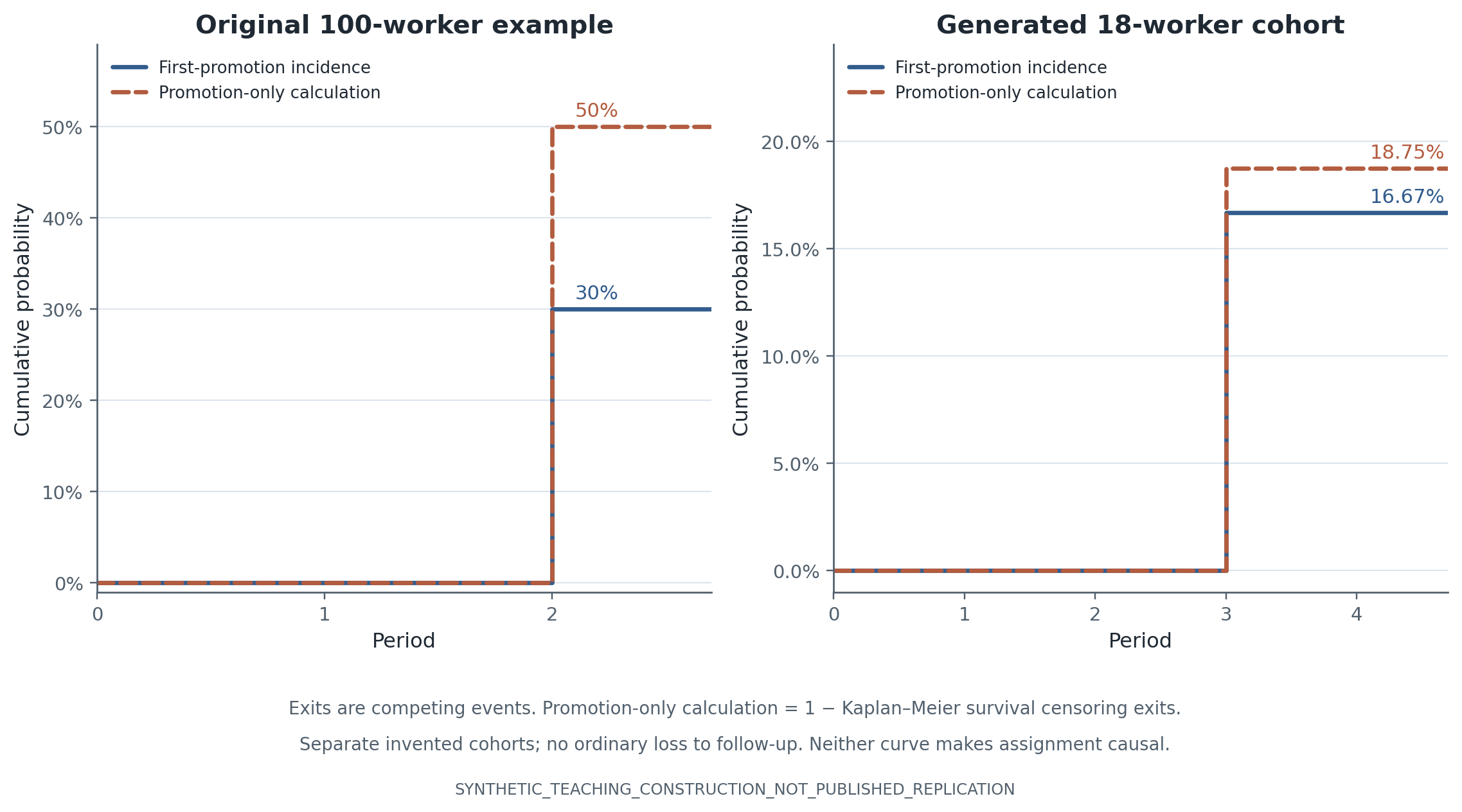
Figure 2:Original synthetic competing-risk illustration. Left: 40 of 100 workers exit before 30 of the remaining 60 are promoted; observed first-promotion incidence is .30, while one minus promotion-only Kaplan–Meier survival is .50. Right: the same two calculations use the generated 18-worker career panel with three fixed promotion slots. Exits are competing first events, with no ordinary loss to follow-up. Censoring them changes the question; the promotion-only curve is not the cohort’s observed advancement probability or an identified effect of eliminating exit. All observations are invented. The plot script preserves diagnostic inputs and the generated risk-set CSV.
C. Training assignment: separate ITT, take-up, and mechanisms
With randomized offers , the offer effect is , accounting for strata and the assignment design. Report the first stage in enrollment/completion. An IV interpretation for actual receipt additionally requires exclusion, relevance, monotonicity and an appropriate interference assumption. An offer may itself communicate management support or alter access to a promotion; exclusion is not automatic. A completer comparison conditions on a choice and survival event affected by treatment.
Keep common skill assessments distinct from routine productivity and later wages. Model spillovers if trained workers help others. The offline lab deliberately removes interference from the skill potential outcomes but includes competition in the promotion allocation, making these assumptions visible rather than silently reusing one estimand for both outcomes.
D. Promotion and rotation event studies: timing is not random by definition
An event study around promotion describes careers of those promoted unless an additional identification argument supports a causal interpretation. Employers may assign tasks before the official title change; workers may apply in anticipation of openings. The relevant untreated trend is not established by nonsignificant pre-event coefficients Roth, 2022.
For genuine staggered, absorbing training access under defensible parallel trends, group-time ATT methods can avoid already-treated comparisons and make aggregation explicit Callaway & Sant'Anna, 2021. Repeated training courses, lateral moves, promotions at multiple grades, and recurrent manager changes are not automatically absorbing treatments. Define a single intervention or an explicit treatment-history comparison, with windows, exclusions and weights fixed before interpretation. Restricting to future nonmovers can create its own selection.
E. Selective outcomes: promoted-only productivity is not everybody’s potential
If managerial productivity is observed only for promoted workers, changing the promotion rule changes who is measured. Report selection rates and the baseline population. Common assessments, temporary trial assignments, or independently sampled evaluations may help; none is costless or automatically representative.
Lee’s bounds provide a disciplined approach to selected outcomes under specific assignment and monotone-selection assumptions Lee, 2009. Do not apply them automatically to a fixed number of promotion slots: a reform may add B and remove A from the measured sample, violating individual monotonicity even with equal overall selection rates. Nor does equal attrition across groups prove that the observed workers are comparable. Document what is bounded and for which always-observed population.
F. Slot competition and assignment-aware inference
People within a promotion contest may affect one another’s outcomes. Measure the number and identity of openings and competitors; decide whether the target is own access, the contest-level effect, or total organizational output. A training intervention can have direct effects, peer benefits, and displacement at once. Randomized saturation, vacancy-level interventions, or an explicit allocation model answer different parts of this problem.
For inference, match the covariance or randomization procedure to the assignment and dependence structure, not the number of payroll rows Cameron & Miller, 2015. Repeated monthly observations do not create new independent assignment units. With a small, known stratified lottery, enumeration supplies a transparent sharp-null test; it is not a universal weak-null confidence interval or a solution to missing outcomes. If manager or team treatment was assigned, do not permute workers independently.
G. A minimum empirical reporting panel
Report eligibility counts, opportunity counts, take-up and completion, unconditional cohort advancement, conditional application/offer/start rates, competing exits, current and future task outcomes, pay, and a worker-welfare measure. Then name which are causal estimands, mechanism evidence, or descriptive diagnostics. Show sensitivity to grade/task definitions, date conventions, follow-up horizons, and outcome observability. A convincing design separates two explanations; it need not claim to recover the entire internal labor market.
Table 3:Methods and identification checklist
| Question | Implementable design / diagnostic | Target | Limitation to state |
|---|---|---|---|
| Does offering training improve capability? | Randomize eligible offers; retain assignment strata; common blind assessment | Offer ITT for baseline eligible cohort | Receipt IV needs exclusion and compliance assumptions; offers may signal support. |
| Does training work through skills rather than credentials? | Separate access from disclosure where feasible; test common and novel tasks | Effects of access/information interventions | Disclosure can change effort, mentoring and assignment; factorial cells must be interpreted as actual interventions. |
| Why do trained workers advance? | Align training, assessment, application, vacancy and promotion dates | Mechanism predictions across gates | Conditioning on each gate changes the sample; mediation is not identified by adding post-treatment controls. |
| Are internal applications deterred? | Predetermined exposure changes or randomized notification/confidentiality | Application response among eligible workers | Movement, productivity and welfare require further outcomes; anticipated rotations matter. |
| Is a promotion criterion allocatively costly? | Predict next-role performance using independent assessments and actual alternative assignments | Criterion versus next-role fit | Observed future performance is selected; incentive benefits of the criterion may offset static allocation losses. |
| Do openings constrain advancement? | Reconstruct vacancy counts, succession and predetermined retirement exposure | Career response to opportunity supply | Workforce age can proxy for other shocks; changes in colleagues’ outcomes create interference. |
| Are exits affecting the apparent promotion rate? | Show baseline cohort incidence and conditional hazards; multi-state/CIF analysis Andersen & Keiding, 2002 | Descriptive transition probabilities | Censoring and observation assumptions remain; hazard contrasts are not automatically causal. |
| Can selection bounds help? | Check monotone observation and correct target population before applying bounds Lee, 2009 | Effects for an always-observed group under assumptions | Fixed-slot changes can swap who is observed in both directions. |
| Is an event study appropriate? | Explicit onset, anticipation and comparison cohorts; use heterogeneous-adoption methods only for compatible histories Callaway & Sant'Anna, 2021Roth, 2022 | Defined group-time effect, if identifying assumptions hold | Promotions and rotations are endogenous/recurrent; robust aggregation does not make timing exogenous. |
| What uncertainty is relevant? | Assignment-aware randomization inference or justified cluster covariance Cameron & Miller, 2015 | Sampling or randomization uncertainty for specified estimand | Many employee-month rows do not create many independent assignments. |
| Did internal allocation improve the whole firm? | Count winners/losers; origin and destination output; total openings and spillovers | Contest/unit/firm policy effect | Individual gains can displace others; unchanged promotion counts do not imply unchanged value. |
| What changed in measured productivity? | Common-task/quality checks; versioned jobs, rubrics and IT systems | Robustness of the outcome construct | Better recorded output alone cannot identify skill growth. |
Before estimation: write the population, treatment, dates, risk sets, alternatives, interference assumptions, outcome availability and inference unit. Freeze those definitions before selecting a favorable estimate.
Reading Ladder And References
Required empirical spine: three papers. Adhvaryu–Kala–Nyshadham (2023) on training and distinct returns; Benson–Li–Shue (2019) on current versus next-role performance; Haegele (2026) on the internal-application gate. Read the relevant design and measurement sections closely, not only the headline result Adhvaryu et al., 2023Benson et al., 2019Haegele, 2026.
Model excerpts. Becker, Acemoglu–Pischke, Lazear and Gibbons–Waldman provide alternative reasons training, pay and assignment move together. Assign selected sections rather than five full theoretical papers Becker, 1962Acemoglu & Pischke, 1999Lazear, 2009Gibbons & Waldman, 1999Gibbons & Waldman, 2006.
Rotating empirical presentations. Training measurement: Bartel and de Grip–Sauermann. Opportunity supply: Bianchi et al. Internal-versus-external assignment: Bidwell and Cowgill et al. Career signals and access: Benson–Li–Shue (2026) and Cullen–Perez-Truglia. Dynamic allocation and current technology: Minni and Brynjolfsson–Li–Raymond Bartel, 1995Grip & Sauermann, 2012Bianchi et al., 2023Bidwell, 2011Cowgill et al., 2025Benson et al., 2026Cullen & Perez-Truglia, 2023Minni, 2026Brynjolfsson et al., 2025.
Research resources. Baker–Gibbs–Holmström and Hoffman–Stanton organize the field. Gathmann–Schönberg and Hoffman–Burks develop transferability and financing. Andersen–Keiding, Lee, Callaway–Sant’Anna, Roth, and Cameron–Miller supply targeted methods, not substitutes for the institutional design Baker et al., 1994Hoffman & Stanton, 2025Gathmann & Schönberg, 2010Hoffman & Burks, 2017Andersen & Keiding, 2002Lee, 2009Callaway & Sant'Anna, 2021Roth, 2022Cameron & Miller, 2015.
The first columns summarize each paper’s contribution; the final column gives a question for a student’s new design, not an allegation that the original authors ignored the issue.
Table 4:Paper, design, and evidence map
| Paper | Variation or evidence | Outcome / mechanism use | Question to take to a new application |
|---|---|---|---|
| Bartel, 1995 | Company training and career records | Training, wages and performance | What time-varying nomination or anticipated promotion remains after worker effects? |
| Grip & Sauermann, 2012 | Randomized training and worker productivity panel | Own and coworker effects | Does the comparison group receive spillovers, and is service quality independently measured? |
| Adhvaryu et al., 2023 | Training field experiment in garment production | Distinct productivity, advancement, compensation and retention outcomes | Does the bundle change skills, effort, communication, or assignment? |
| Benson et al., 2019 | Sales and promotions linked to managerial outcomes | Current performance versus next-role suitability | Who is missing from post-promotion outcomes, and how are offers versus acceptance observed? |
| Haegele, 2026 | Personnel/survey data and variation in hoarding exposure | Internal applications and access | Are announcement, actual rotation, openings, and release timing distinguishable? |
| Bidwell, 2011 | Internal-mover/external-hire personnel comparisons | Compensation, performance and exit by entry route | Do different vacancy needs select the hiring channel? |
| Cowgill et al., 2025 | Assignment model plus internal talent-market evidence | Firm quality, worker preferences, and developmental assignments | Does a simulated reassignment also identify unobserved learning under that assignment? |
| Bianchi et al., 2023 | Unexpected retirement-rule change and heterogeneous firm exposure | Promotion constraints and colleague career spillovers | Does baseline age structure predict other changes in firm demand or technology? |
| Minni, 2026 | Manager rotations and worker–job allocation | Career allocation, learning and persistence | Can lasting effects distinguish skills from durable assignment or composition? |
| Benson et al., 2026 | Performance, potential assessments and promotions | Forecasts of later performance as career gates | Are later outcomes observed only for a selected promoted group? |
| Cullen & Perez-Truglia, 2023 | Personnel/survey evidence and managerial transitions | Contact and career progression | Can access, information, endorsement and learning be separated? |
| Hoffman & Burks, 2017 | Training-contract and quit variation; structural analysis | Financing, retention and returns | Which conclusion is an empirical response and which depends on the counterfactual model? |
| Gathmann & Schönberg, 2010 | Task measures and worker mobility/wage records | Transferability across occupations | Does occupational similarity represent individual skills or only job requirements? |
| Brynjolfsson et al., 2025 | Workplace AI rollout and performance evidence | Experience heterogeneity and learning | Does performance persist on an unassisted or novel task, and translate into careers? |
Version note: Haegele (2026), Benson–Li–Shue (2026) and Minni (2026) are published papers, not generic unpublished frontier placeholders. Cowgill et al. is cited by its 2025 print issue; Hoffman–Burks remains a selected 2017 working paper. No archive pointer in this pack is a completed original-data replication.
Table 5:Reading and lab map
| Layer | Assignment | What students bring to discussion |
|---|---|---|
| Required 1: training | Adhvaryu et al., 2023 | Diagram offer → receipt → distinct outcomes; label bundle effects versus mechanisms. |
| Required 2: promotions | Benson et al., 2019 | Contrast current-job predictors with next-job outcomes; identify what is missing for non-promoted workers. |
| Required 3: internal access | Haegele, 2026 | Reconstruct eligibility, applications, rotation announcements, releases, and the design’s counterfactual. |
| Model excerpts | Becker, 1962Acemoglu & Pischke, 1999Lazear, 2009Gibbons & Waldman, 1999Gibbons & Waldman, 2006 | A short mechanism, assumptions and one observable implication—not five full-paper summaries. |
| Training/data rotation | Bartel, 1995Grip & Sauermann, 2012Gathmann & Schönberg, 2010Hoffman & Burks, 2017 | Compare administrative selection, experimental access, transferability and financing. |
| Opportunity/assignment rotation | Bidwell, 2011Bianchi et al., 2023Cowgill et al., 2025Minni, 2026 | Separate vacancy supply, assignment rules, preferences, and learning. |
| Current career-gate rotation | Benson et al., 2026Cullen & Perez-Truglia, 2023Brynjolfsson et al., 2025 | A precise career mechanism that new data/variation could distinguish. |
| Field and methods resources | Baker et al., 1994Hoffman & Stanton, 2025Andersen & Keiding, 2002Lee, 2009Callaway & Sant'Anna, 2021Cameron & Miller, 2015Roth, 2022 | Read when needed for the proposed design; do not confuse an estimator with identification. |
| Reproduce | Original synthetic training-access lottery, motivated by the required training paper | Assignment ITT and exact sharp-null test; no claim of original microdata replication. |
| Diagnose | Career-denominator reversal, competing exits, role vs skill, slot displacement | Explain why an estimator can be correctly computed and still answer the wrong question. |
| Transfer | Two-page career-transition proposal | Eligibility/application/promotion/exit denominators; two competing mechanisms; independent quality and welfare. |
Boundary and pacing
Treat this as a substantial week, optionally two meetings: training and promotion logic, then internal opportunity access and empirical design. Week 3’s signal updating, Week 4’s incentive algebra and Week 5’s manager-effect material are short bridges, not repeated core lectures. Week 7 owns the full peer/team treatment. Preserve time for the hands-on denominator exercise rather than assigning every reference as mandatory reading.
Exercises And Discussion Prompts
Construct a worker–opening panel and a worker-month panel for the same reform. Which estimand changes, and which event should define eligibility?
Explain how a program can increase productivity and promotions without changing wages. Give two mechanisms and a measurement that separates them.
Rework the comparative-advantage promotion example after making frontline effort respond to the promotion rule. Which missing primitive prevents a complete welfare calculation?
A reform raises internal applications but leaves total promotions unchanged. Write one efficiency interpretation and one redistribution interpretation, and state the evidence needed to distinguish them.
Calculate first-promotion cumulative incidence when exits occur first. Explain why conditioning on employees still present changes the question.
Design a test that separates training-induced skills from certification-induced beliefs. What happens to exclusion if disclosure changes support or effort?
A manager rotation precedes more applications and long-run wage growth. Distinguish announcement, application, actual reassignment and learning mechanisms.
Write the two-page career-transition proposal with two mechanism predictions, all denominators, the comparison, inference unit, quality and welfare measures, and one explicit limit to the claim.
Reproducibility And Code Lab Note
Download the teaching repository (ZIP), or clone the repository. Keep its folder structure and open books/special-topic8-organizational/labs/06-training-internal-mobility-promotions-and-career-ladders/; the lab README supplies the run instructions. Weeks 1–3 use the shared plotting module supplied with the repository.
The Week 6 lab handout and lab README implement original synthetic design reconstruction, with empirical_replication false. Workers, departments, lottery rules, skill gains, histories, and diagnostic numbers are invented. No original microdata or estimation code were downloaded or executed. Public archive listings and code pointers do not establish actual file access, licensing, or successful replication; the optional original-data route remains separate.
From the course root, run the lab and regenerate both figures:
ENV_NAME=research bash labs/06-training-internal-mobility-promotions-and-career-ladders/smoke.sh
conda run -n research python assets/scripts/build-week6-careers.py
The standard-library lab runs all 35 starter assertions. Its smoke checks two fresh default-seed executions with identical manifests, seed 88771, and refusal to overwrite a nonempty directory with exit code 2 and unchanged files. Generated outputs are staged into the canonical lab without replacing authored documents. Tests do not require statistical significance. Potential outcomes and behavioral draws remain instructor-only. Universal endline assessment, including leavers, is an artificial follow-up guarantee; ordinary workplace output after exit is missing, not zero.
Figure generation uses the installed Matplotlib environment and preserves generated inputs. The transfer memo template requires a two-page career-transition design plus a denominator table, two competing mechanisms, independent quality and worker-welfare measures, and explicit limits to the claim. No internet, API, account, GPU, proprietary dataset, or new package is required for the numerical smoke.
Slide Companion Note
The Week 6 slide deck (PDF) and Beamer source form a substantial lecture, optionally split into two meetings. The sequence covers career ledgers, dynamic skills and assignment, financing, training evidence, promotion tradeoffs, internal search and hoarding, developmental matches, limited slots, current research, risk sets, competing risks, and the lab/proposal. Worked examples retain their assumptions and synthetic captions; the five detailed maps remain readable chapter handouts.
Compile from the course root:
conda run -n research latexmk -cd -pdf -interaction=nonstopmode slides/week6/06-training-internal-mobility-promotions-and-career-ladders.texThe deck follows the completed course’s Beamer style and uses the generated figures. Empirical settings, variation, targets, and limitations are kept alongside each paper; model counterfactuals remain distinct from experimental effects.
Bridge Forward
Week 6 treats the organization as a producer of skills and allocator of careers. Week 7 asks what happens when workers learn, coordinate, compete, and apply pressure together. The transition is from the individual’s opportunity path to the production and information externalities created by teams and peer relationships.
- Baker, G., Gibbs, M., & Holmström, B. (1994). The Internal Economics of the Firm: Evidence from Personnel Data. The Quarterly Journal of Economics, 109(4), 881–919. 10.2307/2118351
- Benson, A., Li, D., & Shue, K. (2019). Promotions and the Peter Principle. The Quarterly Journal of Economics, 134(4), 2085–2134. https://www.nber.org/papers/w24343
- Haegele, I. (2026). Talent Hoarding in Organizations. American Economic Review, 116(8), 3110–3151. 10.1257/aer.20220264
- Bianchi, N., Bovini, G., Li, J., Paradisi, M., & Powell, M. L. (2023). Career Spillovers in Internal Labour Markets. The Review of Economic Studies, 90(4), 1800–1831. https://www.nber.org/papers/w28605
- Becker, G. S. (1962). Investment in Human Capital: A Theoretical Analysis. Journal of Political Economy, 70(5, Part 2), 9–49. 10.1086/258724
- Acemoglu, D., & Pischke, J.-S. (1999). The Structure of Wages and Investment in General Training. Journal of Political Economy, 107(3), 539–572. 10.1086/250071
- Lazear, E. P. (2009). Firm-Specific Human Capital: A Skill-Weights Approach. Journal of Political Economy, 117(5), 914–940. 10.1086/648671
- Gibbons, R., & Waldman, M. (1999). A Theory of Wage and Promotion Dynamics Inside Firms. The Quarterly Journal of Economics, 114(4), 1321–1358. 10.1162/003355399556287
- Gibbons, R., & Waldman, M. (2006). Enriching a Theory of Wage and Promotion Dynamics inside Firms. Journal of Labor Economics, 24(1), 59–107. 10.1086/497819
- Hoffman, M., & Burks, S. V. (2017). Training Contracts, Employee Turnover, and the Returns from Firm-sponsored General Training (Techreport No. 23247). National Bureau of Economic Research. 10.3386/w23247
- Bartel, A. P. (1995). Training, Wage Growth, and Job Performance: Evidence from a Company Database. Journal of Labor Economics, 13(3), 401–425. 10.1086/298380
- de Grip, A., & Sauermann, J. (2012). The Effects of Training on Own and Co-worker Productivity: Evidence from a Field Experiment. The Economic Journal, 122(560), 376–399. 10.1111/j.1468-0297.2012.02500.x
- Adhvaryu, A., Kala, N., & Nyshadham, A. (2023). Returns to On-the-Job Soft Skills Training. Journal of Political Economy, 131(8), 2165–2208. 10.1086/724320
- Bidwell, M. (2011). Paying More to Get Less: The Effects of External Hiring versus Internal Mobility. Administrative Science Quarterly, 56(3), 369–407. 10.1177/0001839211433562
- Cowgill, B., Davis, J. M. V., Montagnes, B. P., & Perkowski, P. (2025). Stable Matching on the Job? Theory and Evidence on Internal Talent Markets. Management Science, 71(3), 2508–2526. 10.1287/mnsc.2023.01373