Week 2. Recruiting, Screening, and Entry into Organizations
Learning Objectives
By the end of this week, students should be able to distinguish attracting applicants, evaluating candidates, choosing offers, and securing starts; construct an application–vacancy–event panel with defensible denominators; explain the economic value and cost of another screening step; evaluate tests, discretion, referrals, and interview order using actual research designs; and explain why performance observed only for hired workers cannot automatically validate a hiring policy. The research deliverable is a recruiting-funnel design that states the initial risk set, intervention, counterfactual, outcomes, and missing-performance problem.
Opening Orientation
Central question: How do firms choose whom to evaluate and hire when attention, time, information, and interview capacity are costly?
Two firms can receive the same number of applications for the same job and end with very different workforces. One may review every application immediately, another may stop reviewing after its first acceptable candidate. One may interview mainly referrals, another may use a test to broaden the shortlist. One may make attractive offers that are frequently rejected, while another deliberately targets candidates who are more likely to accept. A comparison of vacancy counts or the characteristics of eventual hires cannot distinguish these processes.
The organizational question is therefore not simply whether the firm hires good workers. It is how the firm builds and evaluates its opportunity set, and what information is lost at each decision. Recruiting combines employer choices with applicant choices. Speed, attention, tests, discretion, and offer conditions may change who enters the process as well as who survives it.
This week is an extended applied field lecture, suitable for two shorter meetings. The first meeting follows the recruiting funnel and the main papers; the second examines selective performance data and designs a study. The chapter contains a broad reading menu, not a requirement to assign every paper. Hoffman, Kahn, and Li provide the central tests-versus-discretion case; the wider personnel-economics review supplies context rather than replacing the individual applications Hoffman et al., 2018Hoffman & Stanton, 2025.
Core Points
Bridge
Week 1 treated the firm as a system for selecting, allocating, motivating, and developing workers. Week 2 opens the entry stage of that system. The focus is on choices within recruiting organizations, not a repeat of centralized matching, exploding offers, or market unraveling from the labor-design special topic. Week 3 will examine measurement and learning after entry; this week introduces probation only as the point where selected candidates begin generating new information.
Start with a hypothetical vacancy receiving 100 applications. Sixty are reviewed, 20 interviewed, 10 offered a job, eight accept, and seven start. The firm chooses whom to review and offer; applicants choose whether to apply, attend, and accept. Seven starts describe the outcome of both sides’ decisions. A hire rate alone cannot locate the bottleneck.
Now give the recruiter one more hour. Reviewing unseen applications expands the considered set; interviewing a shortlisted candidate improves information; contacting an offer recipient may secure a start. The same resource can change different stages. The economic problem is to compare these uses of scarce attention, while recognizing that candidates have outside options and that workers bear participation costs.
The Field Core turns this intuition into an event ledger, a small stopping model, and evidence on actual recruiting interventions. Treat “better hiring” as a question to define: more filled positions, different hires, longer tenure, more output, and improved worker outcomes need separate measures.
Field Core
1. The recruiting funnel is an economic object
Start with an application attached to a specific vacancy. Track screening, interview or contact, offer, acceptance, start, and subsequent retention. A person can submit multiple applications; a vacancy can contain multiple positions; one interview can assess several positions. These are reasons to retain separate applicant, application, vacancy, position, and event identifiers, not reasons to count them interchangeably.
For a genuinely nested cohort with a positive initial count and positive denominators at each reported transition, let be the number of applications and the counts reaching successive stages within explicitly defined horizons. Then
This is an accounting identity: adjacent counts cancel. If a stage has no survivors, the overall final yield is zero, but subsequent conditional transition rates are undefined; report them as unavailable rather than evaluate a zero denominator. The product works only when the stages refer to the same cohort and nested events. Do not multiply this month’s screening rate, last month’s offer acceptance, and an annual retention rate and call the result a hiring probability. An alternative process with direct offers or multiple interview routes needs branching states rather than a forced linear funnel.
What the identity does not identify. A reform can raise interview-to-offer conversion because interviews become more informative, because the shortlist becomes stronger, or because the interview threshold falls. Conditioning on reaching the interview stage selects a potentially different population under the reform. The causal effect of the reform on eventual starts from the original applicant cohort is not the same object as a change in a conditional transition rate.
Vacancy yields in aggregate data need equal care. Davis, Faberman, and Haltiwanger show that establishment-level vacancy and hiring patterns require attention to employer recruiting behavior beyond vacancy counts. Their framework infers aspects of recruiting intensity; it does not observe every interview inside a vacancy Davis et al., 2013. BLS definitions further distinguish job openings measured at a point in time from hires measured over a month. Their ratio is not an application-level conversion probability U.S. Bureau of Labor Statistics, 2026.
Implementation rule. Build a stage ledger before estimating a regression: unit, entry time, exit time, eligible population, event, competing exit, follow-up horizon, and missingness code. Keep rejected, withdrawn, position-cancelled, pending, and administratively censored cases distinct. Table Table 1 provides a template.
This is a construction template, not a claim that every employer follows a linear process. Retain branching paths, cancelled positions, and cross-vacancy applications when they exist.
Table 1:Recruiting funnel and risk-set ledger
| Stage / empirical object | Observation and denominator | What to record | Main interpretation trap |
|---|---|---|---|
| Recruiting outreach | Assigned advertisement/site/channel; eligible or exposed audience if actually observed | Message version, wage disclosure, date, eligibility, views if reliable | Treating applicants as the entire population exposed to recruitment |
| Submitted application | Application × vacancy, not unique person alone | Stable person/application/vacancy IDs, source, timestamp | Counting a multi-position requisition as one worker slot |
| Review opportunity | Applications eligible for review at that time | Queue state, reviewer availability, posted deadline, archived rule version | Treating never reviewed as formally rejected |
| Screening | Reviewed application × assessment event | Test version, raw score, recommendation shown, override and reason | Using later score revisions as if they were available ex ante |
| Interview invitation | Invited / baseline applications and invited / reviewed, reported separately | Invitation, response, schedule, no-show, cancellation | Conditioning on post-policy review without saying so |
| Interview assessment | Candidate × evaluator × session × slot | Start/end times, independent score, ratings, breaks | Creating a lag across different interview sessions |
| Offer | Offers / baseline applications; offer terms and timing | Wage, amenities, expiration, competing offer if measured | Treating employer choice as an accepted match |
| Acceptance and start | Accepted / offers; starts / accepted; starts / baseline applications | Withdrawals, acceptance time, start date, vacancy cancellation | Omitting acceptances that never become starts |
| Probation / retention | Entrants with adequate follow-up, plus censoring accounting | Horizon, survival time, exit reason, missing follow-up | Coding administratively censored entrants as failures |
| Post-hire output | Hires in defined jobs/tasks/time windows | Quantity, quality, task opportunity, supervisor, measurement system | Claiming this reveals rejected candidates’ counterfactual performance |
Three non-negotiable flags: unknown is not zero; a pending case is not a rejection; a successful match is not synonymous with high worker welfare.
Use a baseline-cohort intention-to-treat outcome alongside conditional transition descriptions. A stage-transition product is a valid accounting identity only for nested events from the same cohort and compatible horizons. Do not replace the applicant funnel with a stock/flow ratio from JOLTS U.S. Bureau of Labor Statistics, 2026.
2. A small model: when is another evaluation worthwhile?
Consider a teaching benchmark with one opening, recall of previously evaluated candidates, a finite evaluation horizon, and known candidate-value distributions. Let be the best known match surplus, including the option to leave the position unfilled. Evaluating another candidate costs ; the candidate reveals a net match value . Index evaluation opportunities by , with discount factor . The next-draw distributions are known and exogenous; past observations contain no additional information beyond about future draws. Thus and remaining time suffice as the state. A simple recursion is
Values and costs are measured in the same cardinal employer-surplus units, with a fixed outside option; they are not ordinal test ranks. The first option is to act on current information; the second is to pay for another evaluation. This is an instructor-created benchmark, not an estimated hiring model. It abstracts from competing employers, strategic acceptance, multiple slots, uncertain arrival, and candidate withdrawal. The optimal-search literature provides the conceptual ancestry, but its specific index results require their own assumptions Weitzman, 1979.
Numerical intuition. Suppose one evaluation remains, , , and the new candidate’s value is 6 or 12 with equal probability. Expected best value after evaluation is 10. With cost 1, evaluation yields 9 and is worthwhile; with cost 3, it yields 7 and stopping is preferable. All numbers are hypothetical. The optimized values are 9 and 8, respectively: 7 is the rejected continuation option when evaluating costs 3.
The example separates a high evaluation standard from a long search. A firm with a good current candidate may stop early; another may continue because its shortlist is weak. Early closure alone does not reveal low standards, irrational impatience, or employer power. Those are competing interpretations requiring additional variation.
A test is a noisy signal, not the candidate’s payoff. Its value depends on how it changes the chosen action. Managerial information can complement a test, duplicate it, or distort its use. Likewise, a ranking is not automatically a cardinal surplus measure: welfare calculations need a scale and assumptions linking the recorded signal to production, costs, and worker outcomes.
A one-step offer calculation adds applicant behavior:
where is acceptance probability at compensation and delay , is expected employer surplus conditional on acceptance, and is the relevant offer or delay cost. Here surplus is relative to a fixed fallback normalized to zero if the offer is declined, and the cost is paid for making or delaying the offer. No acceptance elasticity is identified by this notation. It simply explains why the highest test score need not generate the largest expected realized hiring surplus. Worker welfare must be evaluated separately, including pay, conditions, and the cost of participating in recruitment.
3. Recruiting first changes who applies
A policy starts affecting the workforce before anyone is screened. Advertising channels, campus visits, pay information, and descriptions of the job change application costs and beliefs. An evaluation using only submitted applications may therefore miss the policy’s extensive margin.
Where firms recruit. Weinstein studies on-campus recruiting through an equilibrium framework with employer screening costs. The setting illustrates why firms need not consider all potentially suitable workers: recruiting channels and institutions change the cost of reaching and evaluating them Weinstein, 2018. For a related study, collect invited schools or channels, eligible populations where known, employer visits, applications, interview costs, and hires. A regression among visited campuses alone conditions on the organizational choice being explained.
Pay as attraction and information. Dal Bó, Finan, and Rossi use recruitment experiments in Mexican public service to study financial incentives, applicant characteristics, and subsequent recruitment outcomes. Deserranno’s experiment with village-promoter recruitment in Uganda shows why earnings information can also signal the nature of an unfamiliar job and change applicant selection Dal Bó et al., 2013Deserranno, 2019. These are different institutional environments, not a contradiction to be resolved by declaring that high pay always improves or worsens motivation.
Design translation. A randomized advertisement identifies the effect of offering that advertisement to its assigned audience. To study applicant selection, record an independently defined exposure or eligibility denominator when feasible, not just the eventual applicant file. To study acceptance separately, record the offer and who was eligible to receive it. Avoid controlling for applicant attributes that the advertisement itself changes or selects without explaining the new conditional estimand.
4. Recruiting effort, capacity, and sequence
More effort per vacancy is different from more vacancies
Carrillo-Tudela, Gartner, and Kaas combine employer recruitment information and linked records with a model of hiring. Their paper makes recruitment effort, standards, and wage policies explicit rather than collapsing every difference into a vacancy count Carrillo-Tudela et al., 2023. Forsythe and Weinstein use a survey of employers recruiting recent graduates to observe planned effort and compensation, linking greater effort to more hires per vacancy Forsythe & Weinstein, 2025.
Read these alongside the inferred-intensity approach above. A recruiting residual, a reported effort measure, and an exogenous change in interviewer capacity are three different evidence objects. None should be described as the other. More difficult vacancies can induce more effort, creating reverse causality in effort–duration regressions.
A prospective design could randomize additional screening support across comparable requisitions, or exploit a documented capacity shock with a defensible comparison. Record hours, applications reviewed, completed interviews, offers, and vacancy outcomes. Also monitor spillovers: moving one recruiter to treated vacancies can reduce attention to controls. A within-firm treatment can redistribute hiring resources rather than expand them.
The order in which information arrives can change evaluations
Radbruch and Schiprowski study high-stakes admissions and hiring interviews using quasi-random candidate allocation and timing, along with independent assessments of candidate quality. They document sequential contrast effects: evaluations depend on the quality of the preceding candidate. The paper distinguishes this channel from broader sequence composition and examines possible responses; candidate reordering is evaluated through simulation, not reported as a demonstrated field-policy success Radbruch & Schiprowski, 2025.
In the grant setting, allocation is randomized within workshops conditional on gender. In consulting hiring, the relevant allocation pools are position × year × location conditional on gender; quality is informed by the other independent assessments. The hiring records recover interview order without timestamps. Advice below about recording precise timestamps is a prospective data requirement, not a claim about the released source data Radbruch & Schiprowski, 2025.
The methodological contribution for this course is precise: retain the actual sequence, define the evaluator’s comparison pool, and measure candidate quality independently of the focal evaluation. Do not infer a contrast effect merely because yes/no decisions alternate. That pattern could also reflect quotas, changing applicant composition, or common evaluation shocks.
A useful teaching specification, not a transcription of every specification in the paper, is
where is the design-relevant interview pool, is slot, and is a pre-existing or independently constructed quality signal. Interpreting causally requires justified sequence assignment and a signal not mechanically built from the focal rating. Random assignment must be assessed within the actual scheduling blocks; cancellations and substitutions can undo it.
Implementation rule. Sort by evaluator, session, and timestamp. Reset lags at the correct boundaries. A first interview has no preceding interview within that session: it is not a zero-quality predecessor. Freeze how breaks, cancellations, missing evaluations, and tie timestamps are handled. Cluster or randomize inference according to the assignment/dependence structure, not simply the number of candidate rows.
5. Tests and managerial discretion: what should the firm trust?
Hoffman, Kahn, and Li study job-test introduction and managerial decisions across service-sector firms. Managers who deviate from test recommendations do not, on average in their setting, appear to compensate with superior private information as reflected in subsequent hire outcomes. The central outcome lens includes tenure; this is not a universal demonstration that algorithms maximize productivity or that every override is a mistake Hoffman et al., 2018.
The competing hypotheses are productive private information versus inconsistent or biased discretion. A credible design needs the choice set: test scores for candidates who were available, recommendations shown, manager choices, timing, and eventual outcomes. A regression of tenure on hired workers’ test scores cannot by itself say which rejected candidate should have received an offer.
Autor and Scarborough provide a complementary retail application of job-test rollout, examining tenure and minority hiring. It is useful for evaluating multiple consequences of a screening technology instead of assuming a necessary quality–diversity trade-off Autor & Scarborough, 2008. Neither setting justifies treating any proprietary score as unbiased ground truth.
Evaluation plan. Compare a score-only rule, discretion with documented reasons, and a hybrid rule only when the data support each comparison. Distinguish an organizational rollout from random assignment of overrides. Pre-specify protected baseline controls and the outcome horizon. Report hiring composition, fill rates, offer acceptance, subsequent retention, and available output/quality measures separately. Explain any change in job conditions that could affect tenure independently of screening quality.
6. Referrals: information, screening, and participation in hiring
A referral may transmit information about a candidate, change who learns about the opening, help a new hire succeed, or involve incumbents in the organization. These mechanisms imply different data and interventions.
Burks and coauthors compare referred and nonreferred workers across firms, showing why turnover and recruiting costs can matter even when average measured productivity differences are limited. This is valuable personnel evidence, but referral status is not randomly assigned Burks et al., 2015.
Beaman and Magruder experimentally vary referral incentives to examine who refers whom and the information revealed by referrals. Pallais and Sands use field experiments to distinguish informational and other channels of referral value. Together they demonstrate how experimental changes can interrogate mechanisms hidden in a simple referred-worker wage or retention premium Beaman & Magruder, 2012Pallais & Sands, 2016.
Friebel and coauthors randomize an employee referral program across stores. Their analysis separates direct referral outcomes from overall organizational effects, including retention changes among nonreferred employees. The firm-level value of a program is therefore not exhausted by comparing referred hires with other hires Friebel et al., 2023.
Design translation. Keep a referrer–candidate link table separate from the applicant and employment tables. Record when the link was supplied, the reward offered, eligibility, and whether the referrer remains a coworker. Record untreated and nonreferred incumbents for program-level evaluation. For store-level randomization, report store-level assignment effects and dependence-aware inference. Do not absorb spillovers into a generic claim about individual referral productivity.
7. Offers, acceptance, starts, and probation
Employer choice does not complete the match. A candidate can decline, delay, fail to start, or leave quickly. An intervention improving the shortlist may appear ineffective if it increases competition for candidates whom the employer cannot attract. Conversely, easier hiring can reflect targeting people with fewer alternatives, not better work matches.
The public-service recruitment experiment is a useful applied anchor for separating recruitment offers from acceptance Dal Bó et al., 2013. Horton provides a platform field experiment on employer recommendations, showing how an intermediary can change the set of workers an employer considers. Its labor-design lesson here is about directed recruiting, not a reason to recapitulate the entire platform-design literature Horton, 2017.
For a new offer-timing study, distinguish the time since posting, time since application, time since interview, and time since offer. A “one-day delay” in each clock changes a different information set. Hiring before another applicant arrives, delayed evaluation of an already-arrived application, and a short acceptance deadline should not share an unnamed timing coefficient.
Probation can produce valuable new information, but it is experienced only by entrants. A probation outcome combines selection into hiring, job conditions, training, and evaluation. Week 3 studies that learning process in detail. Here, the immediate implementation requirement is to retain starts and exits, define the probation horizon, and avoid coding incomplete follow-up as failure.
8. The missing-performance problem is central, not an appendix
Let denote a recruiting policy and whether candidate would be hired under that policy. Let denote performance if employed in the specified job under its associated regime. Observed performance is available only when . Therefore
The left side compares different selected workforces. It may be a meaningful policy outcome when labeled that way; it is not the individual causal effect of the screening policy on productivity.
A six-candidate example. Six applicants have fixed hypothetical job outputs 10, 9, 8, 7, 6, and 5. A two-slot rule hires candidates with outputs 10 and 9; another hires 10 and 8. Mean output changes from 9.5 to 9, although no candidate’s potential performance changes. This is a composition change. With variable hiring capacity, a lower mean can coexist with greater total production; evaluating that policy additionally requires headcount costs and the value of filling more positions.
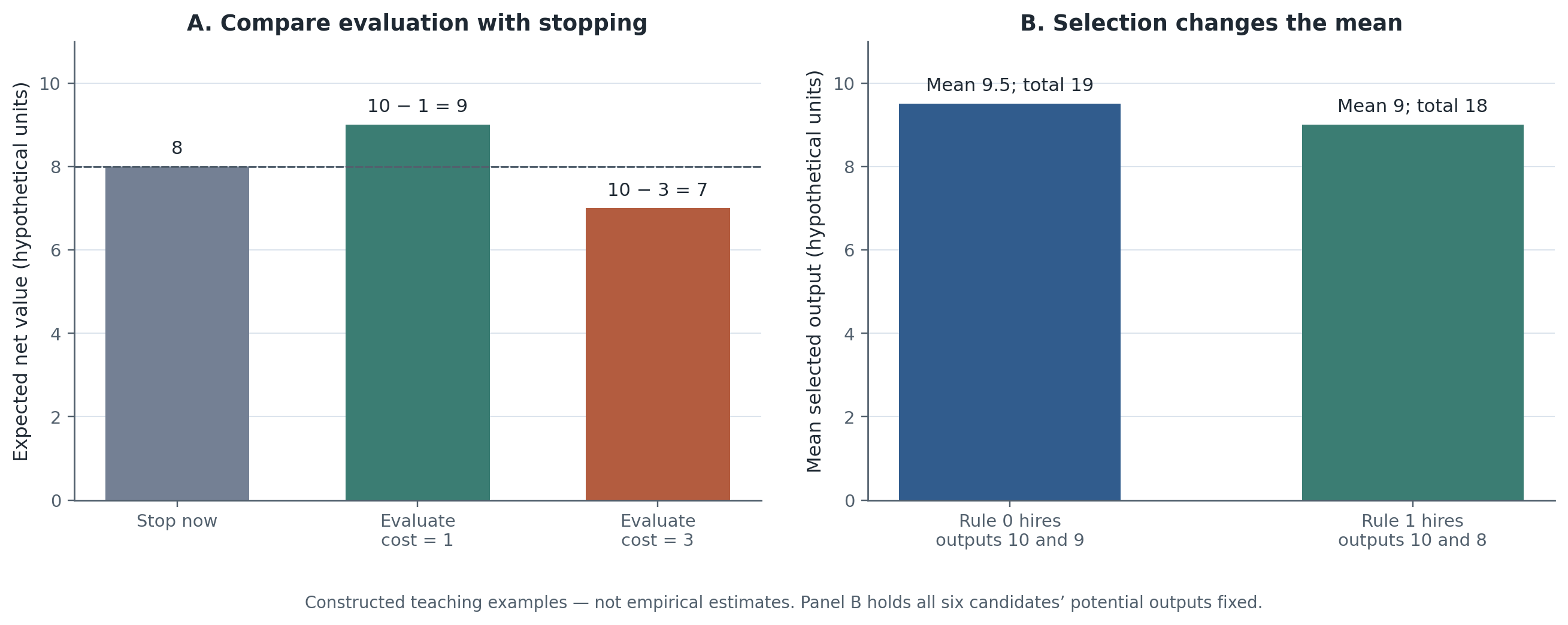
Figure 1:Constructed teaching examples, not empirical estimates. Left: pay for the last evaluation only when its expected value exceeds the stopping payoff. Right: changing the two selected workers changes their average output without changing anyone’s potential productivity. The full six-candidate population has outputs 10, 9, 8, 7, 6, and 5.
A useful firm outcome is production attributable to a fixed set of requisitions over a fixed horizon. Giving unfilled positions zero production in that accounting outcome is legitimate when it matches the question. Coding every rejected candidate’s latent productivity as zero is not. For worker welfare, a rejected applicant’s outside earnings or employment may matter; those are distinct outcomes requiring follow-up or linkage.
Why algorithmic prediction does not solve missingness. Historical labels reflect the previous hiring rule. A model trained only on hires cannot empirically validate its predictions for groups never hired merely by producing scores for them. Li, Raymond, and Bergman’s Hiring as Exploration makes exploration an explicit recruiting objective. Its empirical evaluation is retrospective and a principal quality proxy is eventual hiring among candidates considered for interviews, not universal observed on-the-job productivity Li et al., 2026. Kleinberg and coauthors’ bail application is a methodological comparison for selective labels, not a hiring study Kleinberg et al., 2018.
What additional designs buy. Randomizing a marginal invitation or trial task can generate outcomes on a broader candidate set, but only for the task actually measured. Pallais’s entry-level online labor experiment illustrates how giving workers a job and an evaluation can generate information and affect later opportunities Pallais, 2014. A short paid task is not automatically a complete measure of long-run job performance.
Lee’s bounds offer another route under random assignment and monotone selection. For fixed-slot recruiting, monotonicity is especially questionable: a new rule can hire some previously rejected candidates while rejecting some previously selected candidates. Both directions occur even when the total hiring rate is unchanged. The lab makes this failure visible rather than applying a trimming command by default Lee, 2009.
9. From firm process to a credible empirical design
First, define the treatment. A randomized invitation, interviewer order, test rollout, referral bonus, and algorithmic recommendation are different interventions. A vacancy-level treatment should have vacancy-level outcomes and a record of applicant pathways; an applicant-level intervention must account for competition for shared slots.
Second, choose outcomes that survive selection. From a baseline application cohort, contact, offer, and hire indicators can be measured for everyone if logging is complete. Hire-only output requires a separate interpretation. Applicant welfare can include participation costs, transparency, outside outcomes, and access, not only the firm’s retention rate.
Third, name the comparison and its failure. Randomized scheduling is powerful only within its valid blocks. A staggered test rollout needs a reason untreated sites provide credible counterfactual trends; modern group-time DID addresses particular comparison problems, not endogenous adoption by itself Callaway & Sant'Anna, 2021. A test cutoff supports local RD only when the threshold actually governs treatment and other determinants are appropriately smooth. Manager “leniency” is not automatically a valid IV: managers can alter more than hiring, and assignment need not be random.
Fourth, separate statistical correction from identifying information. Weighting for randomized invitations uses known probabilities and adequate support. Weighting hire-only outcomes using a model does not resolve unobserved selection without extra assumptions. Leave-out scores and cross-fitting can reduce mechanical dependence or leakage; they do not create overlap or make evaluator assignment random. More application rows do not create more independent policy assignments.
Fifth, defend what crosses the firm’s boundary. Kline, Rose, and Walters randomize application characteristics in a large employer correspondence study. It anchors a clean entry-stage outcome: employer contact. It does not reveal rejected applicants’ job performance or identify the causal effect of centralization merely because centralization correlates with contact disparities Kline et al., 2022. A useful broader claim concerns the mechanism and stage actually measured, not every downstream labor outcome.
10. Data resources and research opportunities
A minimum applicant-tracking-system extract should contain stable application and vacancy identifiers; position count; application and evaluation timestamps; recruiter/evaluator identifiers; original and revised scores; the recommendation actually displayed; stage changes with reasons; referral links; compensation and offer dates; acceptance and start dates; and follow-up status. Ask whether edits overwrite history. A final status table can erase the sequence needed for the research design.
For administrative staffing data, distinguish employees from applicants. For survey data, distinguish intended effort from realized effort. The IAB Job Vacancy Survey and linked IABSE-ADIAB resource offer relevant employer information, but the microdata require an access route rather than an unrestricted download. BLS JOLTS public data supply contextual aggregates, not applicant-level screening histories Research Data Centre of the Federal Employment Agency at the Institute for Employment Research, 2026U.S. Bureau of Labor Statistics, 2026.
The interview-sequence article states that its microdata are proprietary; its public archive supplies code, construction information, and empirical moments. Public code is not public microdata. The lab below does not claim access to the original candidate records Radbruch & Schiprowski, 2025Radbruch & Schiprowski, 2024.
Access descriptions checked 21 September 2026. Public documentation or code does not imply public applicant microdata.
Table 2:Recruiting data, access, and minimum usable objects
| Resource / data environment | What it can supply | Access status | Minimum caution / practical request |
|---|---|---|---|
| Applicant-tracking and scheduling logs | Applications, status histories, scores, evaluators, timestamps, offers | Typically employer collaboration; not provided here | Ask for event history rather than overwritten final status; link IDs across applications and vacancies |
| Test-provider records linked to personnel files | Recommendation, test version, manager choice, later tenure/output | Proprietary in the central discretion study Hoffman et al., 2018 | Obtain scores for evaluated applicants, not only hired employees; document score recalibration |
| Referral-program records | Referrer, nominee, timing, eligibility, bonus, employment | Firm-specific agreement; study designs differ | Identify coworkers and nonreferred incumbents; do not retain only successful referrals |
| IAB Job Vacancy Survey / linked IABSE-ADIAB Research Data Centre of the Federal Employment Agency at the Institute for Employment Research, 2026 | Employer recruitment and administrative context | Public documentation; controlled microdata access | Check wave/variable coverage and access application before committing a project |
| BLS JOLTS U.S. Bureau of Labor Statistics, 2026 | Public aggregate openings, hires, separations | Public aggregates, not all establishment microdata | Point-in-time openings and period-flow hires do not measure application transitions |
| Radbruch–Schiprowski interview study Radbruch & Schiprowski, 2024 | Public-code pointer, construction documentation, empirical moments stated in paper | Candidate microdata proprietary; archive files not downloaded here | Do not fabricate a candidate-level replication; use synthetic design reconstruction by default |
| Pallais online-hiring archive Pallais, 2019 | Publicly listed readmes and Stata programs | Archive listing checked; no original worker microdata established by this check | Read terms and dependency notes; archive title is not proof every required file is downloadable |
| Platform postings/applications/responses | Entry restrictions, application choice, employer response | Study-specific; access not assumed | Platform visibility and employer coverage can change over time |
| Included teaching starter | Synthetic interview sessions, funnel, fixed-slot selection | Fully offline Python standard library; no personal data | Parameters are instructor choices; successful recovery verifies the exercise, not the empirical papers |
Suggested extract contract: applicant ID, application ID, vacancy/requisition ID, slot count, site, recruiter/evaluator, timestamps and time zone, original score and version, displayed recommendation, override reason, referral timestamp, offer terms, acceptance, start, exit, and follow-up end. Keep direct identifiers out of the analysis release; use stable pseudonymous keys. Do not upload confidential application text to an external model without authorization and appropriate controls.
Three research proposals connect the evidence to new work without claiming that the questions are wholly unstudied:
Screening capacity versus candidate loss. Randomize reviewer capacity or batch timing at a level that limits resource displacement. Link queue state to withdrawals, offers, starts, and vacancy costs. The key test distinguishes more information from reduced loss of candidates while waiting.
Exploration with meaningful outcomes. Prospectively vary marginal trial invitations among qualified candidates, retain known selection probabilities, and collect standardized output plus worker follow-up. Evaluate the information gained and which applicants benefit, rather than using interview conversion as a synonym for productivity.
Portable, stage-specific barriers. Separate whom job rules discourage from applying, whom screening excludes, and whom employers contact. A September 2026 working paper on posted age limits and employer responses illustrates the value of linked platform stages, while remaining working-paper evidence rather than a settled causal template Feng et al., 2026. Cross-country comparisons should state which rule and stage travel, not equate an identical observed age profile with an identical mechanism.
The data and methods tables turn these proposals into data requests, comparisons, and failure checks. The boundary with Week 9 remains clear: this week studies the recruiting decision; a full analysis of AI adoption and organizational change comes later.
Evidence map for paper discussions
Use this handout map to compare settings, variation, and outcome limits after reading the individual cases.
Use the table as a reading guide. Rows are not claims that every paper identifies the same parameter.
Table 3:Paper → decision → evidence → limitation
| Paper | Organizational decision / data | Research design or object | What students should extract — and not overclaim |
|---|---|---|---|
| Hoffman–Kahn–Li (2018) Hoffman et al., 2018 | Tests and managerial hiring choices | Test introduction and discretion in applicant pools | Reconstruct the manager’s choice set; tenure is one hire outcome, not universal productivity |
| Autor–Scarborough (2008) Autor & Scarborough, 2008 | Retail job testing | Technology rollout; tenure and minority hiring | Evaluate several margins; this is not proof that every hiring score is fair |
| Davis–Faberman–Haltiwanger (2013) Davis et al., 2013 | Establishment vacancies and hires | Measurement plus recruiting-intensity framework | Separate inferred effort from direct observations of screening time |
| Carrillo-Tudela–Gartner–Kaas (2023) Carrillo-Tudela et al., 2023 | Effort, standards, wages, filling | Employer surveys/admin linkage plus model | Explain which statements come from data and which from modeled counterfactuals |
| Forsythe–Weinstein (2025) Forsythe & Weinstein, 2025 | Recruiting recent graduates | Firm survey effort and hire/vacancy patterns | A measured association is not an experimentally induced capacity effect |
| Weinstein (2018) Weinstein, 2018 | Campus recruiting destinations | Screening-cost equilibrium model | The recruited-campus sample is itself selected |
| Dal Bó–Finan–Rossi (2013) Dal Bó et al., 2013 | Public-service recruitment pay | Recruitment/offer experimentation | Separate applicant composition from willingness to accept an offer |
| Deserranno (2019) Deserranno, 2019 | Earnings information about a new job | Recruitment experiment | A pay message can also signal job characteristics |
| Radbruch–Schiprowski (2025) Radbruch & Schiprowski, 2025 | Interview order and subjective ratings | Quasi-random sequence; independent assessments | Define scheduling blocks; lagged decisions alone do not identify contrast effects |
| Burks et al. (2015) Burks et al., 2015 | Referred hires in firm panels | Observational comparison | Referral differences combine selection, information, and other mechanisms |
| Beaman–Magruder (2012) Beaman & Magruder, 2012 | Who receives a referral | Experiment varying referral incentives | Use the intervention to interrogate information and selection |
| Pallais–Sands (2016) Pallais & Sands, 2016 | Why referrals matter | Field experiments distinguishing channels | Map each experimental comparison to its mechanism |
| Friebel et al. (2023) Friebel et al., 2023 | Employee referral program | Store-level randomized introduction | Program-wide effects are not just a referred-versus-nonreferred premium |
| Horton (2017) Horton, 2017 | Employer recommendations | Platform field experiment | Directed outreach can alter consideration; do not infer full market welfare automatically |
| Pallais (2014) Pallais, 2014 | Initial job and evaluation | Online-market experiment | Generating information can change future access; a short task is not every future job |
| Li–Raymond–Bergman (2026) Li et al., 2026 | Resume-screening exploration | Retrospective algorithmic evaluation | Distinguish eventual hiring yield from observed long-run productivity and from a prospective trial |
| Kline–Rose–Walters (2022) Kline et al., 2022 | Employer contact | Randomized correspondence attributes | Contact is an entry-stage outcome; organizational correlations are not organizational experiments |
| Kleinberg et al. (2018) Kleinberg et al., 2018 | Bail decisions, not hiring | Prediction with selectively observed labels | Use as a methodological comparison; do not transfer substantive estimates to employment |
| Feng et al. (2026), working paper Feng et al., 2026 | Posted age restrictions and linked platform stages | Platform evidence and economic model | Optional emerging illustration; inspect the actual cutoff design before calling it an RD |
Methods companions: costly search Weitzman, 1979, monotone-selection bounds Lee, 2009, staggered-rollout comparisons Callaway & Sant'Anna, 2021. These methods do not substitute for the institution-specific assignment argument.
Research Lab
Reproduce
The primary design anchor is Radbruch and Schiprowski (2025). The paper’s proprietary interviews are not included. Use the verified article and archive statement to identify the assignment pools, independent-quality logic, and relevant outcome. An authorized official-data path may be added locally after inspecting the actual release; it is not assumed.
The guaranteed offline path is explicitly synthetic design reconstruction, not replication of published estimates. The included lab generates hypothetical interview sessions with randomized order, a pre-interview score, an evaluator/session effect, and a known sequential-contrast coefficient. Students construct the within-session lag, estimate its simplified session-fixed-effect version, and compute session-clustered uncertainty. The synthetic DGP sets slot effects ; its estimator includes own and previous scores plus session effects, not separate slot indicators. Code and output mark every generated observation as synthetic.
Diagnose
Compare the valid lag with an erroneous lag that crosses sessions. Explain why the first slot cannot be assigned a zero-quality predecessor. Recover the known parameter in the controlled simulation, then explain why successful recovery does not establish the paper’s empirical identifying assumptions.
Next, apply two fixed-capacity hiring rules to the same six-candidate example. Record entry and exit from the selected set, the difference between selected mean and total output, and why Lee-style monotone selection does not follow from an unchanged hiring rate. Keep latent job-output truth in a separate instructor-only synthetic file; the analyst dataset must not accidentally expose outcomes for rejected candidates.
Transfer
Use Hoffman–Kahn–Li and Li–Raymond–Bergman to design a test-versus-discretion or marginal-exploration study. The student memo must specify one rule change, the original applicant risk set, the observed outcome for each stage, the missing performance outcomes, the assignment/inference unit, and the limited claim the design can support. A model-based extrapolation must be labeled separately from the experimental or quasi-experimental estimate.
The lab deliverables are a provenance ledger, interview-event data dictionary, lag-boundary diagnostics, synthetic estimates with clustered standard errors, a selective-label demonstration, a funnel check, and a two-page transfer memo. The lab handout supplies the event schema, execution steps, and transfer memo template.
Methods Box
Table 4:Practical design choices and failure checks
| Question / setting | Usable design or measurement step | What it can identify or describe | What must be checked |
|---|---|---|---|
| Does a test improve hiring? | Randomized rollout when feasible; otherwise documented rollout comparison with pretrends and appropriate group-time effects Callaway & Sant'Anna, 2021 | Effect of introducing the test regime on baseline-cohort or vacancy outcomes | Adoption responds to performance; simultaneous pay/manager changes; newly selected hires |
| Does interview order distort ratings? | Quasi-random order within actual pools + independent candidate-quality measure Radbruch & Schiprowski, 2025 | Sequence-related evaluation response under the assignment assumptions | Cancellations/rescheduling; cross-session lags; contamination of quality with focal ratings |
| Does discretion add information? | Applicant choice sets, displayed recommendation, override reasons, outcome linkage Hoffman et al., 2018 | Evidence comparing recommendation and discretionary choices | Unseen candidate attributes, endogenous override, selective performance |
| Does a referral program work? | Randomize program at site/store; track all incumbents and applicants Friebel et al., 2023 | Assigned program’s overall effect and carefully defined suboutcomes | Referral status is post-treatment; spillovers; few independent sites |
| Does the ad alter the workforce? | Randomized messages/wage information with audience denominator Dal Bó et al., 2013Deserranno, 2019 | Recruitment-offer effect including pool composition | Unknown exposure; application-conditioned selection; messages convey multiple attributes |
| What would rejected candidates do? | Randomized marginal task/interview with known probabilities; task-specific outcome Pallais, 2014 | Outcomes on the newly sampled, supported margin | Limited task validity; noncompliance; no support for never-observed groups |
| Can selection bounds help? | Lee-style bounds only with justified randomization and monotone selection Lee, 2009 | Bounds for the appropriate always-selected group | Fixed-capacity swaps can generate both selection directions; unchanged rate proves nothing |
| Do delayed contacts reduce starts? | Predefined capacity/timing intervention, baseline application risk set, competing-risk ledger | Timing-policy effect, not automatically cost of delay or match surplus | Applicant withdrawals; recruiter resource displacement; age of vacancy versus age of application |
| Is an algorithm better? | Separate training/evaluation, label definition, prospective/offline status, supported policy comparison Li et al., 2026 | Performance against the declared target under evaluation assumptions | Hiring labels inherit previous rules; no universal ground truth; offline evaluation is not an RCT |
| Does the process discriminate? | Randomized correspondence attributes and measured contact outcome Kline et al., 2022 | Causal effect on contact under the audit design | Contact is not hiring; organizational practices are not randomized by the audit |
Inference rule: the dependency and treatment-assignment structure determines independent information. Applications within a vacancy, interviews within a scheduling pool, and workers within a store can share shocks or treatment. Standard-error corrections cannot turn nonrandom assignment into random assignment. Pre-specify what is clustered and why; report cluster counts and interference boundaries.
Reading Ladder And References
Required before class: Hoffman, Kahn, and Li on tests and discretion; Radbruch and Schiprowski on interview sequence; Friebel and coauthors on direct versus overall referral-program effects. These are three different ways to interrogate an organizational process Hoffman et al., 2018Radbruch & Schiprowski, 2025Friebel et al., 2023.
Rotating frontier presentation: Li, Raymond, and Bergman on exploration, or Forsythe and Weinstein on directly measured recruiting effort. Present the outcome and identifying assumptions before presenting the result Li et al., 2026Forsythe & Weinstein, 2025.
Background/research pathways: Hoffman–Stanton for the field map; Weitzman for costly search; Davis–Faberman–Haltiwanger and Carrillo-Tudela–Gartner–Kaas for recruiting intensity; Weinstein for channels; Autor–Scarborough for testing; Dal Bó–Finan–Rossi and Deserranno for applicant selection; the referral experiments and observational studies for mechanism comparison; Pallais, Kleinberg and coauthors, and Lee for selective information; Kline–Rose–Walters for a clean contact-stage experiment; Callaway–Sant’Anna for rollout methods. The reading table assigns a task to each rather than making the whole bibliography compulsory.
Resources: BLS JOLTS definitions; IAB survey/access documentation; the interview paper’s archive statement; and the entry-level online-hiring replication archive. Read each access label before planning a student project U.S. Bureau of Labor Statistics, 2026Research Data Centre of the Federal Employment Agency at the Institute for Employment Research, 2026Radbruch & Schiprowski, 2024Pallais, 2019.
Table 5:Reading ladder and laboratory route
| Role | Reading | Student task |
|---|---|---|
| Required: tests versus judgment | Hoffman–Kahn–Li (2018) Hoffman et al., 2018 | Draw the available applicant choice set and define the later outcome |
| Required: information sequence | Radbruch–Schiprowski (2025) Radbruch & Schiprowski, 2025 | Identify scheduling blocks, quality measurement, and the order-related comparison |
| Required: organizational treatment | Friebel et al. (2023) Friebel et al., 2023 | Separate program ITT from conditional referred-worker differences |
| Rotating frontier | Li–Raymond–Bergman (2026) Li et al., 2026 | Identify selective labels and distinguish offline policy comparison from prospective evaluation |
| Rotating frontier | Forsythe–Weinstein (2025) Forsythe & Weinstein, 2025 | Compare directly reported effort with inferred recruiting intensity |
| Field background | Hoffman–Stanton (2025) Hoffman & Stanton, 2025 | Place the week inside personnel economics, not only algorithmic hiring |
| Theory supplement | Weitzman (1979) Weitzman, 1979 | State the extra assumptions needed for an optimal-search result |
| Recruiting-intensity pathway | Davis et al. (2013); Carrillo-Tudela et al. (2023); Weinstein (2018) Davis et al., 2013Carrillo-Tudela et al., 2023Weinstein, 2018 | Separate vacancies, effort, channels, standards, and model-implied counterfactuals |
| Applicant-selection pathway | Dal Bó et al. (2013); Deserranno (2019) Dal Bó et al., 2013Deserranno, 2019 | Explain why applicant composition is an outcome, not a control to add mechanically |
| Referral pathway | Burks et al.; Beaman–Magruder; Pallais–Sands Burks et al., 2015Beaman & Magruder, 2012Pallais & Sands, 2016 | Compare observational differences with channel-specific experiments |
| Measurement/equity pathway | Autor–Scarborough; Kline–Rose–Walters; Horton Autor & Scarborough, 2008Kline et al., 2022Horton, 2017 | List what each outcome actually measures at the entry stage |
| Selective-information pathway | Pallais; Kleinberg et al.; Lee Pallais, 2014Kleinberg et al., 2018Lee, 2009 | Identify what new observation or assumption is needed for missing performance |
| Optional emerging example | Feng et al. (2026), working paper Feng et al., 2026 | Assess the stage-specific age-barrier evidence without assuming an RD |
Lab modes and deliverables
Table 6:Lab modes and deliverables
| Stage | Guaranteed offline path | Optional official path |
|---|---|---|
| Reproduce | Synthetic design reconstruction of interview sequencing with known DGP parameters | Inspect stated archive materials; use authorized original data only if genuinely available |
| Diagnose | Within-session lags versus cross-session errors; session-clustered uncertainty; fixed-slot selection swap | Reconcile actual comparison pools, documented preprocessing, labels, and reported specifications |
| Transfer | Two-page test/discretion/exploration design using the original applicant risk set | Propose a future data request or experiment, not a claim of available rejected-worker outcomes |
The offline exercise is not an empirical replication of published coefficients. It does not require the optional archive to be reachable and must never fabricate original variable names. Its purpose is to make the paper’s design issues executable in a bounded setting.
Exercises And Discussion Prompts
Derive the nested funnel identity and construct a counterexample where multiplying rates from different cohorts has no hiring-probability interpretation.
Solve the one-step screening example at costs 1 and 3. Which additional observation would you need to distinguish high delay costs from low screening standards in a real firm?
A screening reform raises interview-to-offer conversion but lowers starts per application. Give two mechanisms and one data request that separates them.
Why does a previous evaluator’s yes/no decision require a different identification argument from an independently measured previous candidate quality under quasi-random scheduling?
A new test increases tenure but does not change measured output. Write a defensible conclusion without declaring either result the uniquely correct measure of hire quality.
Use the six-candidate example to show that constant headcount does not imply monotone selection. State the population for which a hire-only outcome comparison is meaningful.
Compare evaluating a referral bonus among referred hires with evaluating the program across all assigned stores. Which effects disappear in the first analysis?
Submit the two-page recruiting-funnel memo: intervention, baseline risk set, stage ledger, counterfactual, selection problem, inference, data access, and one economically meaningful limitation.
Reproducibility And Code Lab Note
Download the teaching repository (ZIP), or clone the repository. Keep its folder structure and open books/special-topic8-organizational/labs/02-recruiting-screening-and-entry-into-organizations/; the lab README supplies the run instructions. Weeks 1–3 use the shared plotting module supplied with the repository.
The Week 2 lab handout guides Reproduce, Diagnose, and Transfer. From labs/02-recruiting-screening-and-entry-into-organizations/, run:
ENV_NAME=research bash smoke.shThe core src/offline_lab.py uses Python’s standard library; the teaching chart uses the repository’s existing Matplotlib environment. The smoke generates 96 synthetic interview sessions, estimates the teaching equation, checks valid and invalid lag constructions, masks rejected-candidate outcomes in the analyst data, rejects a non-nested funnel, verifies a fixed-slot selection swap, and checks a deterministic rerun. No internet, API, private microdata, or credential is needed. Outputs state synthetic design reconstruction, with empirical_replication: false; coefficient recovery verifies this exercise rather than the article’s empirical findings.
The separately stored instructor truth is for the explicitly synthetic diagnosis. It is not information available to a real hiring analyst. The optional empirical archive route is not implemented; the published paper’s proprietary interviews are not included.
Rebuild the chapter’s hypothetical figure from this book directory:
conda run -n research python assets/scripts/build-week2-screening.pySlide Companion Note
The Week 2 slide deck (PDF) develops the funnel, costly evaluation, paper designs, selective labels, and research lab. Its companion Beamer source follows the Week 1 style. The full deck supports an extended session or two meetings; the chapter’s paper and reading maps provide the longer handout material.
Bridge Forward
Entry determines which workers begin producing information inside the organization. Week 3 asks how employers learn from their output, quality, ratings, tasks, and supervisors once they arrive. Carry forward the distinction between changing worker performance and changing who is observed: it remains central when studying monitoring and employer learning.
- Hoffman, M., Kahn, L. B., & Li, D. (2018). Discretion in Hiring. The Quarterly Journal of Economics, 133(2), 765–800. 10.1093/qje/qjx042
- Hoffman, M., & Stanton, C. T. (2025). People, Practices, and Productivity: A Review of New Advances in Personnel Economics. In Handbook of Labor Economics (Vol. 6, pp. 729–818). Elsevier. 10.1016/bs.heslab.2025.07.005
- Davis, S. J., Faberman, R. J., & Haltiwanger, J. C. (2013). The Establishment-Level Behavior of Vacancies and Hiring. The Quarterly Journal of Economics, 128(2), 581–622. 10.1093/qje/qjt002
- U.S. Bureau of Labor Statistics. (2026). Job Openings and Labor Turnover Survey: Definitions. https://www.bls.gov/jlt/jltdef.htm
- Weitzman, M. L. (1979). Optimal Search for the Best Alternative. Econometrica, 47(3), 641–654. 10.2307/1910412
- Weinstein, R. (2018). Employer Screening Costs, Recruiting Strategies, and Labor Market Outcomes: An Equilibrium Analysis of On-Campus Recruiting. Labour Economics, 55, 282–299. 10.1016/j.labeco.2018.10.007
- Dal Bó, E., Finan, F., & Rossi, M. A. (2013). Strengthening State Capabilities: The Role of Financial Incentives in the Call to Public Service. The Quarterly Journal of Economics, 128(3), 1169–1218. 10.1093/qje/qjt008
- Deserranno, E. (2019). Financial Incentives as Signals: Experimental Evidence from the Recruitment of Village Promoters in Uganda. American Economic Journal: Applied Economics, 11(1), 277–317. 10.1257/app.20170670
- Carrillo-Tudela, C., Gartner, H., & Kaas, L. (2023). Recruitment Policies, Job-Filling Rates, and Matching Efficiency. Journal of the European Economic Association, 21(6), 2413–2459. 10.1093/jeea/jvad034
- Forsythe, E., & Weinstein, R. (2025). Recruiting Intensity, Hires and Vacancies: Evidence from Firm-Level Data. The Economic Journal, 135(669), 1734–1748. 10.1093/ej/ueaf002
- Radbruch, J., & Schiprowski, A. (2025). Interview Sequences and the Formation of Subjective Assessments. The Review of Economic Studies, 92(2), 1226–1256. 10.1093/restud/rdae039
- Autor, D. H., & Scarborough, D. (2008). Does Job Testing Harm Minority Workers? Evidence from Retail Establishments. The Quarterly Journal of Economics, 123(1), 219–277. 10.1162/qjec.2008.123.1.219
- Burks, S. V., Cowgill, B., Hoffman, M., & Housman, M. (2015). The Value of Hiring through Employee Referrals. The Quarterly Journal of Economics, 130(2), 805–839. 10.1093/qje/qjv010
- Beaman, L., & Magruder, J. (2012). Who Gets the Job Referral? Evidence from a Social Networks Experiment. American Economic Review, 102(7), 3574–3593. 10.1257/aer.102.7.3574
- Pallais, A., & Sands, E. G. (2016). Why the Referential Treatment? Evidence from Field Experiments on Referrals. Journal of Political Economy, 124(6), 1793–1828. 10.1086/688850