Wage Posting, Bargaining, and Wage-Setting
Learning Objectives
By the end of Week 5, students should be able to:
explain why a search model is incomplete until it specifies how wages are set;
distinguish posted wages, individualized bargaining, standardized pay rules, and collective or administrative wage-setting;
explain how search frictions generate wage dispersion, job ladders, and retention pressure even among similar workers;
separate reservation wages, outside offers, the value of nonemployment, and bargaining threat points;
connect wage-setting protocols to rent-sharing, pass-through, and firm wage premia without collapsing those objects together;
evaluate empirical evidence by naming the identifying variation, observed unit, observed margin, and the key latent object left unresolved;
connect Week 4 search models to Week 6 monopsony and labor market power.
Opening Orientation
The economic question for Week 5 is central to Labor II: once a worker and a firm meet in a frictional labor market, what protocol converts match surplus into pay, and how can we tell in the data whether the relevant protocol is posting, bargaining, a standardized wage rule, or something in between Burdett & Mortensen, 1998Hall & Milgrom, 2008Mortensen, 2003?
Bridge
Week 4 taught students to think in terms of meetings, hazards, separations, and job ladders. But a meeting technology does not by itself determine wages. Once outside options, employed search, and retention pressure exist, the wage is no longer an anonymous competitive parameter. It becomes the outcome of a wage-setting protocol: a posted wage, a bargained wage, a rule-based schedule, or a pay outcome constrained by internal or institutional norms.
The bridge back to Week 4 is therefore precise. Search theory gave us unemployment-to-employment hazards, employment-to-employment mobility, and vacancy-filling congestion. Week 5 asks how those same flow objects discipline the wage each match receives. The bridge forward to Week 6 is equally precise. Week 5 is about the protocol that maps surplus into wages. Week 6 is about the elasticity and conduct environment in which that protocol operates.
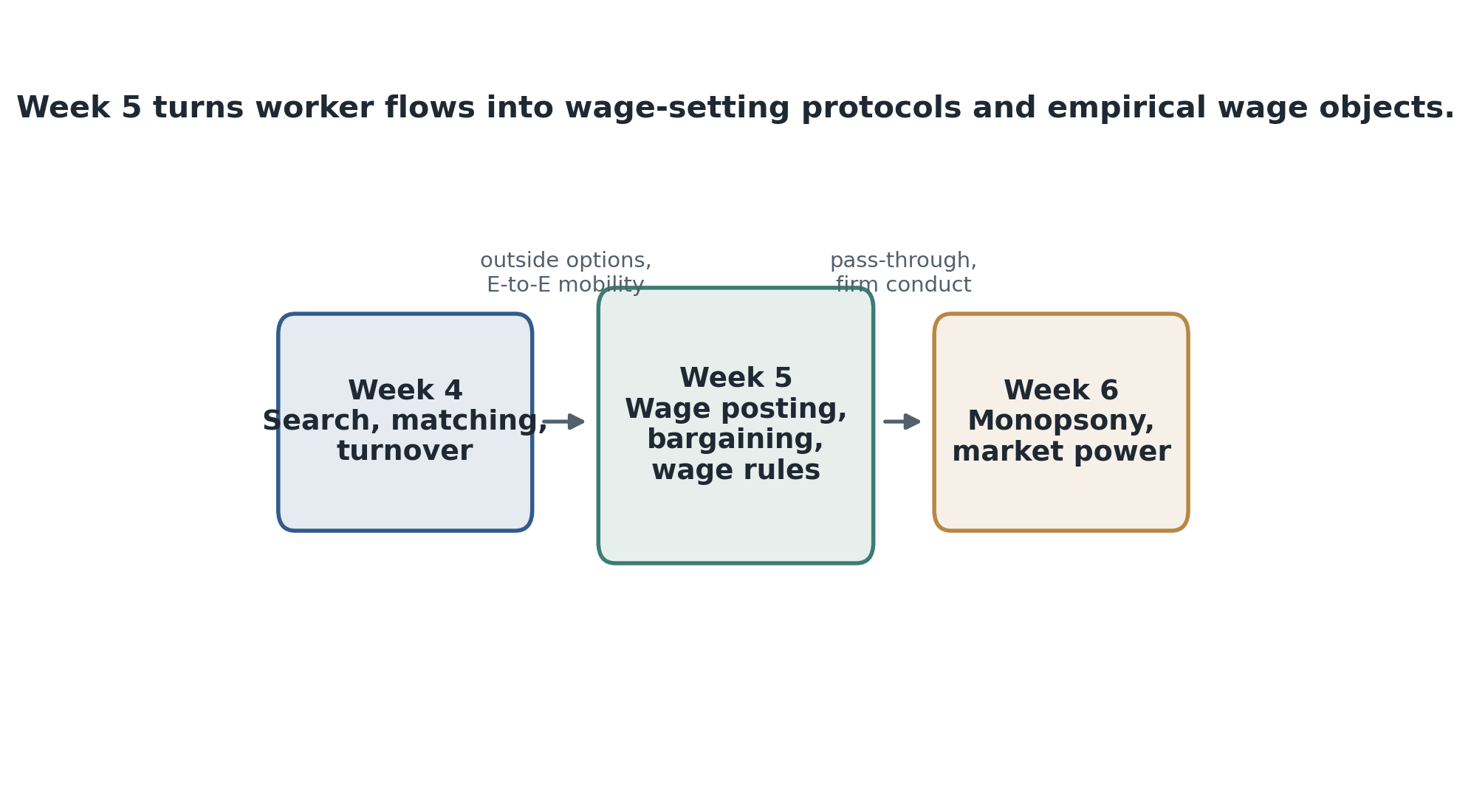
Figure 1:Week 5 sits between search and monopsony. It converts worker flows and outside options into wage-setting protocols, then turns those protocols into empirical wage objects.
Figure Figure 1 is the course repositioning figure for the week. Wage-setting is the bridge from search as a mobility theory to later topics such as labor market power, policy incidence, and firm wage premia.
Why search models need a wage-setting protocol
Under a competitive benchmark, the wage is the market-clearing price of labor and identical workers in identical jobs should not exhibit persistent wage dispersion once relevant amenities and productivity are held fixed. That benchmark is analytically useful, but it is not a sufficient description of the frictional labor market students saw in Week 4. If offers arrive sequentially, vacancies take time to fill, employed workers receive outside opportunities, and firms worry about retention, then identical matches need not pay identical wages Mortensen, 2003.
The acceptance problem is already enough to see the break from the competitive benchmark:
Equation (1) says that employment is accepted when the value of the job at wage exceeds the value of nonemployment . This is only an acceptance object. It is not yet a posting object, a bargaining object, or a standardized wage rule. That distinction is the organizing logic of the entire week.
Table 1:Wage-setting regimes map for Week 5
| Regime | Core idea | Wage object | Main observables | Canonical papers | Common empirical challenge |
|---|---|---|---|---|---|
| Competitive benchmark | Wage equals marginal product in an integrated market | Market-clearing wage | Worker wages and market conditions | Intro benchmark; foil for all later regimes | Hard to reconcile with persistent firm wage premia and search frictions |
| Wage posting | Firm chooses a wage anticipating recruiting and retention responses | Posted wage schedule | Offer distributions, separations, job ladders, wage dispersion | Burdett & Mortensen, 1998; Lachowska et al., 2022 | Distinguishing true posting from constrained bargaining |
| Bilateral bargaining | Worker and firm split surplus after meeting | Negotiated wage | Wage responses to outside options, rejected offers, pass-through | Hall & Milgrom, 2008; Jäger et al., 2020 | Outside option and threat point are usually latent |
| Standardized pay | Firm or institution constrains pay by schedule, grade, or seniority | Rule-based wage cell | Pay grids, compression, within-job variance, mover selection | Biasi, 2021; Massenkoff & Wilmers, 2023 | Rules often coexist with informal discretion |
| Discretionary pay | Managers or decentralized units adjust pay case by case | Flexible or negotiated wage | Within-job dispersion, response to offers, management practice | Massenkoff & Wilmers, 2023; Caldwell et al., 2025 | Hard to observe the underlying pay protocol directly |
| Collective / coordinated setting | Sectoral, firm-level, or formal collective bargaining constrains wage outcomes | Contracted wage floor or schedule | Coverage, contract terms, spillovers, compression | Bhuller et al., 2022 | Institutions shape both wages and outside options simultaneously |
Table Table 1 is the opening taxonomy. It is useful because it says exactly what is endogenous in each regime. Under posting, the firm chooses a wage schedule while anticipating recruiting or retention responses. Under bargaining, the wage is a joint outcome. Under standardized pay, the match does not fully customize the wage at all. Under discretionary pay, managerial choice or local bargaining may matter even inside a large firm.
Field Core
Competitive wages versus frictional wage setting
The clean benchmark contrast is this: in a competitive model, labor supply to a single firm is effectively infinitely elastic at the market wage, so a given firm does not need a separate wage-setting problem. In a frictional setting, labor supply to the firm is shaped by search, turnover, and outside options. Wages therefore depend on how the firm recruits and retains workers, how the worker can leave, and whether internal wage rules compress or decentralize pay.
That is why Week 5 treats “wage-setting” as a protocol for converting surplus into pay rather than as a synonym for “the wage equation.” Two jobs can face the same product market and the same production technology yet pay differently because the wage-setting protocol differs. A salary schedule, a take-it-or-leave-it posted wage, and a bilateral negotiation do not load the same information into wages.
Wage posting, search, and the logic of wage dispersion
The canonical posted-wage object begins with a firm choosing compensation while anticipating how recruiting and retention respond:
where is match productivity and is the labor supply or staffing response induced by the posted wage. Equation (2) is the basic logic behind wage posting: the firm picks a wage because the wage changes both profits per worker and the probability of attracting and keeping workers Burdett & Mortensen, 1998.
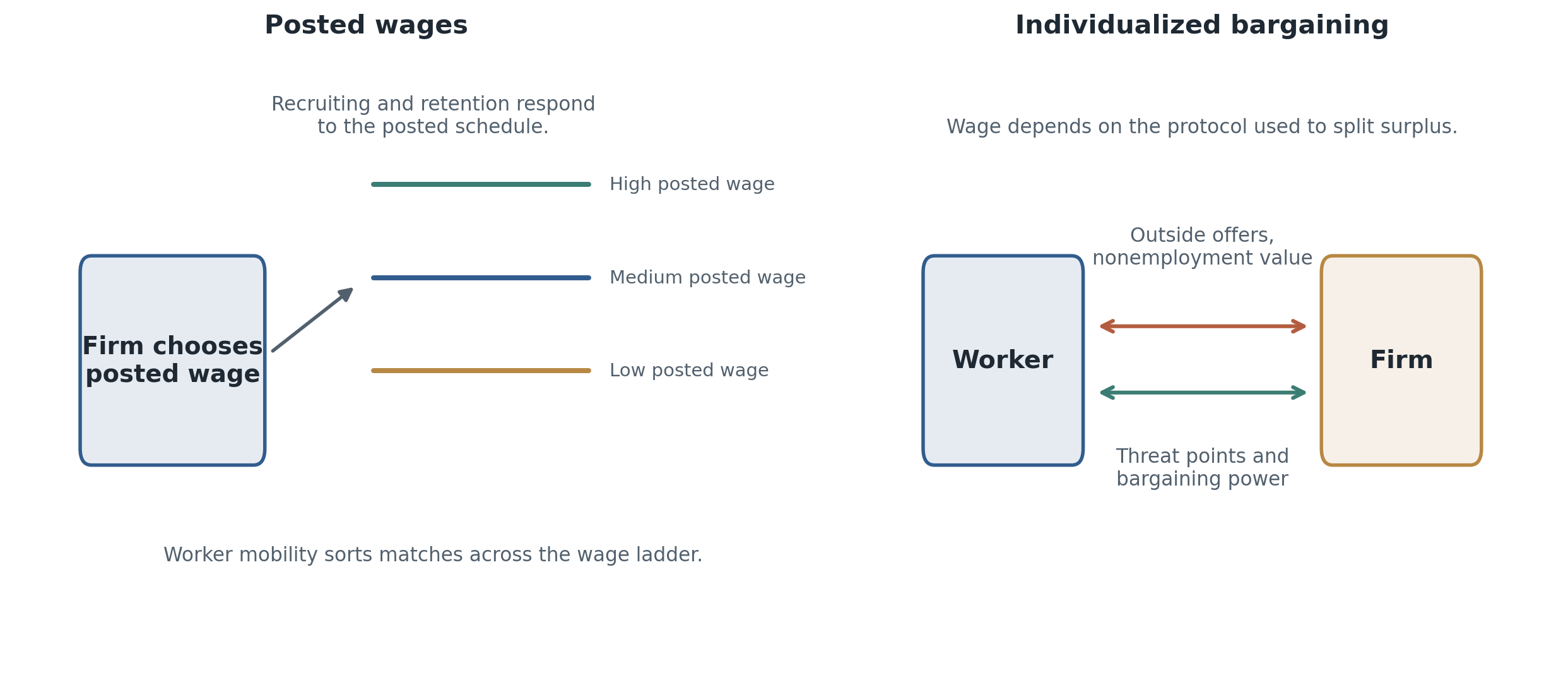
Figure 2:Posted wages and individualized bargaining solve different economic problems. Posting makes the wage part of the firm’s recruiting strategy, while bargaining makes it part of a bilateral surplus-splitting protocol.
In the Burdett--Mortensen logic, on-the-job search means some firms post higher wages to retain workers who can otherwise climb the job ladder. Wage dispersion then need not signal only heterogeneous productivity. It can reflect equilibrium wage-setting in a frictional market with employed search, poaching, and retention Burdett & Mortensen, 1998Mortensen, 2003. The posted wage object is therefore not just an offer level. It is also a recruiting and retention policy.
This is the first place to connect directly back to Week 4. Job ladders create a worker-side mobility option even when an observed outside offer is not in hand. That is why a posted-wage equilibrium can generate persistent wage dispersion and systematic quit patterns without requiring a fresh bilateral negotiation in every match.
Lachowska et al., 2022 is especially useful here because it asks whether wage changes in one job transmit to another job held by the same worker. The identifying variation comes from shocks to compensation in a worker’s secondary job. The unit of observation is the dual-jobholder spell. The observed margins are primary-job wage responses and separations. The key latent object is the full menu of unobserved offers and employer responses available to the worker. That makes the paper ideal for Week 5: it is explicit about the difference between a posting prediction and a bargaining prediction.
Bargaining, outside options, and the Hall--Milgrom critique
The bilateral bargaining benchmark shifts the wage from a one-sided posting choice to a joint surplus-splitting problem:
where summarizes worker bargaining power, is the worker surplus from employment, and is the firm’s continuation surplus. Equation (3) is deliberately compact, but it makes clear that the wage is no longer chosen only by the firm.
Table 2:Bargaining objects and observables for Week 5
| Object | Definition | Why it matters | Directly observed? | Typical proxy or design | Frequent mistake |
|---|---|---|---|---|---|
| Reservation wage | Lowest acceptable wage for a worker at a point in time | Governs acceptance decisions | Rarely | Surveys, duration models, offer histories | Treating reservation wages as identical to current outside options |
| Outside offer | Concrete offer from another employer | Can discipline current pay or trigger separation | Sometimes | Dual jobholders, matched offer data, survey offers | Confusing realized offers with the value of nonemployment |
| Value of nonemployment | Value of the worker’s fallback if not employed | Primitive object in many bargaining and posting models | No | Policy shocks to benefits, local conditions, quasi-experimental nonemployment value changes | Treating UI generosity or unemployment rate as the object itself |
| Threat point | Payoff relevant during negotiation breakdown or delay | Determines bargained wage under specific protocol | No | Theoretical assumption plus institutional setting | Equating threat points mechanically with exit payoffs |
| Firm wage premium | Persistent firm-specific pay component | Connects wage-setting to firm heterogeneity and rents | Indirectly | Matched worker-firm data, AKM-style decompositions | Reading the premium as a fully structural wage-setting parameter |
| Rent-sharing / pass-through | Wage response to firm surplus or shocks | Measures how firm conditions translate into wages | Indirectly | Productivity shocks, demand shocks, policy cost shocks | Ignoring sorting and composition changes |
Table Table 2 is essential because the Week 5 vocabulary is often misused. A reservation wage is an acceptance cutoff. An outside offer is a realized alternative. The value of nonemployment is a fallback-value object. A threat point is protocol-specific: it depends on what happens if bargaining breaks down or is delayed. These are not interchangeable terms.
Hall and Milgrom’s contribution is exactly to challenge the idea that the relevant threat point is always immediate exit into unemployment. If bargaining can break down into delay rather than permanent separation, the link between unemployment conditions and wages can be weaker than a simple outside-option interpretation suggests Hall & Milgrom, 2008. That matters for comparative statics and for empirical interpretation. A weak reduced-form link between unemployment and wages does not by itself imply that outside options are irrelevant. It may instead imply that the bargaining protocol is different.
Wages and the value of nonemployment
Week 5 also needs a careful section on a modern empirical object that students often conflate with observed outside offers:
Equation (4) asks how much an exogenous change in the value of nonemployment passes through to wages. The object is more primitive than a realized competing offer. It includes benefits, expectations, search conditions, and other determinants of the worker’s fallback value.
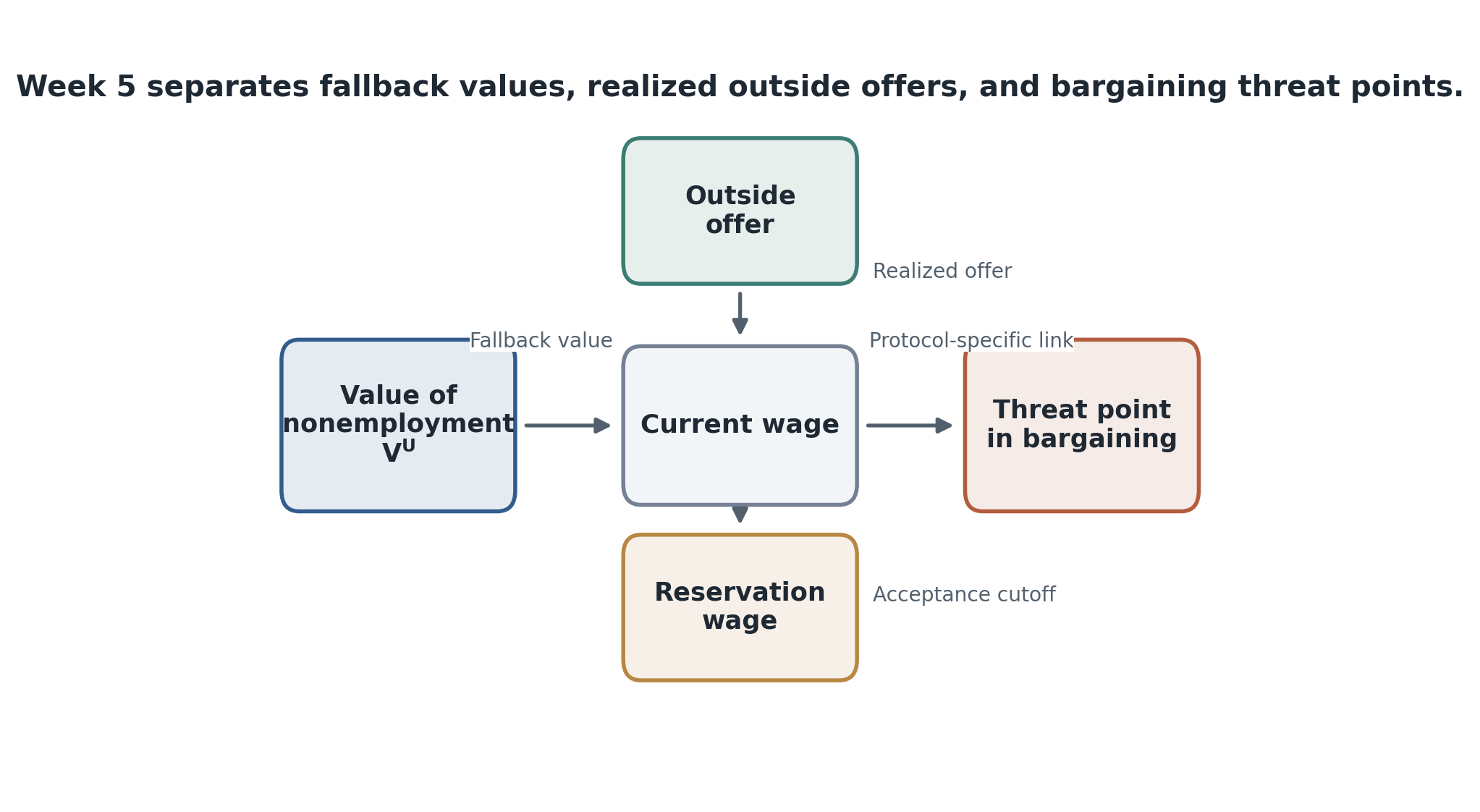
Figure 3:Week 5 separates the value of nonemployment, realized outside offers, reservation wages, and bargaining threat points. Empirically, these objects are related but not identical.
Jäger et al., 2020 is the field-core empirical anchor because the paper names the object explicitly. The identifying variation comes from quasi-experimental shifts in fallback values. The unit of observation is the worker or worker-firm relationship. The observed margin is wage pass-through. The key latent object is the full dynamic opportunity set facing the worker, including any unobserved offers and beliefs about future search. This is exactly why the paper belongs in Week 5 rather than only in a policy week: it teaches students to separate the value of nonemployment from a realized outside offer.
Week 5 should also be explicit that pass-through from outside-option shocks and pass-through from firm shocks are different empirical questions. A wage response to more generous nonemployment benefits is not the same object as a wage response to higher firm value added. The first speaks to fallback values. The second speaks to rent-sharing. Conflating the two makes later monopsony discussions much less clear.
Standardized versus discretionary wage-setting inside firms
The interior of the firm matters because many large employers do not bargain from scratch for every job. Some use grades, steps, internal equity rules, or occupation-level pay cells. Others leave more room for manager discretion, individualized offers, or responses to outside bids.
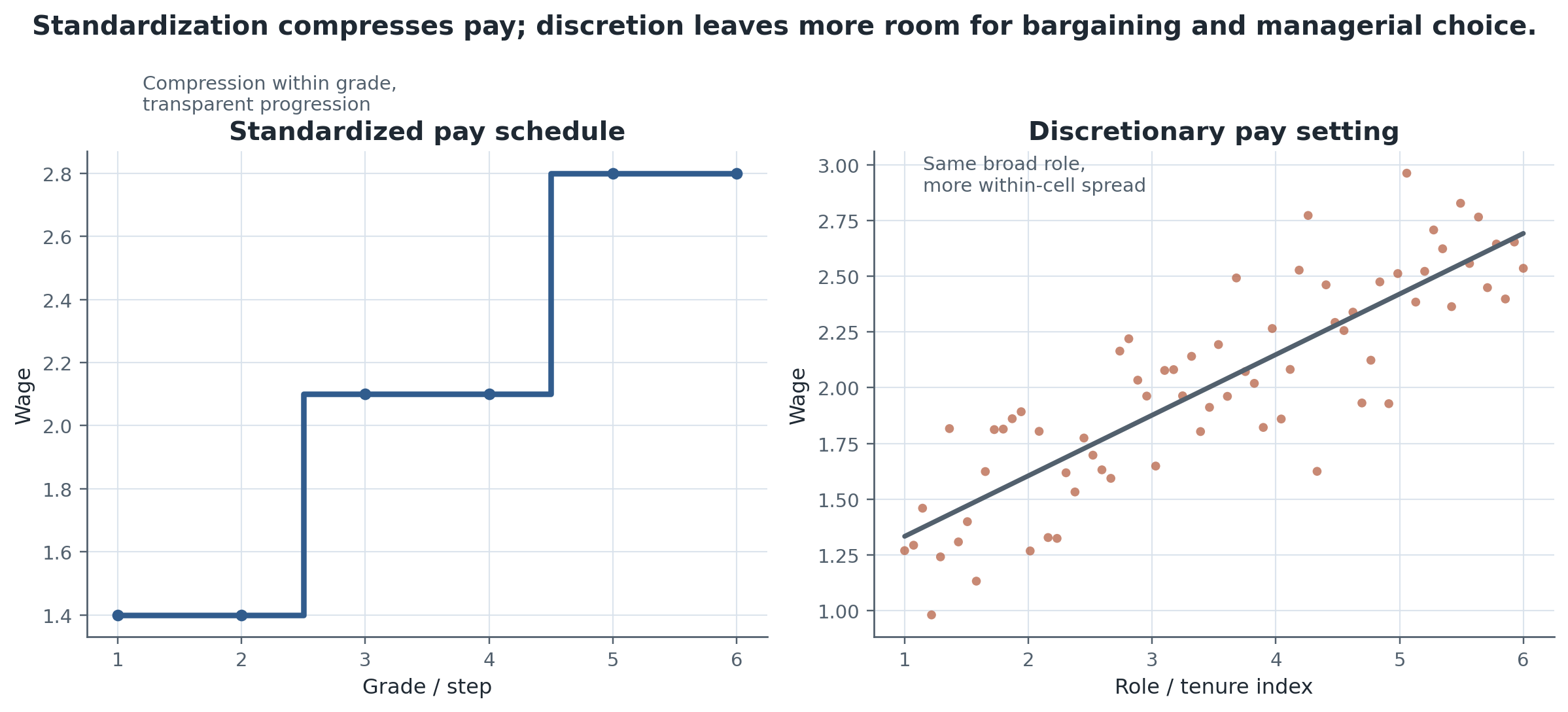
Figure 4:Standardized pay compresses wages within job cells and makes progression more transparent. Discretionary pay leaves more room for bargaining, local managerial choice, and within-cell inequality.
Massenkoff & Wilmers, 2023 is a good empirical bridge because it studies the decline of standardized pay rates and links that decline to wage stagnation and changing within-firm wage-setting practices. The identifying variation comes from changes in observed rate structures over time. The unit of observation is the occupation-establishment or worker-job cell. The observed margins include the prevalence of standardized rates, wage compression, and within-cell dispersion. The key latent object is the informal discretion that may coexist with formal schedules. Biasi, 2021 adds a policy-relevant version of the same logic: teacher labor markets reveal how salary schedules and flexible pay generate different sorting and staffing outcomes, with school districts or teachers as the observed units and the nonwage job bundle still partly latent.
The main Week 5 lesson is not that one regime is universally better. It is that the wage rule itself is a substantive economic object. Standardization can compress wages and limit within-job bargaining. Discretion can facilitate targeted retention and local adaptation, but it can also amplify inequality and obscure the wage-setting protocol that students are trying to identify.
Empirical designs and what they identify
Table 3:Identification and pass-through map for Week 5
| Design family | What varies | Unit of observation | Margin observed | Wage-setting question answered | Main limitation |
|---|---|---|---|---|---|
| Dual jobholders / revealed-preference test | Wage shocks in a secondary job or outside option | Worker-job spell | Wage response versus separation response | Posting or bargaining? | Requires specialized worker histories and strong behavioral assumptions |
| Policy or institutional reform to pay rules | Contract expiration, schedule reform, flexibility reform | Worker, establishment, or district | Wage dispersion, mobility, sorting, composition | How do pay rules shape wages and worker allocation? | Pay-rule change may affect many margins at once |
| Outside-option / nonemployment value shock | Benefits, eligibility, or fallback value changes | Worker or matched worker-firm panel | Wage pass-through, mobility, retention | How much do fallback values matter for pay? | Outside option often remains partially latent |
| Matched worker-firm data with firm shocks | Productivity, value added, or revenue shocks at firm level | Worker-firm match | Wage pass-through, firm premia, rent-sharing | How much of firm-side rents reach workers? | Sorting, match quality, and composition may confound pass-through |
| Establishment-by-occupation wage-rule data | Standardization versus discretion within workplaces | Occupation-establishment cell | Pay compression, within-cell dispersion | Are wages set by schedule or by discretion? | Detailed wage-rule data are rare |
| Survey-based bargaining evidence | Reported offers, negotiation, beliefs, attachment | Worker or firm | Self-reported protocol and perceptions | What do workers and firms say they do when setting pay? | Survey responses may not map one-to-one into structural primitives |
Table Table 3 should organize the empirical lecture by design family rather than by chronology.
Dual-jobholder or revealed-preference tests use wage shifts in a secondary job or in a realized outside opportunity. The unit is the worker-job spell. The observed margin is whether wages respond in-place or whether separation is the main adjustment margin. The hardest latent object is the full offer set the worker faces, not only the realized second job. That is why Lachowska et al., 2022 is informative but not fully structural.
Policy or institutional reforms to pay rules use contract expirations, salary-schedule changes, or flexibility reforms. The unit may be the worker, school district, or establishment. The observed margins are wage compression, mobility, sorting, and composition. The hardest latent object is the set of simultaneously changing nonwage conditions. Biasi, 2021 is especially useful because the pay rule changes are clear while amenities and mission differences remain important.
Outside-option or nonemployment-value designs use shocks to benefits, eligibility, or fallback values. The unit is typically the worker or worker-firm match. The observed margin is wage pass-through, mobility, or retention. The hardest latent object is the full counterfactual search environment that the worker expects.
Matched worker-firm designs with firm shocks use variation in value added, productivity, demand, or revenues. The unit is the worker-firm relationship. The observed margin is wage pass-through, firm wage premia, or rent-sharing. The hardest latent object is how much of the wage effect reflects sorting, match quality, or changing composition. Card et al., 2018 and Rudanko, 2023 are the natural anchors here because they separate firm wage premia, wage dispersion, and frictional wage setting without claiming that reduced-form pass-through by itself fully identifies the protocol.
Survey and establishment-by-occupation evidence on wage rules or bargaining protocols can say much more about what firms report doing, but it remains difficult to map self-reports one-to-one into structural primitives. Caldwell et al., 2025 is a useful frontier anchor precisely because bargaining intensity, wage inequality, and protocol heterogeneity are likely to coexist inside the same labor market.
Rent-sharing, pass-through, and the bridge to market power
The firm-side pass-through object that bridges Week 5 to Week 6 can be written compactly as
Equation (5) treats wage-setting as the transmission of a firm-side shock into pay. The object is not a complete structural wage-setting parameter. It is a reduced-form pass-through object whose interpretation depends on sorting, bargaining, internal wage rules, and the elasticity of labor supply to the firm Card et al., 2018Rudanko, 2023.
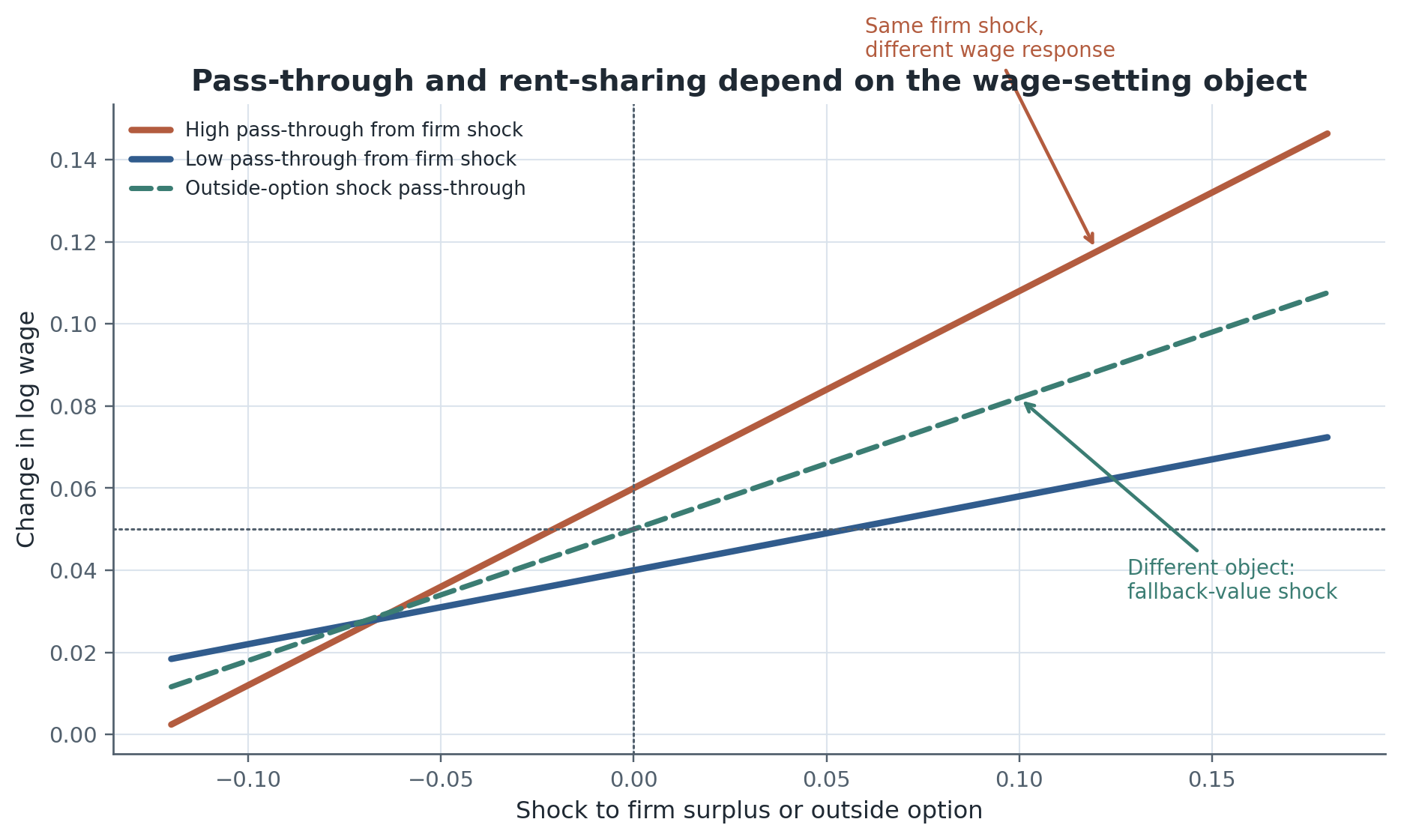
Figure 5:Pass-through depends on which shock moves the problem. Wage responses to firm-side surplus shocks and wage responses to outside-option shocks are related but distinct empirical objects.
This is the key bridge to Week 6. Week 5 says that posted wages, bargaining, and wage rules determine how a given match responds to opportunities and shocks. Week 6 will ask how much conduct power firms have because workers do not face perfectly elastic labor supply. The two weeks are complements. Wage posting and bargaining are protocols; monopsony is about the labor-supply and conduct environment in which those protocols operate.
Research Lab
The optional extension block for Week 5 should feel like a research workshop on wage-setting heterogeneity, not a miscellaneous appendix. One strong line of inquiry asks how worker beliefs about outside options shape bargaining and retention. A second asks how within-firm inequality changes when more pay is discretionary rather than standardized. A third asks how pay transparency, salary-history restrictions, or algorithmic offer management reshape the mapping from outside options to wages. A fourth asks how measured pass-through interacts with monopsony metrics once the firm’s labor supply curve is not infinitely elastic Massenkoff & Wilmers, 2023Rudanko, 2023Caldwell et al., 2025.
Bhuller et al., 2022 is useful for the frontier discussion because it reminds students that collective bargaining and coordinated wage-setting are not merely policy add-ons. They are alternative wage-setting protocols that can compress pay, reshape outside options, and change what a bargaining or pass-through estimate means. The extension block should therefore ask students to name the data opportunity, the identifying variation, the observed margin, and the unresolved latent object in any frontier paper they read.
The bounded Week 5 lab follows Reproduce -> Diagnose -> Transfer. The reproduction anchor is Lachowska et al., 2022, where the protocol under test is posting versus bargaining and the key observed margin is whether a wage shock in one job changes wages or separations in another job held by the same worker. The transfer anchor is Massenkoff & Wilmers, 2023, where the protocol under study is a wage-rule change from standardized to less standardized pay, and the key observed margin is compression versus dispersion within comparable job cells. Biasi, 2021 is the optional extension because public teacher salary schedules make it easier to transfer the same logic to open data.
Methods Box
Week 5 only works if the objects stay separate.
Posted wages versus individualized bargaining versus standardized wage schedules: these are different protocols, not interchangeable labels for “the wage.”
Reservation wages versus outside offers versus the value of nonemployment: an acceptance cutoff, a realized alternative, and a fallback value are not the same object.
Worker outside options versus bargaining threat points: the relevant disagreement payoff depends on the bargaining protocol, especially once Hall--Milgrom-style delay is allowed.
Pass-through from firm shocks versus pass-through from outside-option shocks: both are wage responses, but they move different primitives.
Firm wage premia versus worker sorting versus match-specific rents: a firm effect in matched data is not automatically a pure bargaining or monopsony parameter.
Reduced-form rent-sharing evidence versus structural wage-setting interpretation: pass-through estimates discipline theory, but they do not on their own reveal the entire protocol or all equilibrium spillovers.
Evidence without design language is not enough: every empirical result in this week should be reported with the identifying variation, unit of observation, observed margin, and most important latent object.
Reading Ladder And References
Required / field core
Burdett & Mortensen, 1998 for wage posting, job ladders, and equilibrium wage dispersion.
Hall & Milgrom, 2008 for why bargaining protocol assumptions matter and why delay can weaken the unemployment-wage link.
Jäger et al., 2020 for the value of nonemployment as a wage-setting object.
Lachowska et al., 2022 for a direct empirical test of posting versus bargaining using dual jobholders.
Strong empirical complements
Massenkoff & Wilmers, 2023 for standardized versus discretionary pay-setting inside firms.
Biasi, 2021 for salary schedules, flexible pay, and worker sorting in teacher labor markets.
Card et al., 2018 for firm wage premia, inequality, and the limits of a purely worker-side wage interpretation.
Optional / frontier / bridge to Week 6
Mortensen, 2003 for the broader frictional wage-setting perspective.
Rudanko, 2023 for firm wages in a frictional labor market and the bridge to market power.
Bhuller et al., 2022 for collective bargaining as a wage-setting protocol rather than an institutional afterthought.
Caldwell et al., 2025 for frontier work on bargaining and inequality.
Exercises And Discussion Prompts
Use Equation (1) to explain why a reservation wage is not the same thing as a realized outside offer.
Compare Equations (2) and (3). Which margins move if the worker receives a stronger outside option under each protocol?
Why does Hall--Milgrom imply that a weak empirical unemployment-wage gradient need not mean that wage-setting is purely rigid?
In Lachowska et al., 2022, what varies, what unit is observed, what margin is observed, and what key wage-setting object remains latent?
In Jäger et al., 2020, why is the value of nonemployment conceptually more primitive than an observed outside offer?
Use Figure Figure 4 to explain how standardized and discretionary pay regimes could produce different within-job wage distributions even with similar workers.
Why does Equation (5) not by itself reveal whether observed wage pass-through reflects bargaining, firm wage premia, or match-specific rents?
Propose one transfer design using a public teacher salary schedule dataset, a public contract dataset, or a small synthetic offer-and-separation panel. Name the observed unit, the observed margin, and the main latent object.
Reproducibility And Code Lab Note
The Week 5 lab is built around Reproduce -> Diagnose -> Transfer. The bounded reproduction path uses a local synthetic dual-jobholder panel inspired by Lachowska et al., 2022 so students can measure whether an outside wage shock primarily changes incumbent wages or separations. The diagnose step forces students to say whether the paper is testing posting or bargaining, what the observed outside-option margin is, what the main identification challenge is, and what remains latent. The transfer step then uses a synthetic wage-rule panel anchored to Massenkoff & Wilmers, 2023 so students can compare standardized and discretionary pay compression, while Biasi, 2021 is the optional extension to public teacher salary schedules. The local handout lives at lab.md.
Slide Companion Note
The slide deck at 05
Bridge Forward
Use this closing bridge to carry the module’s labor object, mechanism, and evidence into the next course step or research-design exercise.
- Burdett, K., & Mortensen, D. T. (1998). Wage Differentials, Employer Size, and Unemployment. International Economic Review, 39(2), 257–273. 10.2307/2527292
- Hall, R. E., & Milgrom, P. R. (2008). The Limited Influence of Unemployment on the Wage Bargain. American Economic Review, 98(4), 1653–1674. 10.1257/aer.98.4.1653
- Mortensen, D. T. (2003). Wage Dispersion: Why Are Similar Workers Paid Differently? MIT Press.
- Lachowska, M., Mas, A., Saggio, R., & Woodbury, S. A. (2022). Wage Posting or Wage Bargaining? A Test Using Dual Jobholders. Journal of Labor Economics, 40(S1), S469–S493. 10.1086/718321
- Jäger, S., Schoefer, B., Young, S., & Zweimüller, J. (2020). Wages and the Value of Nonemployment. Quarterly Journal of Economics, 135(4), 1905–1963. 10.1093/qje/qjaa016
- Biasi, B. (2021). The Labor Market for Teachers under Different Pay Schemes. American Economic Journal: Economic Policy, 13(3), 63–102. 10.1257/pol.20200295
- Massenkoff, M., & Wilmers, N. (2023). Wage Stagnation and the Decline of Standardized Pay Rates, 1974–1991. American Economic Journal: Applied Economics, 15(1), 474–507. 10.1257/app.20200819
- Caldwell, S., Haegele, I., & Heining, J. (2025). Bargaining and Inequality in the Labor Market (Working Paper No. 33396). National Bureau of Economic Research. 10.3386/w33396
- Bhuller, M., Moene, K. O., Mogstad, M., & Vestad, O. L. (2022). Facts and Fantasies about Wage Setting and Collective Bargaining. Journal of Economic Perspectives, 36(4), 29–52. 10.1257/jep.36.4.29
- Card, D., Cardoso, A. R., Heining, J., & Kline, P. (2018). Firms and Labor Market Inequality: Evidence and Some Theory. Journal of Labor Economics, 36(S1), S13–S70. 10.1086/694153
- Rudanko, L. (2023). Firm Wages in a Frictional Labor Market. American Economic Journal: Macroeconomics, 15(1), 517–550. 10.1257/mac.20200440