Trade, Offshoring, and Labor Market Adjustment
Learning Objectives
By the end of Week 12, students should be able to:
distinguish import competition, export exposure, offshoring, input-cost, and structural-change channels as separate trade shocks to labor markets;
construct and interpret a local labor-market trade-exposure object without confusing place-level exposure with worker-level treatment;
explain how trade shocks can move wages, employment, unemployment, nonparticipation, sector shares, and welfare over different horizons;
separate short-run displacement from long-run reallocation, and worker adjustment from place adjustment;
explain why manufacturing-to-service transition evidence is not the same as incumbent manufacturing workers smoothly switching sectors;
interpret empirical trade papers by naming the identifying variation, unit of observation, observed labor margin, and key offstage equilibrium margin;
connect reduced-form local-exposure evidence to structural and dynamic equilibrium approaches;
bridge Week 11 technology shocks to Week 12 trade shocks and bridge forward to Week 13 synthesis.
Opening Orientation
The economic question for Week 12 is explicit: how do trade and offshoring shocks transmit through workers, firms, sectors, and places, and what determines dislocation, reallocation, and welfare?
Bridge
Week 11 treated technology as a shock generated inside production: automation changes tasks, firm organization, and worker adaptation from within the production process. Week 12 keeps the same labor-market objects onstage, but the shock now comes from outside the local production unit. Trade changes relative prices, competitive pressure, export opportunities, imported-input access, and the location of production across firms, sectors, and places.
That is why this week should not collapse into either a generic trade lecture or a single import-competition narrative. The labor-economics question is how an external product-market shock propagates through the mechanisms students already know from Labor II:
labor demand and scale effects from Weeks 1 and 2;
turnover, search, and unemployment from Week 4;
wage-setting and bargaining from Week 5;
monopsony and mobility frictions from Week 6;
regulation, insurance, and incidence from Weeks 7 through 9;
dynamic adjustment and reallocation from Weeks 10 and 11.
Table 1:Trade channels map for Week 12
| Channel | Economic object | Typical exposure / treatment | Main labor-market margins | Canonical evidence |
|---|---|---|---|---|
| Import competition | Foreign supply shock in competing sectors | Import penetration growth, import exposure instrument, tariff cuts abroad | Employment, wages, unemployment, nonparticipation, sector decline | Autor et al., 2013 |
| Export expansion | Improved foreign demand / market access | Foreign tariff cuts, exchange-rate or demand shocks, export exposure | Employment growth, wage gains, firm expansion, local job creation | Dix-Carneiro & Kovak, 2017 |
| Offshoring / fragmentation | Tasks or intermediate stages relocated abroad | Imported intermediates, outsourcing intensity, services trade exposure | Skill demand, wage inequality, task composition, within-firm organization | Feenstra & Hanson, 1999 |
| Input-cost / productivity channel | Cheaper imported inputs raise efficiency | Input-tariff reductions, imported input availability | Output expansion, labor demand shifts, sector spillovers | Caliendo et al., 2019 |
| Structural-change channel | Relative-price and demand shifts between sectors | Trade-cost change plus sector expenditure / income effects | Manufacturing share, services share, skill premium, transition margins | Cravino & Sotelo, 2019 |
| Local reallocation channel | Heterogeneous exposure across places | Bartik-style region-sector exposure | Place-level adjustment, migration limits, persistence | Kim & Vogel, 2021 |
Table Table 1 is the opening discipline for the week. It keeps trade labor-focused by separating import competition, export expansion, offshoring, input-cost effects, structural change, and local reallocation rather than treating all of them as one undifferentiated globalization shock.
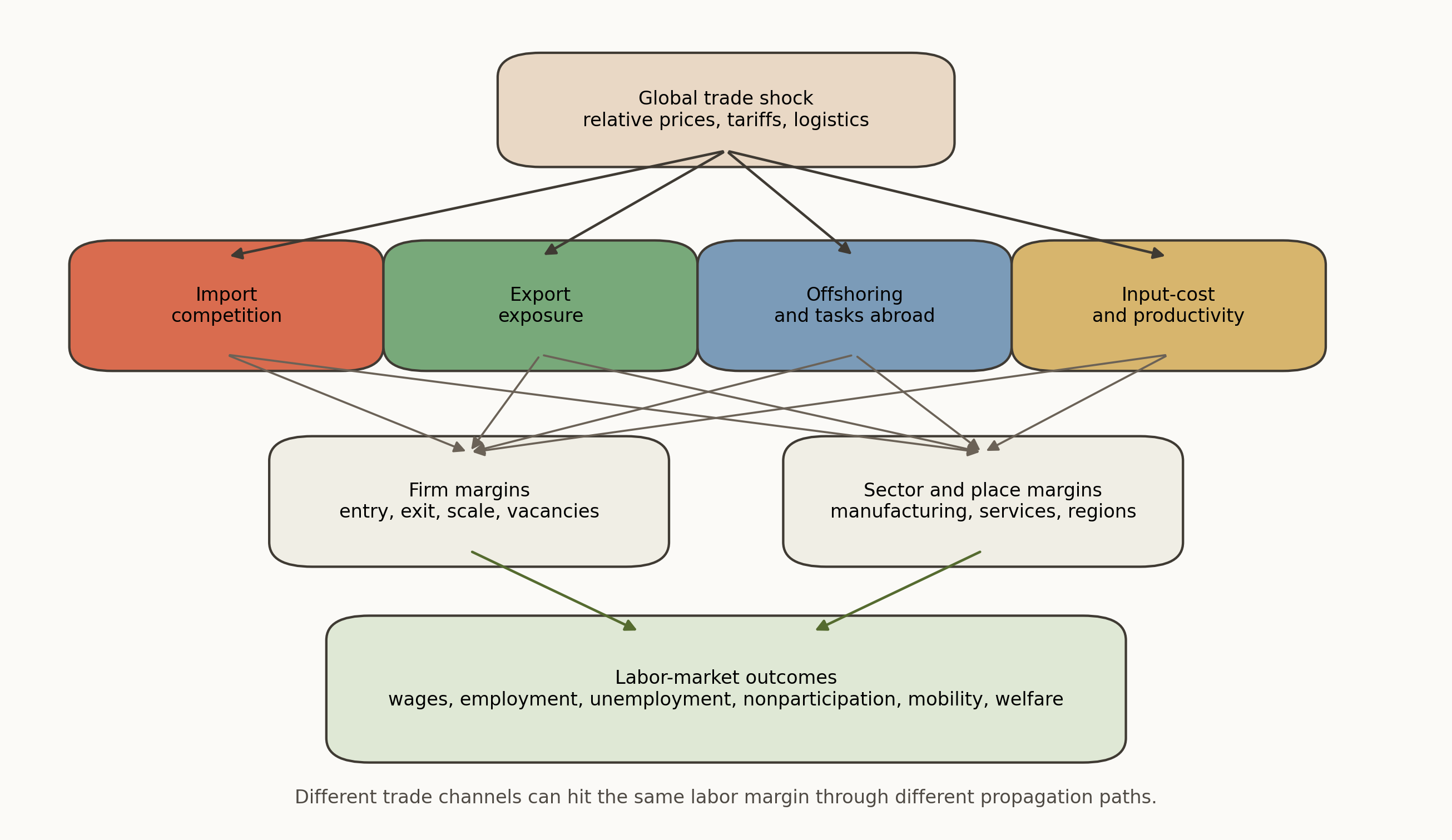
Figure 1:Week 12 organizes trade shocks as a channel map. Relative-price changes can move import competition, export demand, offshoring, input access, firm selection, and sectoral composition at the same time, but each channel reaches workers through different labor-market margins.
Figure Figure 1 previews the lecture structure. The key move is to map sectoral price and trade-cost changes into worker, firm, and place outcomes before making welfare statements.
Field Core
Trade as a labor-market shock
Trade shocks are not primitive labor shocks. They typically begin with changes in tariffs, foreign productivity, transportation costs, exchange rates, or supply-chain integration, and only then show up as labor-market shocks through firms, sectors, and places. That is why the same trade shock can look like plant contraction in one setting, export-led hiring in another, offshoring-driven task reorganization in a third, and service-sector expansion somewhere else Autor et al., 2013Dix-Carneiro & Kovak, 2017Feenstra & Hanson, 1999.
The week therefore turns on three linked objects.
Channels through which trade affects labor markets.
Transition margins through which workers and places adjust.
Welfare and research questions that require stronger structure than a single local reduced-form coefficient.
Formal core: exposure, outcomes, structural change, dynamics, and welfare
The most common reduced-form organizing object is a local exposure measure:
where is a baseline sector-share weight for region and is a sector-level change in import competition, tariffs, export demand, or offshoring exposure. Equation (1) is deliberately broad. When the unit is a commuting zone, is often an initial employment share. When the unit is a worker, it may be a lagged industry attachment. When the unit is a firm, it may be a sales or input share. The treatment object changes with the unit.
The reduced-form labor outcome equation is then
where could be local employment, wages, unemployment, nonparticipation, earnings losses, sector shares, or migration. Equation (2) is useful because it forces students to ask what the observed labor-market margin actually is before interpreting .
To make structural change explicit, the lecture needs a two-sector manufacturing-services object:
Equation (3) is not a complete equilibrium model. It is a guide for interpreting why trade shocks can change manufacturing employment shares, service employment growth, and the skill premium at the same time Cravino & Sotelo, 2019. A fall in relative manufacturing prices, changes in expenditure patterns as income changes, and productivity differences across sectors can all push labor away from manufacturing and toward services, but the labor-market consequences depend on who moves and how slowly.
Dynamic adjustment requires a separate object:
where the horizon-specific coefficients distinguish short-run displacement from medium-run and long-run adjustment. This is the key empirical bridge from local exposure papers to dynamic regional and worker-level evidence Dix-Carneiro & Kovak, 2017Kovak & Morrow, 2025.
Finally, the week needs a worker-versus-place welfare accounting object:
Equation (5) makes the non-negotiable point. Worker losses, place losses, and aggregate gains are not the same object. Place-level employment decline does not automatically reveal individual lifetime losses, and aggregate welfare claims require more structure than a local reduced-form coefficient Kim & Vogel, 2021Caliendo et al., 2019.
Local exposure measures and what they identify
The local-labor-market exposure design is the canonical reduced-form entry point. Autor et al., 2013 maps national import growth from China into commuting-zone exposure using pre-period industrial composition. The identifying variation is differential baseline sector mix across commuting zones interacted with national industry exposure. The unit of observation is the commuting zone. The observed labor margins are manufacturing employment, broader employment, wages, unemployment, and nonparticipation. The key offstage margin is national equilibrium adjustment through prices, migration, firm entry and exit, and demand spillovers.
Pierce & Schott, 2016 complements that local design by using U.S. policy variation tied to Permanent Normal Trade Relations. The identifying variation is industry exposure to policy uncertainty resolution around China trade integration. The unit of observation is the industry. The observed margin is manufacturing employment decline. The key offstage margins are local service offsets, worker transitions, and broader equilibrium pass-through.
The immediate lesson is that local import competition estimates identify place-level incidence under heterogeneous exposure, not a full welfare object. They are indispensable for labor incidence, but they are not a sufficient statistic for aggregate gains from trade.
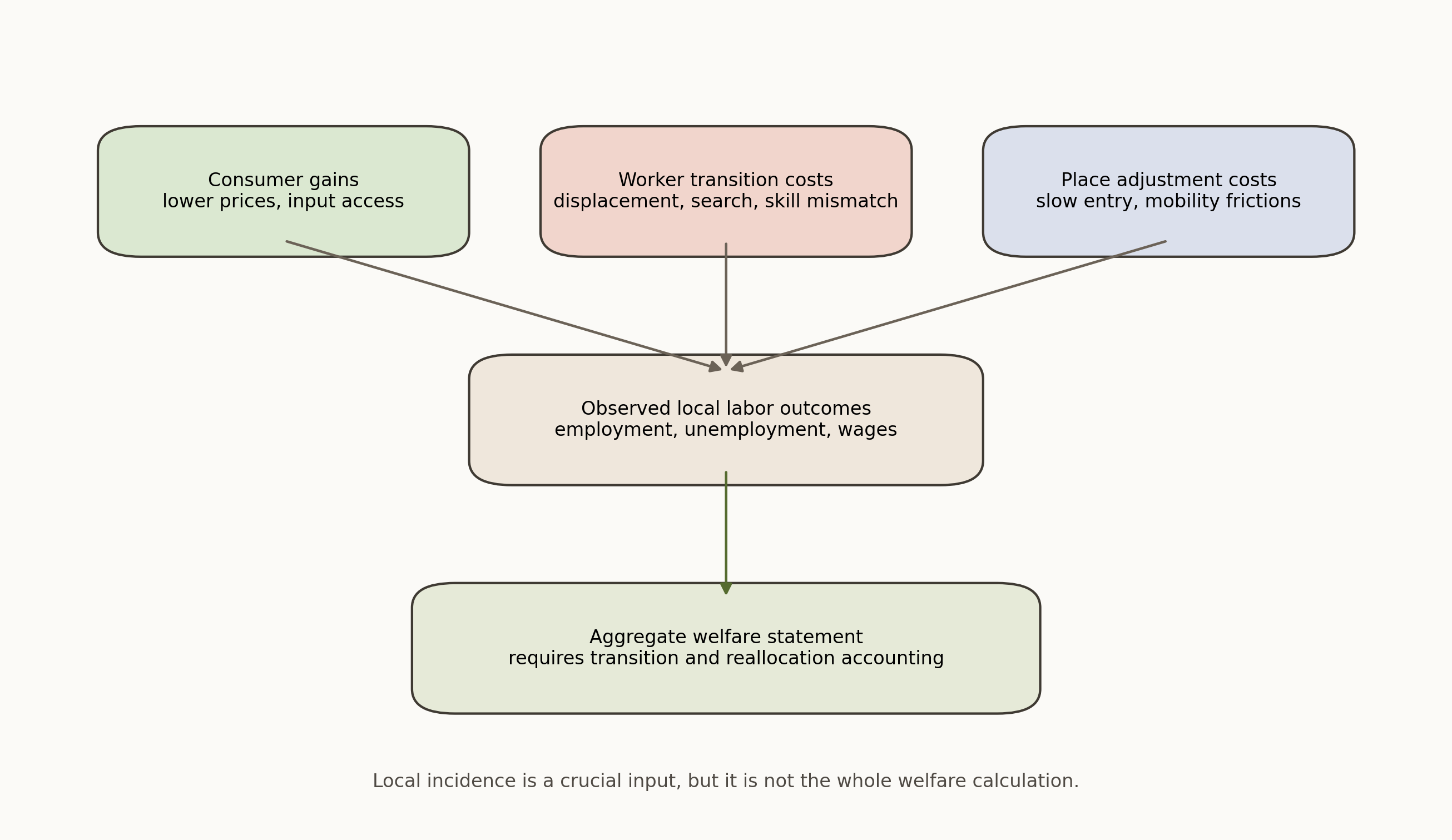
Figure 2:Trade shocks move labor outcomes through short-run displacement, slower sectoral reallocation, migration, entry, and firm adjustment. Local reduced-form estimates are strongest on exposed margins, while welfare conclusions require additional structure on transition costs and reallocation.
Figure Figure 2 is the warning label for the local design. It clarifies why import competition, export expansion, offshoring, and reallocation can all be active even when a paper estimates one dominant reduced-form coefficient.
U.S. import competition: the China shock and local labor-market adjustment
The China-shock literature is the natural first empirical block because it makes the commuting-zone exposure logic transparent. In Autor et al., 2013, rising Chinese import competition is associated with lower manufacturing employment, lower labor-force participation, and weaker wage outcomes in more exposed commuting zones. The design identifies place effects. It does not directly identify the lifetime loss of a particular worker, and it does not by itself recover equilibrium consumer gains or input-cost offsets.
Pierce & Schott, 2016 sharpens the institutional narrative by linking the manufacturing decline to the policy environment around China trade rather than only to import-penetration accounting. That is useful in Labor II because it shows how trade transmission depends on firm exit, industry restructuring, and labor reallocation, not merely on a static demand curve.
The major methods lesson is the distinction between a trade channel and a labor margin.
Import competition is the channel.
Employment, wages, unemployment, and nonparticipation are the observed margins.
Migration, worker retraining, and sector switching are major offstage margins.
Aggregate welfare cannot be read directly off a commuting-zone coefficient.
Dynamic regional adjustment: Brazil and horizon effects
Dix-Carneiro & Kovak, 2017 is the key dynamic-adjustment section for the course. The identifying variation is differential regional exposure to Brazil’s tariff reform through pre-liberalization industrial composition. The unit of observation is the region over time. The observed margins include employment structure, earnings, and regional adjustment trajectories over long horizons. The crucial insight is that adjustment is not instantaneous. Regional labor markets can continue adjusting for many years after the initial tariff shock.
That dynamic perspective matters for three reasons. First, early local losses need not reveal long-run reallocation. Second, persistence itself is a labor-market fact that requires explanation: mobility frictions, slow sectoral entry, and imperfect worker transition all matter. Third, long-run place recovery does not imply that initially exposed workers are fully insured.
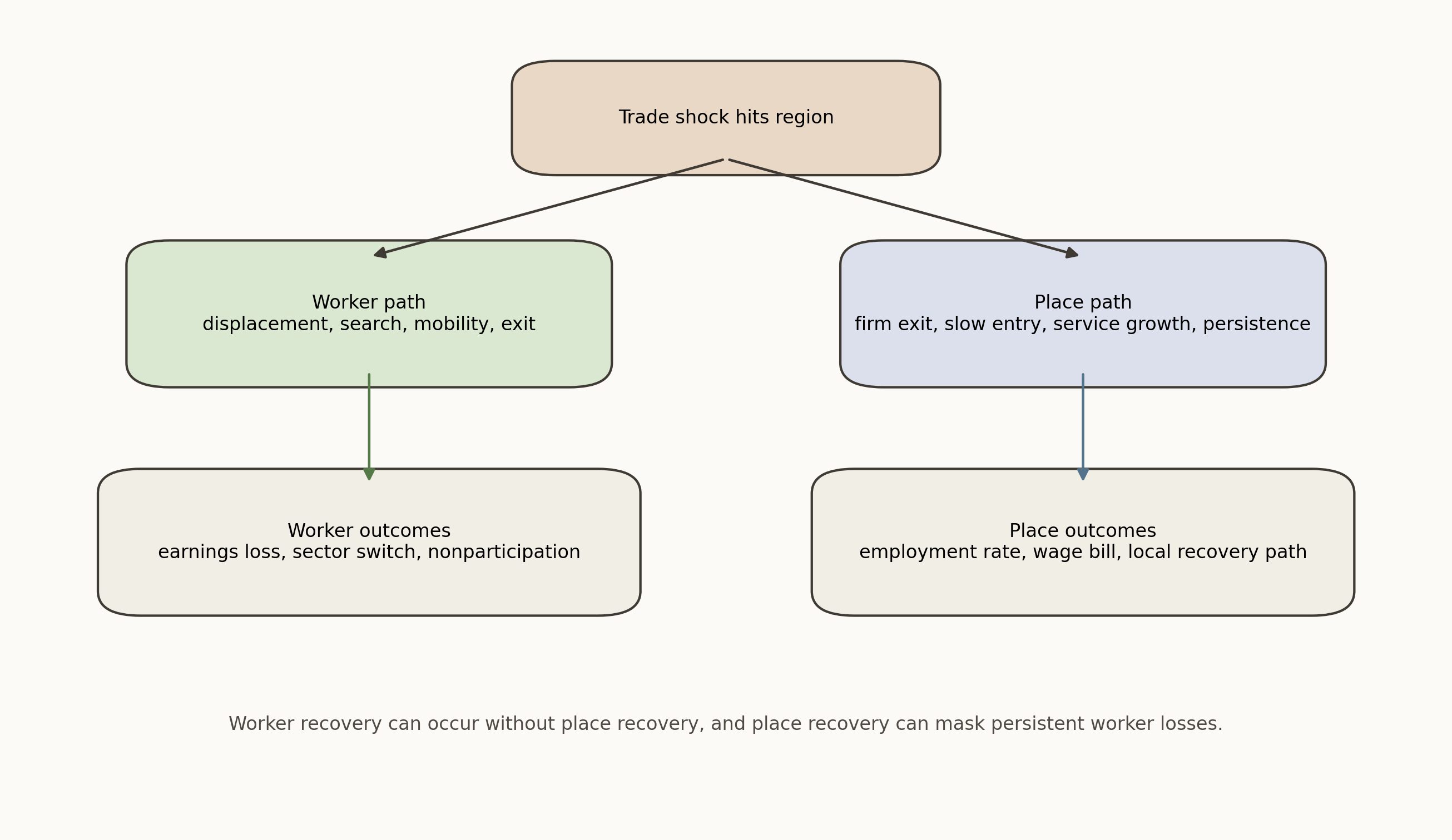
Figure 3:Worker and place adjustment can diverge sharply after trade shocks. Places can exhibit long persistence because migration, firm entry, and service growth are slow, while incumbent workers may experience displacement, delayed transitions, or exit from the labor force.
Figure Figure 3 shows why Labor II needs both worker and place language. Place-level persistence does not reveal whether incumbent workers stay and lose, move and recover, or exit altogether.
Manufacturing-to-service transitions and who actually adjusts
Trade-induced structural change is often summarized as manufacturing decline plus service growth, but that summary is too coarse for labor economics. The real question is how service growth happens and for whom. Dauth et al., 2017 provides the core teaching object here. The identifying variation comes from differential German exposure to trade with Eastern Europe and China. The units of observation include regions and workers. The observed margins include manufacturing employment decline, service employment growth, and heterogeneity across adjustment margins. The key contribution is that service reallocation does not simply consist of incumbent manufacturing workers moving smoothly into service jobs.
Table 2:Structural change and transition map for Week 12
| Transition margin | What moves | Why it matters | Empirical lesson | Anchor paper |
|---|---|---|---|---|
| Manufacturing to services | Sector shares and employment composition | Trade shocks often look like “manufacturing decline,” but the key is how service employment grows and for whom | Reallocation need not come from incumbent manufacturing workers switching directly into services | Dauth et al., 2017 |
| Incumbents vs entrants / returnees | Existing workers vs new labor-market participants | Observed sectoral change may come through entry and return margins rather than incumbent transitions | Sectoral adjustment can be much more entry-driven than textbook narratives suggest | Dauth et al., 2017 |
| Short-run displacement | Earnings and employment losses after shock | Immediate losses often dominate public debate | Short-run local losses can be large and persistent even when aggregate gains exist | Autor et al., 2013 |
| Long-run adjustment | Reallocation, recovery, and cumulative earnings | Researchers must distinguish temporary disruption from long-horizon worker trajectories | Long-run worker outcomes can differ from early regional responses | Kovak & Morrow, 2025 |
| Skill and structural change | Relative demand for skilled vs unskilled labor | Trade can alter inequality via sector composition, prices, and expenditure patterns | Manufacturing decline does not automatically imply a simple skill-bias story; channels must be unpacked | Cravino & Sotelo, 2019 |
Table Table 2 keeps the transition margins separate: manufacturing-to-services, incumbent versus entrant or returnee margins, short-run displacement, long-run adjustment, and the link to skill and structural change.
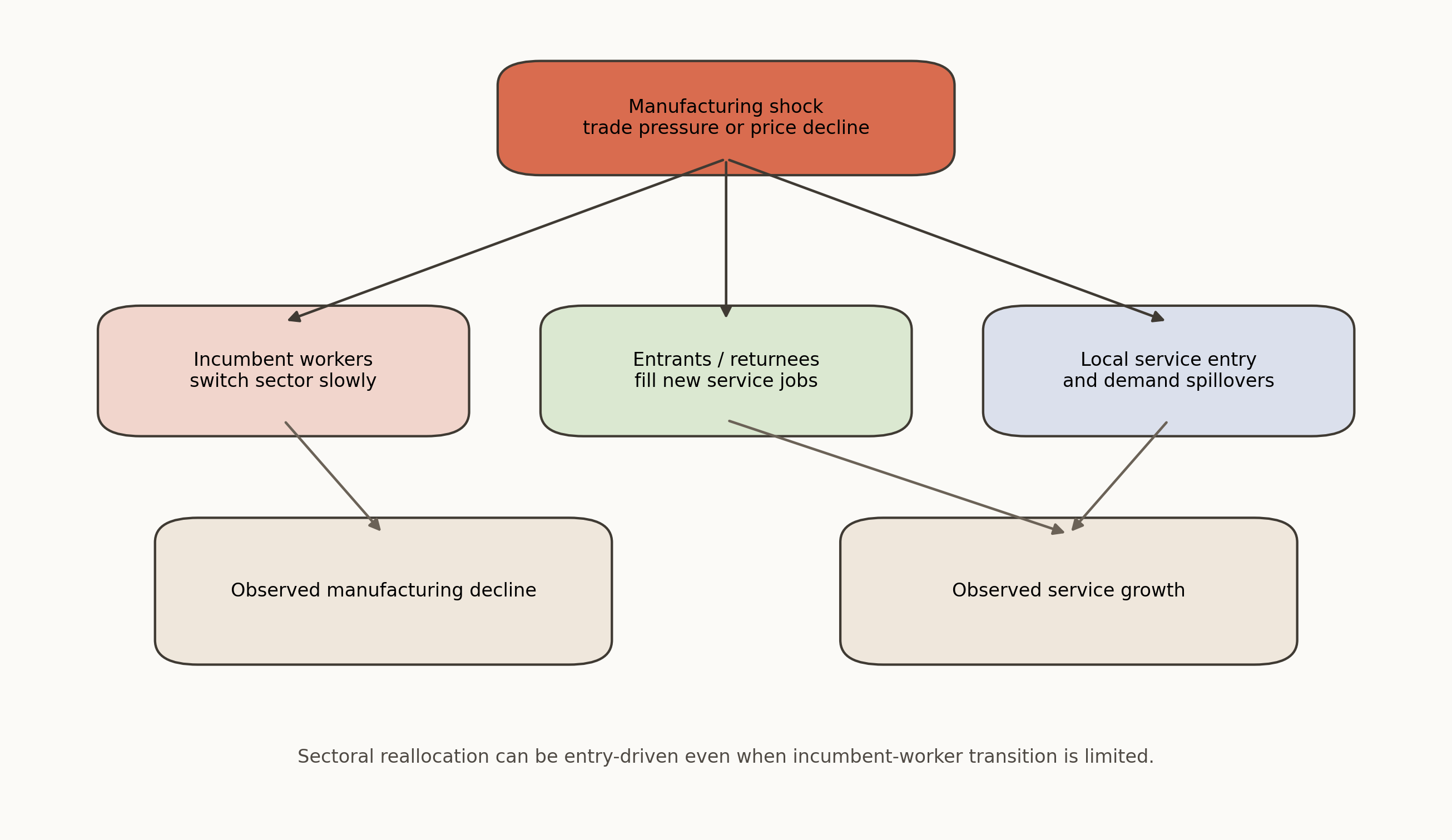
Figure 4:Manufacturing-to-service transitions can occur through several margins at once: incumbent worker moves, new entrants, returnees, migration, and sectoral entry. Observed service growth after trade shocks should not be narrated as frictionless worker reallocation.
Figure Figure 4 makes the non-negotiable point for the week: sectoral reallocation is not the same as incumbent-worker transition. That matters for both welfare and policy because entrants, returnees, and local service expansion can mask persistent losses for displaced manufacturing workers.
Trade-induced structural change and inequality
Cravino & Sotelo, 2019 links trade to the skill premium through the structural-change channel rather than through a narrow import-competition narrative. The identifying object comes from a structured quantitative framework using cross-country differences in sectoral composition, trade, and expenditure responses. The unit of analysis is the country-sector equilibrium. The observed and inferred margins are sector shares, relative wages, and the skill premium. The key offstage labor margin in simpler reduced-form work is the expenditure and general-equilibrium side of the adjustment.
This is where Equation (3) earns its place. Trade can move labor demand not only by shrinking exposed manufacturing sectors, but also by changing relative prices, expenditure shares, and productivity in ways that alter the size and skill intensity of services. That is why manufacturing decline after trade integration need not map mechanically into one simple inequality story.
Offshoring and services trade are distinct channels
Offshoring belongs in the week as its own transmission mechanism. Feenstra & Hanson, 1999 studies outsourcing and high-technology capital as linked forces affecting wages in the United States. The identifying variation is industry-level change in outsourcing intensity and capital use. The unit of observation is the industry. The observed margin is wages and relative demand. The key offstage margins are local equilibrium spillovers, worker transitions, and service-side reorganization.
The labor takeaway is not historical nostalgia about outsourcing. It is conceptual separation. Final-goods import competition, offshoring of production stages, imported business services, and cheaper intermediates do not identify the same labor-market object. Offshoring can change within-firm organization, task composition, and skill demand even when local import competition is modest.
Worker versus place adjustment, welfare, and structured equilibrium
The week should now step beyond reduced-form place effects. Kim & Vogel, 2021 gives a tractable labor-market adjustment framework that connects trade shocks to unemployment, nonparticipation, and reallocation frictions. The identifying object is structural discipline rather than one single instrument. The units of analysis are workers, sectors, and markets embedded in equilibrium. The contribution is to clarify which margins must be modeled if we want to move from local incidence to welfare and policy.
Caliendo et al., 2019 pushes further by bringing dynamic labor-market adjustment into a quantitative trade setting. The unit is an equilibrium economy with worker mobility and search frictions. The contribution is not to replace reduced-form evidence, but to show what must be added to interpret the transition path, unemployment risk, and welfare consequences of trade shocks. These frameworks are especially useful once students ask whether consumer gains, imported-input gains, and worker losses can coexist. The answer is yes, and the coexistence is precisely why local employment losses are not the same object as aggregate welfare.
Global evidence and frontier directions
Week 12 should not end with a U.S.-only story. The contrast across the United States, Brazil, Germany, and cross-country structural-change frameworks shows that institutions, worker mobility, entry margins, and sector mix shape adjustment Autor et al., 2013Dix-Carneiro & Kovak, 2017Dauth et al., 2017Cravino & Sotelo, 2019.
Table 3:Global evidence and frontier map for Week 12
| Setting / question | Main paper | Unit / design | Key contribution | Frontier follow-up |
|---|---|---|---|---|
| U.S. local import competition | Autor et al., 2013 | Commuting-zone exposure, instrumented import competition | Canonical local-labor-market trade-shock design | Worker vs place trajectories; welfare across locations |
| Brazil trade liberalization | Dix-Carneiro & Kovak, 2017 | Regional tariff-cut exposure over long horizons | Dynamic adjustment, persistence, and regional transition costs | Rich worker panels and sector-switching frictions |
| Germany and structural change | Dauth et al., 2017 | Individual and regional evidence on East/Far East trade exposure | Manufacturing-to-service transition and entry margins | Services reallocation, sorting, and inequality |
| Quantitative trade and labor adjustment | Kim & Vogel, 2021; Caliendo et al., 2019 | Structured equilibrium frameworks | Connect local trade shocks to unemployment, nonparticipation, and welfare | Better discipline on policy counterfactuals and transition dynamics |
| Global structural change | Cravino & Sotelo, 2019 | Quantitative global evidence | Trade affects manufacturing shares and the skill premium through structural change | Trade, services, and labor-market transitions outside high-income countries |
| Long-run FTA evidence | Kovak & Morrow, 2025 | Matched worker administrative data | Long-run worker trajectories, import vs export asymmetry | Worker-level adjustment, people vs places, and long-run welfare |
Table Table 3 organizes the global evidence and frontier agenda: local U.S. place effects, Brazilian dynamic adjustment, German structural change, quantitative trade-and-labor frameworks, global structural change, and the move toward long-run worker panels.
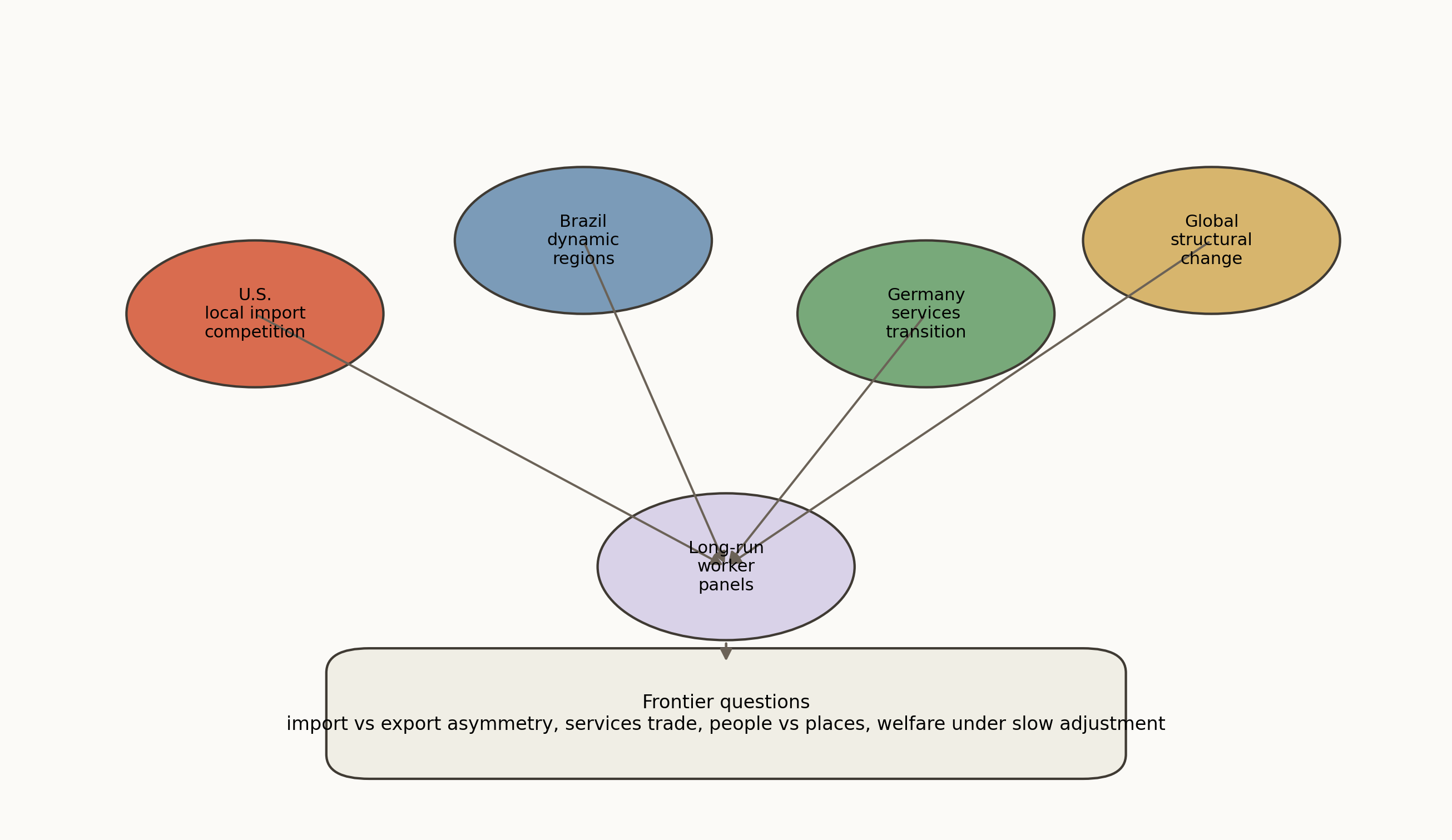
Figure 5:The current frontier moves from short-run place-level coefficients toward linked worker, firm, and regional adjustment paths across countries. Import and export asymmetries, service-sector transitions, and long-run trajectories are increasingly central.
The frontier section should be concrete rather than generic.
People versus places: long-run worker tracking is changing how the literature thinks about persistent local decline and recovery Kovak & Morrow, 2025.
Structural change into services: service growth after trade shocks often depends heavily on entrant, returnee, and local-entry margins rather than only incumbent worker switching Dauth et al., 2017.
Import versus export asymmetry: import competition and export access can move labor markets in opposite directions and on different horizons Dix-Carneiro & Kovak, 2017Kovak & Morrow, 2025.
Offshoring and white-collar fragmentation: services trade and imported tasks remain conceptually distinct from final-goods import competition Feenstra & Hanson, 1999.
Welfare and policy: local reduced-form evidence is crucial for incidence, but worker insurance, place policy, and aggregate evaluation require stronger equilibrium structure Kim & Vogel, 2021Caliendo et al., 2019.
Bridge to Week 13
Week 12 completes the major shock-and-adjustment block of Labor II. Week 11 asked how labor markets adjust when production technology changes from inside firms. Week 12 asked how labor markets adjust when product-market integration and global production fragmentation change relative prices and exposure from outside the firm. Week 13 can then synthesize the semester by asking how firm behavior, frictions, institutions, and shocks fit into one coherent labor-market research framework.
Research Lab
The Week 12 lab follows the standard Reproduce -> Diagnose -> Transfer design and keeps the bounded student path fully local. The primary anchor is Autor et al., 2013, where students build a small commuting-zone trade-exposure object and track place-level employment, unemployment, and nonparticipation margins. The challenge anchor is Dix-Carneiro & Kovak, 2017, which turns the discussion from one-period incidence to multi-period adjustment. The optional extension anchor is Dauth et al., 2017, which brings structural change and entry margins into the interpretation.
The local handout lives at lab.md. The key discipline is to force students to name the trade channel, the treatment object, the observed labor margin, and the key reallocation margin before they interpret any result.
Methods Box
Keep these distinctions explicit throughout the week.
Import competition versus export exposure: they are different channels and need not offset symmetrically Autor et al., 2013Dix-Carneiro & Kovak, 2017.
Goods trade versus offshoring or services trade: imported final goods, imported intermediates, and fragmented tasks are not the same treatment object Feenstra & Hanson, 1999.
Worker-level, firm-level, and place-level treatment: baseline shares, sector attachment, and exposure objects change with the unit.
Short-run displacement versus long-run adjustment: event-time coefficients, dynamic regional evidence, and long-run worker panels answer different questions Dix-Carneiro & Kovak, 2017Kovak & Morrow, 2025.
Incumbents versus entrants and returnees: sectoral service growth can occur without incumbent manufacturing workers being the ones who move Dauth et al., 2017.
Reduced-form Bartik or tariff-exposure designs versus structural equilibrium approaches: each is informative, but they identify different objects Autor et al., 2013Caliendo et al., 2019.
Local labor-market outcomes versus aggregate welfare statements: local incidence is not the same object as national gains or losses Kim & Vogel, 2021.
Place effects versus worker losses: a region can partially recover even if initially displaced workers bear persistent losses, and worker recovery need not imply place recovery Kovak & Morrow, 2025.
Reading Ladder And References
Ladder A. Core channel map and local exposure logic
Ladder B. Dynamic adjustment and structural change
Ladder C. Welfare and equilibrium frameworks
Ladder D. Long-run worker trajectories and frontier directions
Optional revisit: Dauth et al., 2017
Exercises And Discussion Prompts
Use Equations (1) and (2) to explain why a commuting-zone import-exposure estimate is a place-level object rather than a worker-level treatment effect.
Why can import competition, export exposure, and offshoring generate different wage effects even when they all originate from trade integration?
Use Equation (3) to give two reasons why manufacturing-to-service transition after a trade shock need not imply incumbent-worker recovery.
Compare Autor et al., 2013 and Dix-Carneiro & Kovak, 2017. What is the identifying variation, unit of observation, observed labor margin, and key offstage equilibrium margin in each paper?
Why is Dauth et al., 2017 especially useful for distinguishing place reallocation from incumbent-worker transitions?
What additional assumptions or structure do Kim & Vogel, 2021 and Caliendo et al., 2019 add before one can make welfare or policy statements?
Suppose a region loses manufacturing employment after an import shock but gains service employment later. What outcomes would you still need to observe before concluding that workers were fully insured?
Reproducibility And Code Lab Note
The bounded Week 12 lab is fully local and synthetic. Students first reproduce a compact China-syndrome-style commuting-zone exposure object and recover its relationship to manufacturing employment, unemployment, and nonparticipation. They then diagnose why that design identifies place effects rather than worker welfare. The transfer exercise asks them to carry the same exposure idea into a bounded structural-change setting by comparing manufacturing-share decline, service-share growth, and unemployment under a small synthetic region-year panel inspired by Dix-Carneiro & Kovak, 2017. The optional extension asks them to reinterpret the same transition logic through the manufacturing-to-service evidence in Dauth et al., 2017.
Slide Companion Note
The Week 12 slide deck lives at 12
Bridge Forward
Use this closing bridge to carry the module’s labor object, mechanism, and evidence into the next course step or research-design exercise.
- Autor, D. H., Dorn, D., & Hanson, G. H. (2013). The China Syndrome: Local Labor Market Effects of Import Competition in the United States. American Economic Review, 103(6), 2121–2168. 10.1257/aer.103.6.2121
- Dix-Carneiro, R., & Kovak, B. K. (2017). Trade Liberalization and Regional Dynamics. American Economic Review, 107(10), 2908–2946. 10.1257/aer.20161214
- Feenstra, R. C., & Hanson, G. H. (1999). The Impact of Outsourcing and High-Technology Capital on Wages: Estimates for the United States, 1979–1990. Quarterly Journal of Economics, 114(3), 907–940. 10.1162/003355399556179
- Caliendo, L., Dvorkin, M., & Parro, F. (2019). Trade and Labor Market Dynamics: General Equilibrium Analysis of the China Trade Shock. Econometrica, 87(3), 741–835. 10.3982/ECTA13758
- Cravino, J., & Sotelo, S. (2019). Trade-Induced Structural Change and the Skill Premium. American Economic Journal: Macroeconomics, 11(3), 289–326. 10.1257/mac.20170434
- Kim, R., & Vogel, J. (2021). Trade Shocks and Labor Market Adjustment. American Economic Review: Insights, 3(1), 115–130. 10.1257/aeri.20200101
- Kovak, B. K., & Morrow, P. M. (2025). The Long-Run Labour Market Effects of the Canada-U.S. Free Trade Agreement. Review of Economic Studies, 92(6), 4026–4058. 10.1093/restud/rdae113
- Pierce, J. R., & Schott, P. K. (2016). The Surprisingly Swift Decline of US Manufacturing Employment. American Economic Review, 106(7), 1632–1662. 10.1257/aer.20131578
- Dauth, W., Findeisen, S., & Suedekum, J. (2017). Trade and Manufacturing Jobs in Germany. American Economic Review, 107(5), 337–342. 10.1257/aer.p20171025