Unions, Collective Bargaining, and Worker Voice
Learning Objectives
By the end of Week 8, students should be able to:
distinguish union membership, collective-bargaining coverage, union density, bargaining regime, and worker voice;
explain how collective bargaining changes wages, wage dispersion, amenities, job security, and workplace governance;
map organizing demand, certification, employer opposition, and bargaining law into observed union takeup and realized coverage;
separate direct effects on covered workers from spillovers and threat effects on uncovered workers;
interpret union evidence by naming the identifying variation, unit of observation, observed margin, and key unobserved object;
explain why disagreements in the literature often reflect different objects, settings, selection processes, and spillover concepts;
connect unions to Weeks 5--7 on bargaining, monopsony, and minimum wages and to Week 9 on labor regulation, enforcement, and insurance.
Opening Orientation
The economic question for Week 8 is not whether unions are generically “good” or “bad.” It is what collective bargaining changes in labor markets, how membership differs from coverage, how organizing differs from post-union outcomes, and how modern labor economics identifies direct effects, spillovers, and political feedbacks Jäger et al., 2024Hirsch, 2008Kaplan & Naidu, 2025.
Bridge
Week 7 treated wage floors as rules imposed on decentralized wage-setting. Week 8 asks what changes when wages and workplace rules are shaped by organized worker voice rather than only by statutory floors or individual contracts. This is why unions belong in the middle of Labor II rather than at the edge of a labor-history survey. Weeks 5 and 6 taught us that wages depend on bargaining protocols and employer labor-market power. Week 7 showed that legal floors can compress wage-setting from the outside. Week 8 adds the central institution that changes wage-setting from inside the employment relationship: collective bargaining.
The bridge from Week 7 is especially useful because minimum wages and unions are related but distinct. A minimum wage is a legal floor that targets the lower tail of pay. Collective bargaining can instead reshape the whole wage structure, nonwage conditions, grievance procedures, staffing rules, and the distribution of rents inside the firm or sector. The bridge to Week 9 is equally important. Week 8 introduces bargaining institutions and organizing rules, but it does not yet become the labor-law and enforcement lecture. That next week will ask how regulation, insurance, and enforcement sustain or constrain the institutional environment introduced here.
This week keeps five distinctions explicit from the start.
union membership is not the same thing as collective-bargaining coverage;
firm-level bargaining is not the same thing as sectoral, multi-employer, or extension regimes;
organizing and certification are not the same thing as realized coverage or post-union wage effects;
direct effects on covered workers are not the same thing as spillovers or threat effects on uncovered workers;
labor-market effects of unions are not identical to unions’ political effects, even though the two are linked.
Table 1:Collective-bargaining concepts map
| Object | Definition | Why it matters in this lecture | Typical data / empirical proxy | Common confusion to avoid |
|---|---|---|---|---|
| Union membership | Worker reports belonging to a union | Measures organizational attachment and dues-paying membership | CPS / Unionstats membership measures | Not all covered workers are members |
| Collective-bargaining coverage | Worker is covered by a union contract whether or not they are a member | Closer to the bargaining institution than membership alone | CPS coverage measure, administrative contract coverage data | Coverage effects are not identical to membership premia |
| Union density | Share of workers who are union members in a firm, sector, region, or country | Useful for spillovers, threat effects, and political influence | CPS, Unionstats, establishment-level measures | Density is an aggregate environment, not an individual treatment |
| Bargaining regime | Institutional level at which bargaining occurs: firm-level, sectoral, multi-employer, or extension | Central for cross-country comparison and interpretation of spillovers | Country institutional data, bargaining laws, sectoral contracts | A country with low membership can still have high coverage |
| Worker voice | Ability of workers to shape wages, conditions, grievances, and governance | Broadens the lecture beyond wage premia | Contract clauses, grievance procedures, representation structures | Voice is not reducible to a single wage coefficient |
| Coverage premium | Difference in pay or conditions associated with bargaining coverage | Useful in cross-country and institutional settings | Wage regressions, harmonized microdata | Coverage premia are not automatically causal |
| Wage compression | Reduction in within-firm or within-sector wage dispersion | Key reason unions matter for inequality | Variance / quantile comparisons, AKM-type decompositions | Compression can coexist with modest average wage effects |
Table Table 1 is the opening taxonomy for the week. It keeps the chapter from collapsing membership, coverage, bargaining regime, and worker voice into one generic “union” object.
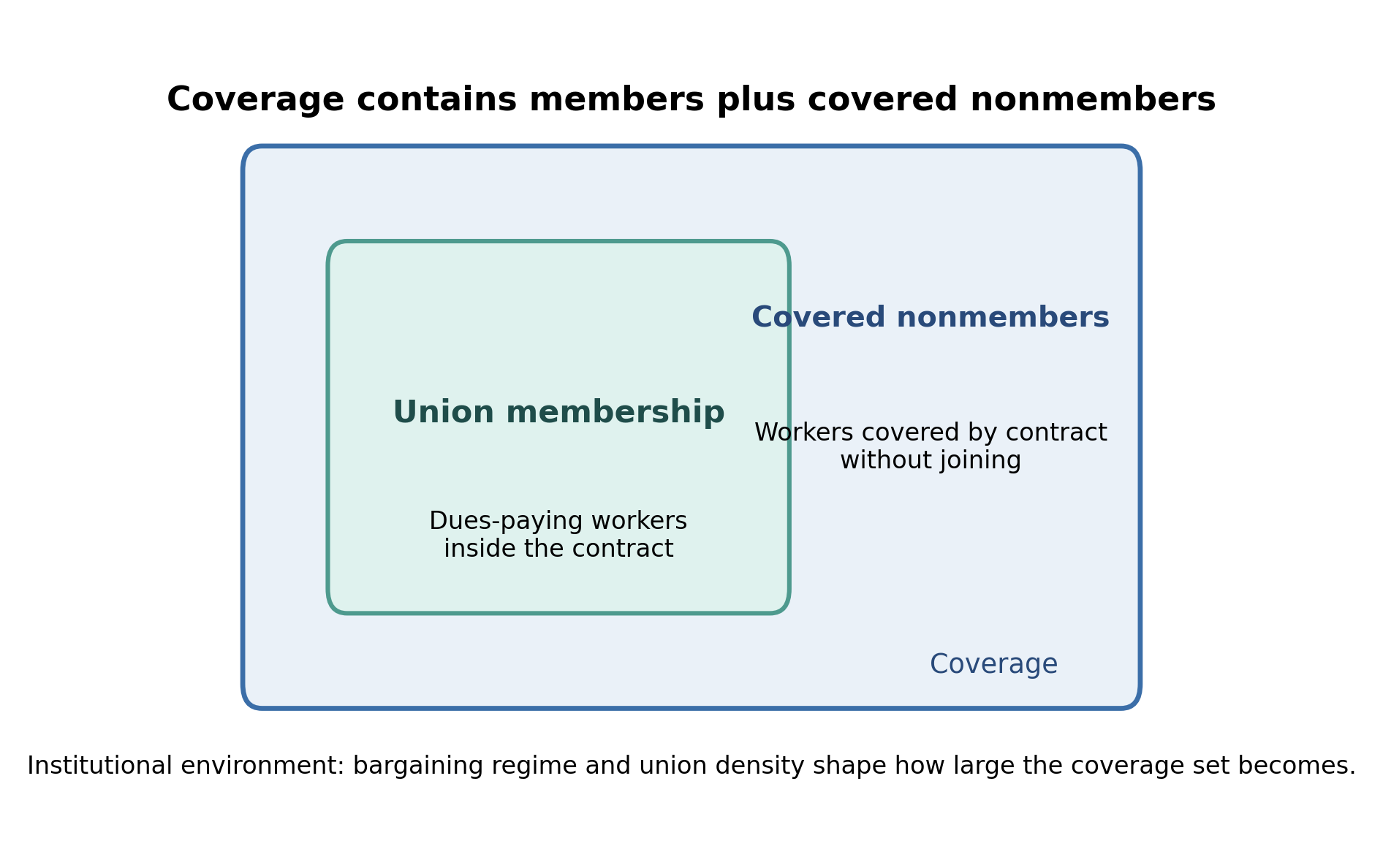
Figure 1:Membership, coverage, and bargaining regime are distinct objects. Coverage can exceed membership, and bargaining institutions can matter even where dues-paying membership is limited.
Figure Figure 1 is the first anchor for the lecture. It visually states the most common empirical confusion: bargaining coverage is often the more institutionally relevant object even when membership is the more visible political statistic.
Field Core
What unions and collective bargaining change
The core labor-economics reason to study unions is that they alter the mapping from firm rents and worker outside options into wages and workplace rules. In Week 5, bargaining was often bilateral. In Week 8, bargaining becomes collective. In Week 6, labor-market power was firm-facing. In Week 8, organized worker voice partly counteracts or redirects that power. In Week 7, wage floors compressed the lower tail from outside the firm. In Week 8, bargaining institutions can compress wages from inside the firm or sector.
The clean accounting identity is the right place to begin:
where is union membership in region or regime at time , and is collective-bargaining coverage. Equation (1) says that covered nonmembers are part of the labor-market institution even if they are not dues-paying union members. This distinction is essential in cross-country work, in U.S. public-sector settings, and in any application where contract extension rules matter Jäger et al., 2024Hirsch & Macpherson, 2003.
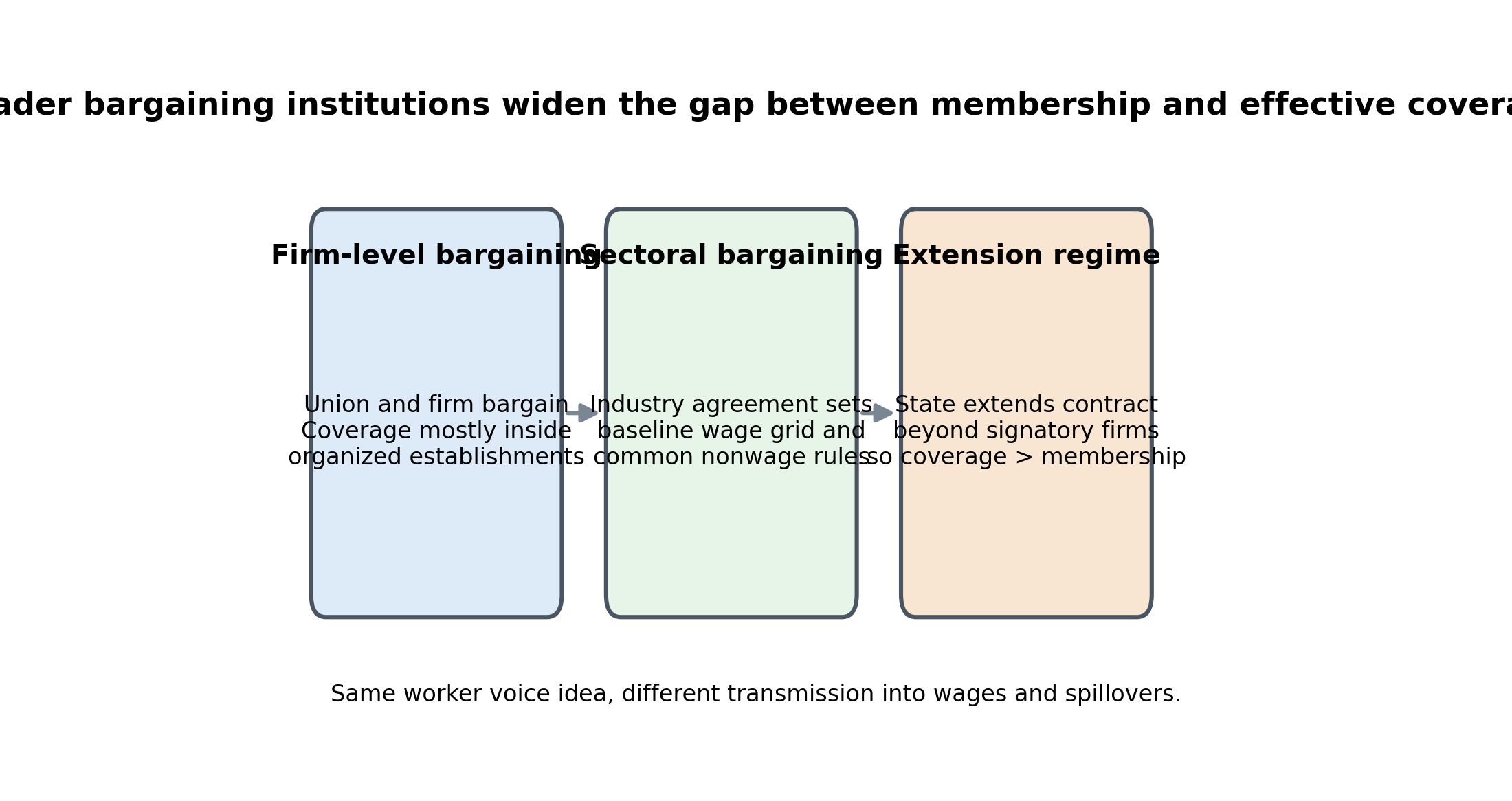
Figure 2:Firm-level bargaining, sectoral bargaining, and extension regimes transmit worker voice into wages very differently. The membership rate alone cannot summarize that institutional structure.
Figure Figure 2 is the institutional map for the week. Firm-level bargaining matters most directly for the U.S. private-sector certification literature. Sectoral and extension regimes matter most directly for the coverage and wage-structure literatures emphasized by Jäger et al., 2024.
The compact collective-bargaining object can be written as
where is the fallback or nonunion wage, is rent or surplus available at establishment or bargaining unit , and summarizes how bargaining institutions and worker power shift rent-sharing toward labor. Equation (2) is deliberately schematic. It does not claim that every union estimate is a clean rent-sharing coefficient. It only states the channel: bargaining can raise the wage level, compress wage differences, or reallocate surplus toward covered workers.
The labor-market objects changed by unions are broader than wages alone. Bargaining can affect benefits, schedules, grievance procedures, job protection, promotion rules, and formal voice channels. Harju et al., 2025 is useful here because the identifying variation comes from workplace-level representation arrangements, the unit of observation is the workplace or worker-workplace relationship, the observed margin is voice and participation, and the key unobserved object is the full counterfactual governance structure absent representation. That is why worker voice belongs in the title of the week even though the empirical core remains about wages, employment, coverage, and spillovers.
Hirsch, 2008 provides the right conceptual caution. Unions and competition can coexist, but that coexistence depends on what unions bargain over, whether gains come from rent-sharing or productivity changes, and how employers respond on employment, investment, and survival margins. Week 8 should therefore treat unions as wage-setting and governance institutions, not as a single reduced-form wage premium.
Membership, coverage, bargaining regimes, and why the objects differ
Membership is the organizational attachment object. Coverage is the contract object. Density is the environment object. Bargaining regime is the institutional architecture. Worker voice is the governance object. The fact that these are separable is not semantic. It determines what the data mean and which comparisons are credible.
U.S. CPS and Unionstats data are especially useful because they separately observe membership and coverage. The identifying variation in those data is usually descriptive rather than causal. The unit is the worker-year or demographic cell. The observed margins are membership, coverage, wages, and inequality. The key unobserved object is the untreated counterfactual path of labor-market structure absent deunionization or institutional change Hirsch & Macpherson, 2003Farber et al., 2021. That is why CPS/Unionstats panels are ideal for trend description and bounded teaching labs but not sufficient on their own for sharp causal claims.
Cross-country comparisons make the distinction even more concrete. Jäger et al., 2024 uses harmonized international data where bargaining coverage, not just membership, is central. The identifying variation is coverage and regime differences across countries and over time. The unit is the worker-country-year or sector-country-year cell. The observed margins are wage levels and dispersion. The key unobserved object is the bundle of other institutions that move with bargaining regimes. The paper is therefore powerful for teaching the membership-versus-coverage distinction and weaker as a one-number causal estimate.
This section is also where public-sector or education-sector bargaining should be separated from private-sector unionization if mentioned. Teacher salary schedules or public-sector bargaining laws often illuminate wage rules and worker voice, but they operate under different legal and fiscal institutions from private-sector certification and collective bargaining. Week 8 is anchored primarily in private-sector unionization and bargaining coverage unless the contrast itself is the point.
Organizing, takeup, certification, and who gets covered
The organizing question is not “why did union density decline?” in the abstract. It is how worker demand for representation maps imperfectly into realized coverage once employer opposition, bargaining law, establishment characteristics, and labor-market conditions intervene.
The reduced-form organizing object can be written as
where captures worker demand, employer opposition or campaign response, and the broader legal and labor-market environment. Equation (3) is the key takeup object for the week. It says plainly that organizing success is not a pure preference measure.
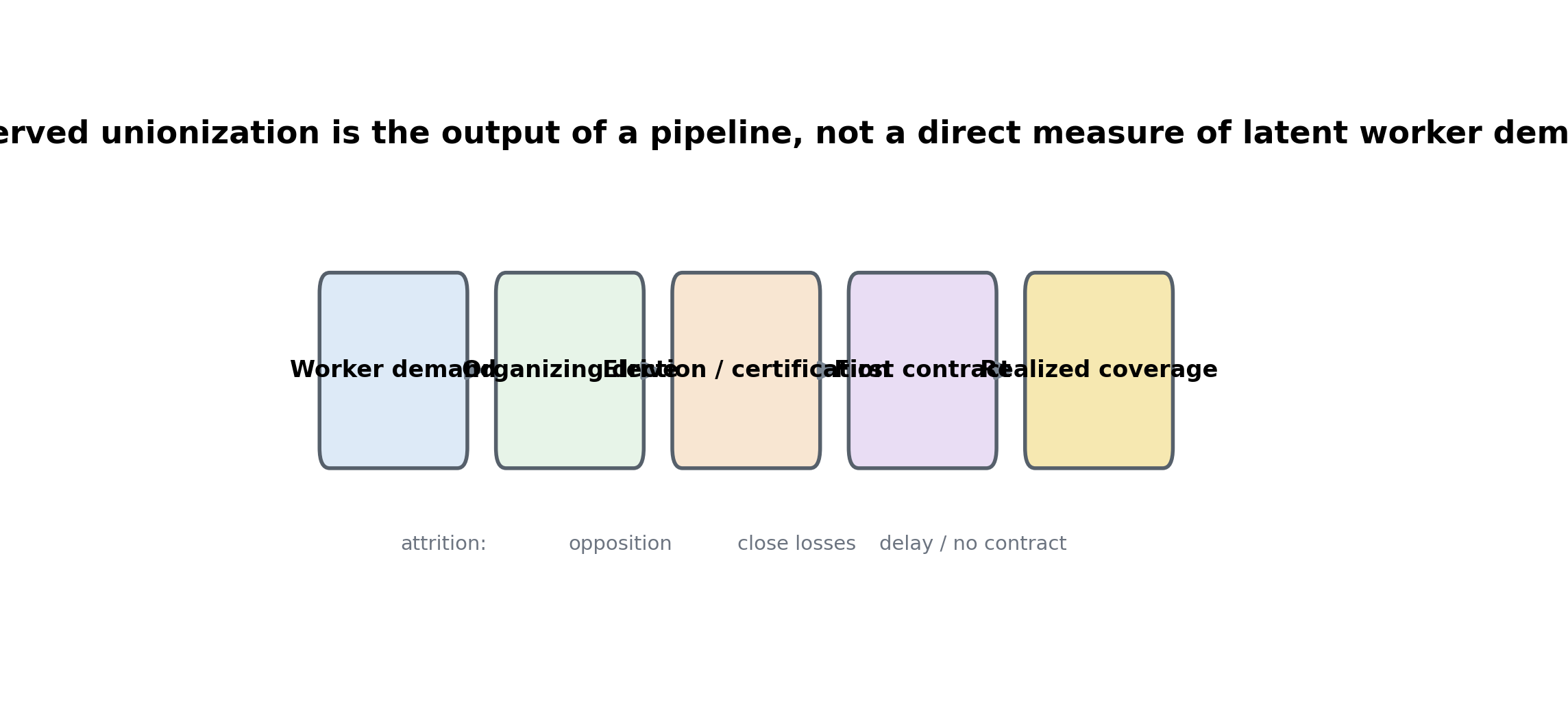
Figure 3:Observed coverage is the end of a pipeline from worker demand to organizing, election, bargaining, and contract realization. Attrition at each stage makes union desire different from observed unionization.
Figure Figure 3 is the organizing backbone for the lecture. It keeps students from interpreting a certification-election estimate as if it were the same object as a coverage premium or an equilibrium union-density effect.
Table 2:Union takeup, coverage, and spillovers map
| Margin / question | Core object | Representative papers | Main design / variation | Main lesson |
|---|---|---|---|---|
| Organizing / takeup | Which establishments are targeted and unionized? | Dinlersoz et al., 2017; Pezold et al., 2023 | NLRB election data matched to establishments; labor-market tightness shifts | Worker demand is not the same as realized unionization; takeup depends on employer opposition and market conditions |
| Certification causal effects | What happens after close union wins? | DiNardo & Lee, 2004; Frandsen, 2021 | Close-election RD; matched employer-employee RD | Different datasets and outcomes produce different local causal effects |
| Coverage and inequality | How do unions reshape the wage structure? | Farber et al., 2021; Jäger et al., 2024 | Historical survey data; harmonized cross-country coverage comparisons | Unions can compress wages and reduce inequality, but the object is often coverage rather than pure membership |
| Spillovers / threat effects | How are uncovered workers affected? | Fortin et al., 2021; Fortin et al., 2022 | Distribution regressions; policy shocks such as right-to-work laws | Ignoring spillovers understates the aggregate role of unions |
| Political spillovers | How do unions affect politics and regulation? | Kaplan & Naidu, 2025 | Survey plus administrative political data, legal and institutional reforms | Political effects matter, but they remain adjacent to the core labor-market estimands in this week |
Table Table 2 organizes the evidence by margin rather than chronology. It is particularly useful because it puts organizing, certification, coverage, spillovers, and political spillovers in one map without treating them as the same estimand.
Dinlersoz et al., 2017 is the clean life-cycle organizing paper for this week. The identifying variation comes from NLRB election data linked to establishment characteristics. The unit of observation is the establishment or election episode. The observed margin is where organizing occurs. The key unobserved object is latent worker demand absent employer and legal frictions. The main lesson is that who gets organized is itself selective and economically structured.
Pezold et al., 2023 brings labor-market tightness directly into the takeup discussion. The identifying variation comes from changes in local labor-market conditions interacted with union activity. The unit is the election, campaign, or local labor-market environment. The observed margin is union activity and organizing intensity. The key unobserved object is whether tightness shifts worker beliefs, employer vulnerability, or both. This is exactly the kind of Week 8 link back to Weeks 4 and 6 that students should see clearly: organizing depends partly on outside options and bargaining conditions in the market.
Certification elections are central in the U.S. literature because they generate quasi-experimental variation near the win threshold, but they remain only one object. Close-election designs tell us about marginal elections near the cutoff, not about all workplaces that might desire a union or about countries where sectoral coverage expands without establishment-level certification.
Direct effects on covered workers: premia, compression, selection, and survival
The direct-effect literature is where many students first look for “the union effect,” but Week 8 needs more discipline. A union wage premium for newly organized private-sector workers is not the same object as a broad coverage effect in a sectoral regime. A within-firm compression effect is not the same object as an average wage premium. An employment or survival effect for establishments after close election wins is not the same object as the long-run role of unions in aggregate inequality.
DiNardo & Lee, 2004 is the canonical certification-election regression discontinuity design. The identifying variation is a close union win versus a close union loss at the certification threshold. The unit of observation is the establishment or election. The observed margins are wages, employment, survival, and firm outcomes after unionization. The key unobserved object is the counterfactual path for non-close elections and the broader equilibrium environment. The main teaching value is that the paper identifies a local causal effect of marginal union victories, not the full aggregate effect of union institutions.
Frandsen, 2021 uses matched employer-employee data around close elections. The identifying variation is again near-threshold union victories, but the observed unit is the worker-firm match rather than only the establishment. The observed margins include earnings, employment, and worker composition. The key unobserved object is longer-run equilibrium sorting outside the treated match. The paper matters because it shows how a similar certification design can reveal more about payroll, worker composition, and heterogeneous treatment than a pure establishment panel.
Farber et al., 2021 is the central wage-structure anchor. The identifying variation is long-run survey variation in union status and union exposure over time. The unit is the worker-year, state-year, or distributional cell, depending on the decomposition. The observed margins are wage dispersion, unionization, and inequality over the twentieth century. The key unobserved object is the untreated distributional path absent deunionization and the exact division between direct and spillover channels. The paper is therefore strongest for teaching unions as a distributional institution rather than as a single marginal private-sector RD treatment.
The wage-structure insight is the non-negotiable direct-effect lesson. Unions can raise pay for covered workers and compress wages at the same time. Compression may operate through narrower occupation differentials, flatter within-firm wage ladders, or stronger floors for lower-paid covered workers. That compression is often more important for inequality than the average premium alone.
Selection remains central throughout. Workers who sort into union jobs may differ in unobserved attachment, preferences, and outside options. Firms or establishments where organizing succeeds may differ in rents, technology, conflict, or workforce composition. This is why direct effects estimated from cross-sectional coverage premia, certification RDs, and matched employer-employee designs can disagree without logical contradiction.
Spillovers and threat effects on nonunion workers
Week 8 is incomplete without spillovers because unions can reshape wages outside the formal bargaining unit. The direct treatment of covered workers is only part of the equilibrium story. Uncovered workers can gain if union wage norms raise outside options or if nonunion firms pay more to avoid organizing. They can lose if bargaining reallocates employment, compresses differentials only inside the covered sector, or changes firm composition in ways that crowd workers into the uncovered sector.
The reduced-form spillover object is
where is the wage of nonunion or uncovered workers and captures spillover, threat, or crowd-out effects associated with union presence. Equation (4) is not a full equilibrium model. It only clarifies that the nonunion wage response is a separate estimand from the covered-worker premium.
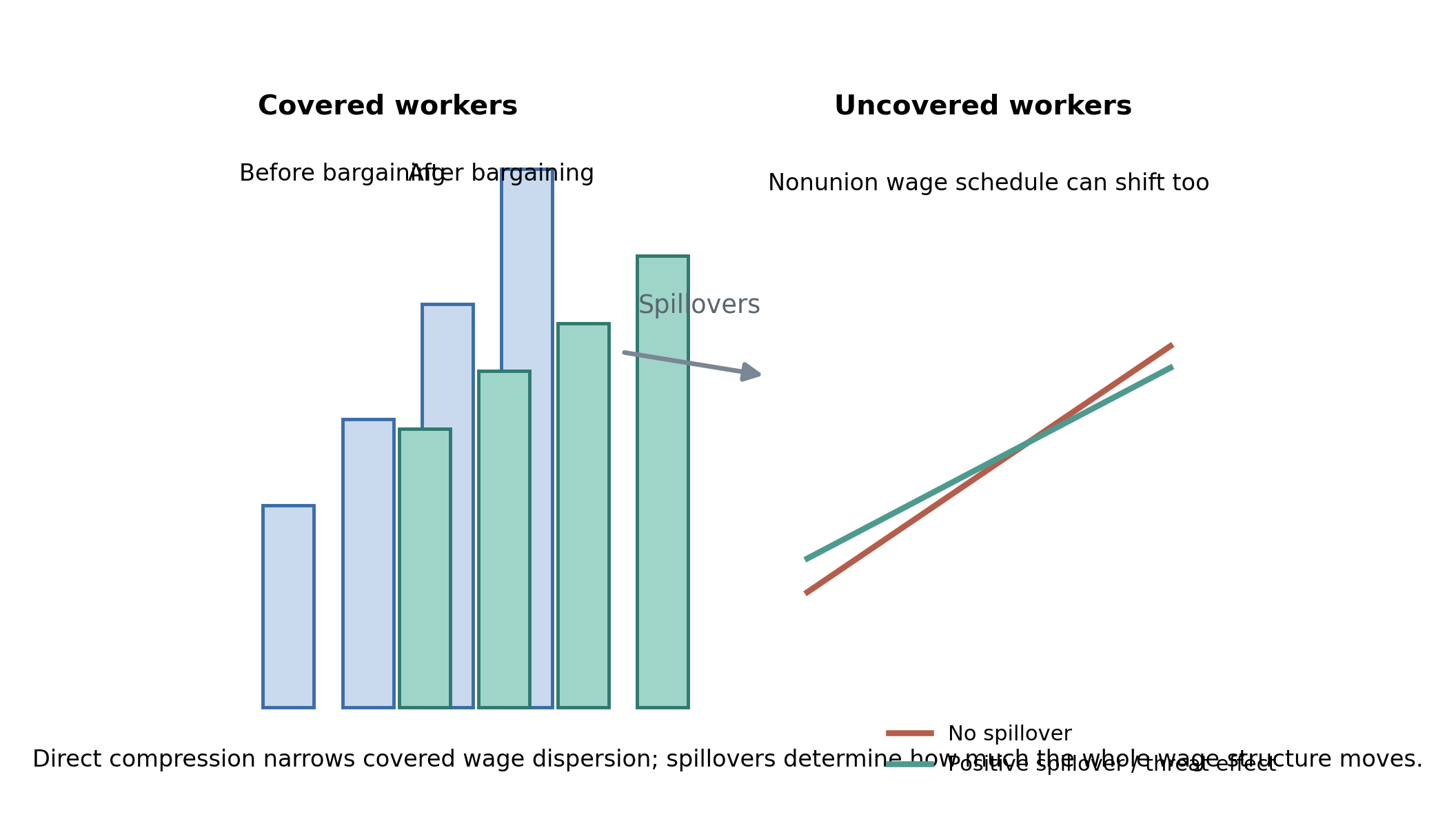
Figure 4:Collective bargaining can compress wages directly for covered workers and indirectly through spillovers, threat effects, or labor reallocation in uncovered markets.
Figure Figure 4 is the distributional anchor for the week. It emphasizes that compression can arise through both direct contract effects and broader wage-setting spillovers.
Fortin et al., 2021 is the core spillover paper. The identifying variation comes from differences in labor-market institutions and union exposure combined with distributional wage analysis. The unit is the worker, region, or wage-distribution cell depending on the specification. The observed margin is wages across the distribution, especially for uncovered workers. The key unobserved object is the untreated wage structure absent institutional spillovers. The paper is central because it shows why focusing only on members or covered workers understates the aggregate role of unions in inequality.
Fortin et al., 2022 sharpens the threat-effect discussion using right-to-work and related institutional changes. The identifying variation is policy reform timing and exposure. The unit is the state-year, sector-year, or worker-region cell. The observed margins are unionization and wage-setting outcomes for both union and nonunion workers. The key unobserved object is policy endogeneity and the untreated institutional path. This is the best point in the lecture to say explicitly that threat effects, positive spillovers, and negative crowd-out are different notions of spillover and can generate different empirical signs.
This is also why nonunion workers inside partially unionized firms are not automatically clean controls. They may be affected by common firm wage policies, internal equity norms, bargaining spillovers, or employer anti-organizing responses. Week 8 should make that point early, because it helps students understand why aggregate inequality decompositions and matched employer-employee designs often treat spillovers as first-order rather than secondary.
Data and empirical designs: what each design identifies
Table 3:Identification map and political-economy bridge
| Design family | Unit of observation | What it identifies best | Key limitation | Political-economy or institutional bridge |
|---|---|---|---|---|
| Certification-election RD | Establishment / election | Local causal effect of union victory near the threshold | Local treatment effect; close elections may not generalize | Shows how organizing rules and employer opposition shape takeup |
| Matched employer-employee union designs | Worker-firm match | Payroll, employment, survival, composition, wage structure | Often requires restricted administrative data | Useful for linking bargaining to firm outcomes and worker sorting |
| Historical survey / decomposition | Worker-year or state-year | Long-run role of unions in inequality and wage compression | More structural assumptions; causal leverage often indirect | Connects deunionization to broad changes in the wage structure |
| Cross-country coverage comparisons | Worker-country-year or sector-country-year | Role of bargaining regimes, coverage premia, and compression | Institutions differ on many dimensions simultaneously | Best setting to teach the membership-versus-coverage distinction |
| Policy-shock event studies | State-year, sector-year, or country-year | Effects of bargaining-law changes, right-to-work laws, and duty-to-bargain rules | Exposure measurement and policy endogeneity | Natural bridge from labor economics to political economy |
| Descriptive CPS / Unionstats panels | State-year, sector-year, demographic cell | Coverage trends, membership decline, and organizing environments | Not causal by itself | Excellent for bounded lab extensions and replication exercises |
Table Table 3 is the empirical design map for Week 8. It should be read as a guide to objects, not as a ranking of papers.
Certification-election RD designs vary close election outcomes around the legal win threshold. The unit is the establishment or election. The object identified is the local causal effect of marginal union victories. The key limitation is local external validity and the fact that the design starts after the organizing pipeline has already selected a set of workplaces into election.
Matched employer-employee union designs vary unionization at the firm-worker match and observe payroll and composition more directly. The unit is the worker-firm match. The object identified is the direct effect on earnings, employment, and composition in matched data. The key limitation is that spillovers and longer-run general equilibrium resorting remain only partially observed Frandsen, 2021.
Historical survey and decomposition designs vary unionization, coverage, and institutional exposure over long horizons. The unit is the worker-year, state-year, or wage-distribution cell. The object identified is the contribution of unions to long-run wage compression and inequality. The key limitation is that stronger modeling assumptions are needed to separate direct effects, selection, and spillovers Farber et al., 2021.
Cross-country coverage comparisons vary bargaining regime and contract coverage across countries or sectors. The unit is the worker-country-year or sector-country-year cell. The object identified is the association between coverage institutions and wage structure. The key limitation is that many institutions move jointly with coverage, so transportable causal interpretation is difficult Jäger et al., 2024.
Policy-shock and event-study designs vary bargaining law, right-to-work status, or extension rules over time. The unit is usually the state-year, sector-year, or country-year cell. The object identified is the effect of legal and institutional reforms on wage-setting and sometimes politics. The key limitation is policy endogeneity and exposure measurement.
Descriptive CPS and Unionstats panels vary union membership and coverage across states, sectors, and demographic cells. The unit is the worker-year or state-year cell. The object identified is trend and heterogeneity description, with bounded transfer value for teaching labs. The key limitation is that descriptive movement is not by itself causal Hirsch & Macpherson, 2003.
Brief political-economy bridge
Unions are labor-market institutions first and political actors second in this lecture, but the second role cannot be ignored. Bargaining institutions affect voting, party coalitions, lobbying, and support for labor regulation. Political channels can then feed back into labor-market institutions through labor law, enforcement, social insurance, and public spending.
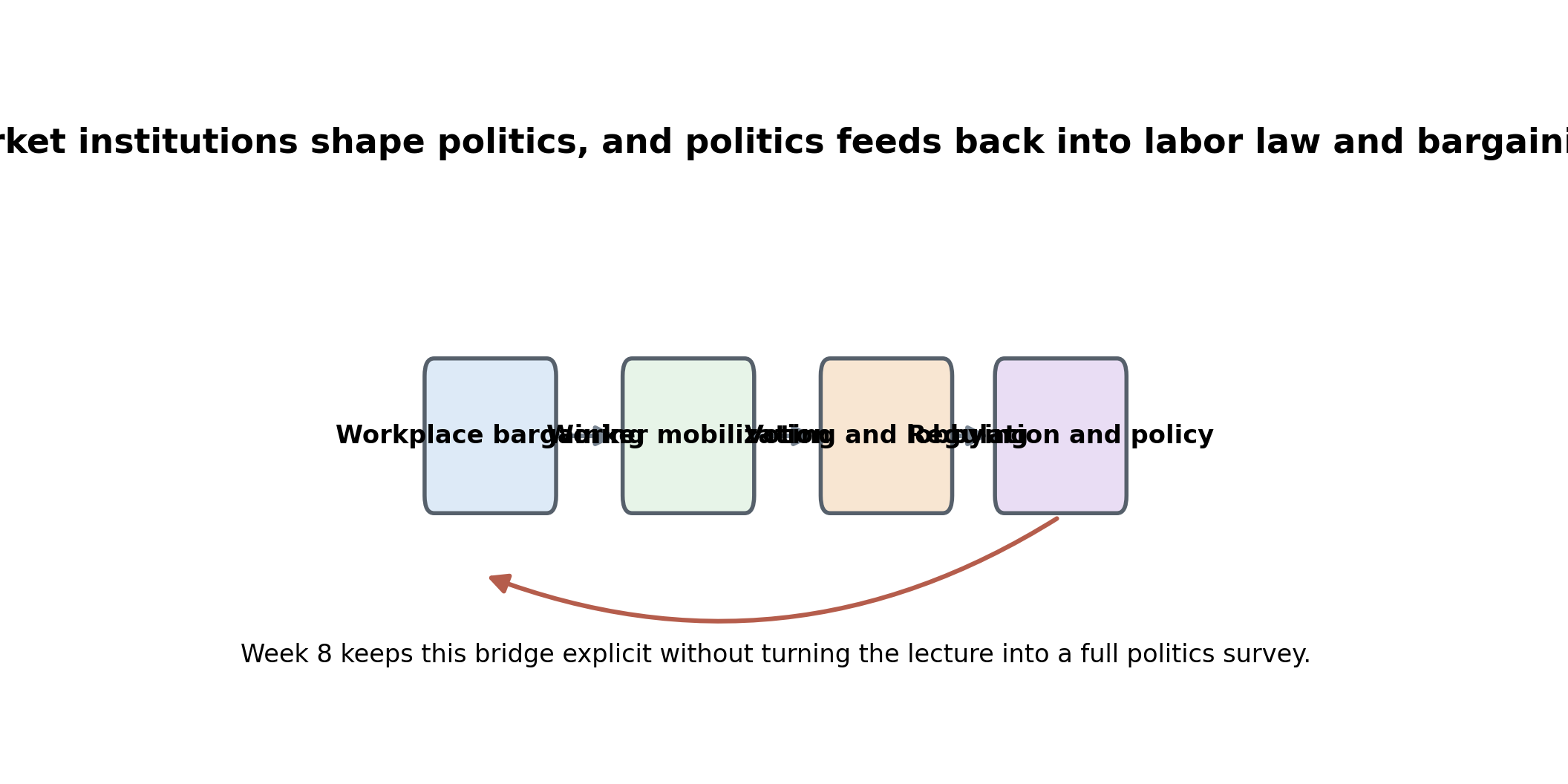
Figure 5:Collective bargaining can transmit workplace organization into political participation, lobbying, and regulation, but those political effects remain an adjacent bridge rather than the main estimand of Week 8.
Figure Figure 5 is intentionally small and explicit. It bridges outward without turning the chapter into a general political-economy survey.
Kaplan & Naidu, 2025 is the anchor here. The identifying variation comes from institutional change, political data, and the interaction between labor organizations and electoral or policy outcomes. The unit is the worker, union, region, or political jurisdiction depending on the design. The observed margins are turnout, policy support, coalition formation, and regulation. The key unobserved object is the full counterfactual political environment absent labor organization. The point for Labor II is not to re-teach political economy. It is to say clearly why labor economists care: workplace organization can shift both wage-setting and the rules under which wage-setting occurs.
Research Lab
The optional extension block for Week 8 should feel like a research workshop on institutions rather than a catch-all appendix. Four directions are especially productive.
First, coverage regimes vary far more across countries than union membership does, which makes international comparisons especially useful for distinguishing bargaining architecture from organizational density Jäger et al., 2024. Second, unions and monopsony interact: collective bargaining can counter employer wage-setting power, but the size of that correction depends on outside options, product-market rents, and who gets organized. Third, spillovers inside partially unionized firms remain undermeasured because uncovered workers are often affected by common wage policies and threat effects. Fourth, new data on union campaigns, elections, and worker beliefs create better opportunities to study organizing demand separately from realized certification outcomes Pezold et al., 2023.
The bounded Week 8 lab follows Reproduce -> Diagnose -> Transfer. The reproduction anchor is Farber et al., 2021, where the object is the contribution of union coverage and related exposure to wage compression and inequality over time. The diagnose anchor is DiNardo & Lee, 2004, where the object is the local causal effect of close certification wins on establishments and workers near the threshold. The optional extension anchor is Fortin et al., 2021, where the object is spillovers onto uncovered workers and the aggregate wage distribution. The lab handout lives at lab.md.
The research extension should explicitly push students to ask four questions of any new paper.
Is the paper estimating membership, coverage, organizing, or bargaining regime?
Is the effect direct on covered workers, indirect through spillovers, or threat-based on uncovered workers?
What identifying variation makes the result credible?
What key object remains latent: worker demand for unions, employer opposition, uncovered spillovers, or the untreated political environment?
Methods Box
Week 8 only works if the empirical objects remain separate.
Union membership is not the same thing as collective-bargaining coverage.
Firm-level bargaining is not the same thing as sectoral bargaining, multi-employer bargaining, or extension regimes.
Direct effects on covered workers are not the same thing as spillovers or threat effects on uncovered workers.
Certification-election RD designs identify marginal organizing victories, not the full aggregate role of unions.
Matched employer-employee designs reveal payroll, employment, and composition more directly, but still do not automatically solve spillover and general-equilibrium problems.
Historical decompositions and distributional studies are especially informative about wage compression and inequality, but they rely on stronger assumptions than close-election designs.
Private-sector unionization should not be conflated with public-sector or education-sector bargaining when the legal environment differs.
Different papers can disagree because they study different objects: membership versus coverage, wages versus employment versus survival, selection into organizing, and different notions of spillover.
Every empirical claim in this week should name the identifying variation, unit of observation, observed margin, and key unobserved object.
Reading Ladder And References
Required / field core
Jäger et al., 2024 for the membership-versus-coverage distinction and the international wage-structure perspective.
Farber et al., 2021 for unions as a distributional institution shaping wage compression and inequality over time.
DiNardo & Lee, 2004 for the canonical certification-election RD and the local causal effect of marginal union victories.
Strong complements
Frandsen, 2021 for matched employer-employee evidence on earnings, payroll, and employment after close election wins.
Dinlersoz et al., 2017 for who gets organized and why takeup differs across establishments.
Pezold et al., 2023 for organizing and labor-market tightness.
Fortin et al., 2021 for spillovers and the wage-distribution role of labor-market institutions.
Hirsch, 2008 for the competition, productivity, and coexistence perspective.
Optional / frontier / bridge outward
Fortin et al., 2022 for right-to-work, unionization, and wage-setting under policy change.
Kaplan & Naidu, 2025 for the political-economy bridge from labor organization to policy and coalitions.
Harju et al., 2025 for worker voice beyond a pure wage-premium interpretation.
Hirsch & Macpherson, 2003 for CPS/Unionstats measurement of membership and coverage.
Exercises And Discussion Prompts
Use Equation (1) to explain why a decline in union membership need not imply a one-for-one decline in bargaining coverage.
Why is Equation (2) only a schematic bargaining object rather than a literal estimate of every union effect?
In Dinlersoz et al., 2017, what is the observed unit, and why does that matter for interpreting organizing selection?
In DiNardo & Lee, 2004, what variation identifies the estimate, what margin is observed, and what broader object remains unobserved?
How does Frandsen, 2021 change what we learn relative to a pure establishment-level close-election design?
Use Equation (4) to distinguish positive spillovers, threat effects, and negative crowd-out in the uncovered sector.
Why can a country with modest union membership still have high bargaining coverage and substantial wage compression?
Why are nonunion workers inside partially unionized firms not automatically clean controls for covered workers?
In Farber et al., 2021, what makes the object a distributional decomposition rather than a local organizing treatment effect?
Propose one transfer design using a CPS/Unionstats panel, certification-election panel, or synthetic coverage-inequality panel. Name the observed unit, observed margin, identifying variation, and key unobserved object.
Reproducibility And Code Lab Note
The Week 8 code lab is deliberately bounded and fully local. The reproduction step uses a synthetic state-year panel in the spirit of Farber et al., 2021 so students can separate membership, coverage, direct compression, and spillover compression without requiring confidential microdata. The diagnose step uses a synthetic certification-election panel in the spirit of DiNardo & Lee, 2004, forcing students to say explicitly that the object is organizing success near a legal threshold rather than broad coverage or equilibrium union density. The optional extension asks how the same logic transfers to a public CPS/Unionstats panel or to a spillover design inspired by Fortin et al., 2021. The bounded path runs locally; the handout lives at lab.md.
Slide Companion Note
The Week 8 slide deck is designed to stay lighter than the chapter even though this is a heavy institution week. The deck should define the question, isolate the membership-versus-coverage distinction, show the collective-bargaining and organizing pipelines, separate direct from spillover effects, and end by bridging backward to Week 7 minimum wages and forward to Week 9 labor regulation, enforcement, and insurance. The canonical source is 08
Bridge Forward
Use this closing bridge to carry the module’s labor object, mechanism, and evidence into the next course step or research-design exercise.
- Jäger, S., Naidu, S., & Schoefer, B. (2024). Collective Bargaining, Unions, and the Wage Structure: An International Perspective (Working Paper No. 33267). National Bureau of Economic Research. 10.3386/w33267
- Hirsch, B. T. (2008). Can Unions and Industrial Competition Coexist? Journal of Economic Perspectives, 22(1), 153–176. 10.1257/jep.22.1.153
- Kaplan, E., & Naidu, S. (2025). Between Government and Market: The Political Economics of Labor Unions. Annual Review of Economics, 17, 367–396. 10.1146/annurev-economics-051520-025251
- Hirsch, B. T., & Macpherson, D. A. (2003). Union Membership and Coverage Database from the Current Population Survey: Note. ILR Review, 56(2), 349–354. 10.1177/001979390305600208
- Harju, J., Jager, S., & Schoefer, B. (2025). Voice at Work. American Economic Journal: Applied Economics, 17(3), 271–309. 10.1257/app.20220451
- Farber, H. S., Herbst, D., Kuziemko, I., & Naidu, S. (2021). Unions and Inequality over the Twentieth Century: New Evidence from Survey Data. Quarterly Journal of Economics, 136(3), 1325–1385. 10.1093/qje/qjab012
- Dinlersoz, E., Greenwood, J., & Hyatt, H. (2017). What Businesses Attract Unions? Unionization over the Life Cycle of U.S. Establishments. ILR Review, 70(3), 733–766. 10.1177/0019793916654926
- Pezold, C., Roth, C., & Schoefer, B. (2023). Labor Market Tightness and Union Activity (Working Paper No. 31988). National Bureau of Economic Research. 10.3386/w31988
- DiNardo, J., & Lee, D. S. (2004). Economic Impacts of New Unionization on Private Sector Employers: 1984–2001. Quarterly Journal of Economics, 119(4), 1383–1441. 10.1162/0033553042476217
- Frandsen, B. R. (2021). The Surprising Impacts of Unionization: Evidence from Matched Employer–Employee Data. Journal of Labor Economics, 39(4), 861–894. 10.1086/711852
- Fortin, N. M., Lemieux, T., & Lloyd, N. (2021). Labor Market Institutions and the Distribution of Wages: The Role of Spillover Effects. Journal of Labor Economics, 39(S2), S369–S412. 10.1086/712923
- Fortin, N., Lemieux, T., & Lloyd, N. (2022). Right-to-Work Laws, Unionization, and Wage Setting (Working Paper No. 30098). National Bureau of Economic Research. 10.3386/w30098