Synthesis and Student Research Designs
Learning Objectives
By the end of Week 13, students should be able to:
place a labor-market question inside one integrated map of workers, firms, frictions, institutions, and shocks;
explain how Labor I worker-side objects and Labor II market-side objects fit together in modern labor economics;
choose deliberately among worker-, firm-, establishment-, occupation/task-, region-, and market-level units of analysis;
distinguish descriptive, reduced-form, and structural approaches without treating them as a prestige ranking;
separate policies from shocks, direct effects from spillovers, and partial-equilibrium responses from equilibrium conclusions;
explain how wage-setting, labor market power, institutions, and major shocks interact rather than treating each block as a silo;
turn a labor-market mechanism into a bounded research design that names the treatment object, observed margin, and offstage equilibrium channels;
identify frontier directions that connect Labor II to Behavioral Labor, Labor Markets and Political/Cultural Institutions, and dissertation-scale questions.
Opening Orientation
The economic question for Week 13 is explicit: when a labor-market outcome changes, how do we decide whether the key object is worker choice, firm behavior, market friction, institution, or shock, and what kind of empirical design is needed to learn something credible about it?
Bridge
Labor I to Labor II and back again
Labor I centered the worker. It emphasized labor supply, human capital, households, inequality, discrimination, mobility, and policy targeted at individuals or families. Labor II kept those worker-side objects alive, but embedded them inside firms, search frictions, wage-setting institutions, labor market power, and large market-level shocks. The two-semester sequence is therefore best understood as one field with two vantage points rather than two disconnected courses.
The practical reason this bridge matters is that a wage, employment, or mobility outcome rarely comes from one mechanism alone. Worker heterogeneity remains important, but it is filtered through labor demand, organizational design, bargaining environments, institutional coverage, enforcement capacity, and the propagation of macro, technology, and trade shocks Hicks, 1932Hamermesh, 1993Mortensen & Pissarides, 1994.
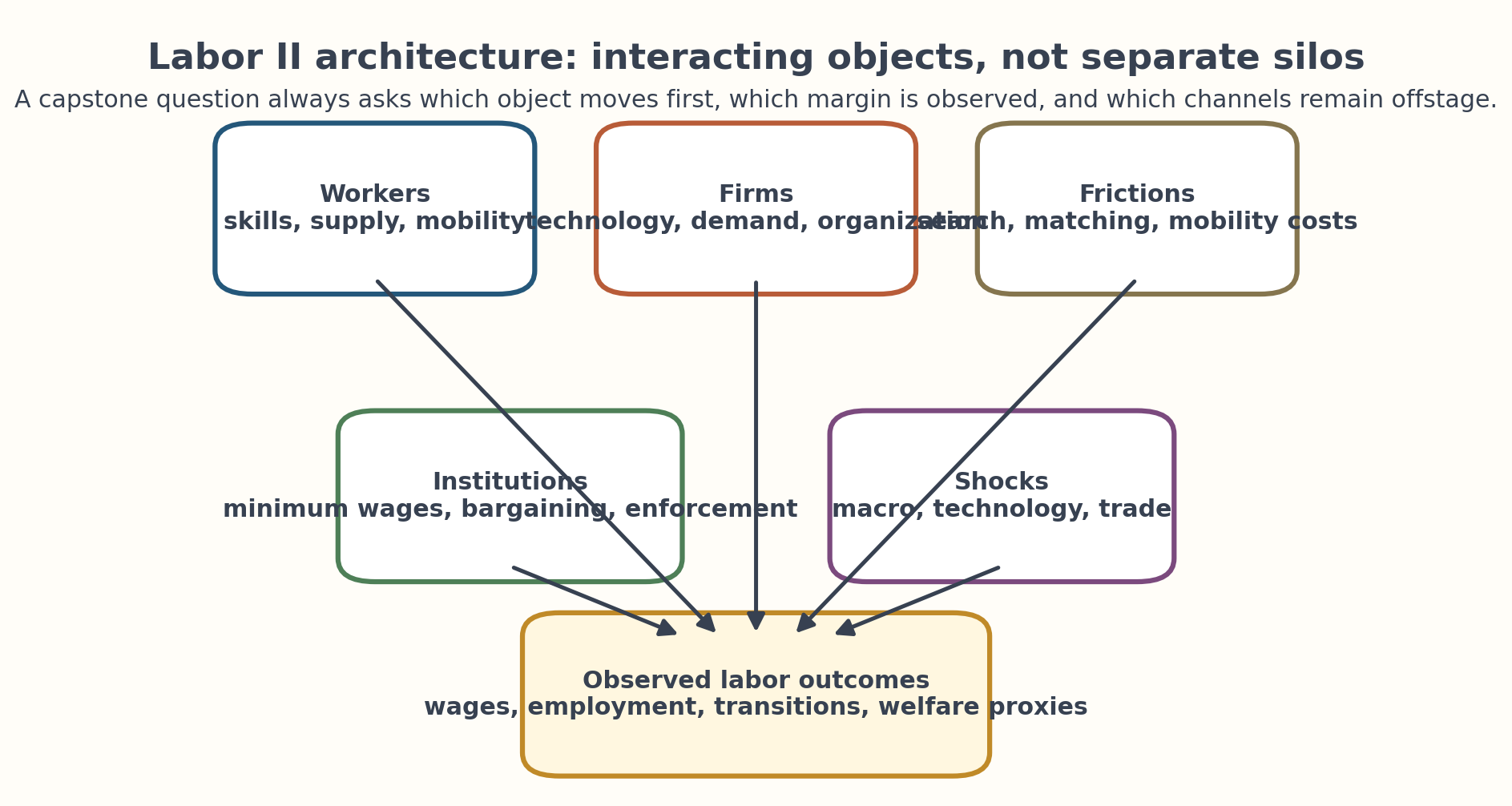
Figure 1:Week 13 reorganizes Labor II as one architecture rather than a list of topics. Workers, firms, frictions, institutions, and shocks interact through different units of observation, horizons, and equilibrium channels.
Table 1:Labor II architecture map for Week 13
| Block | Core object | Canonical units | Representative empirical question | Key equilibrium caution | Bridge beyond the course |
|---|---|---|---|---|---|
| Labor demand and firm behavior | cost minimization, adjustment, organization | firm, establishment, plant | how do product or labor-cost shocks change hiring and pay? | local firm responses may miss market-wide pass-through and reallocation | personnel economics, production networks, organizational economics |
| Search, wage-setting, and unemployment | matching, bargaining, posting, outside options | worker, firm, labor market | how are wages and transitions shaped by frictions and nonemployment values? | observed transition or wage effects need not pin down surplus division or welfare | behavioral labor, macro-labor, structural search |
| Labor market power | labor supply to the firm, markdowns, rents | firm, occupation, local market | where does monopsony power come from and how is it measured? | concentration, mobility, and markdowns are related but not identical | antitrust, market design, labor law |
| Institutions and regulation | coverage, enforcement, incidence, spillovers | worker, firm, region, policy regime | which margins are directly treated and where do uncovered effects go? | direct treatment effects rarely equal full equilibrium or welfare effects | political/cultural institutions, public policy, comparative labor systems |
| Macro and market-level shocks | cyclical, technological, trade shocks | worker, firm, place, market | how do shocks propagate through employment, wages, mobility, and sorting? | worker adjustment, place persistence, and aggregate welfare can diverge | technology, trade, development, economic history |
| Capstone research design | question -> mechanism -> unit -> design | any of the above | what is the smallest credible project that contributes something real? | attractive questions fail when the unit, mechanism, or counterfactual is vague | dissertation design, field papers, special-topics courses |
Table Table 1 gives the semester’s compact architecture. It is useful precisely because it does not pretend that all questions have the same unit, treatment, or counterfactual.
One architecture object for the semester
The capstone object for the course is
Equation (1) is not itself a structural model. It is a disciplined organizing device. The index may refer to a worker, firm, establishment, occupation/task cell, region, or market depending on the question. The point is to force the class to ask what changes in the mapping from fundamentals to observed outcomes when the unit changes.
The economic content of the components is straightforward.
captures worker heterogeneity, skills, demographics, search intensity, and outside options.
captures technology, productivity, organization, management, and labor-demand conditions.
captures frictions such as search, mobility costs, bargaining environments, and information asymmetries.
captures institutions and regulation such as wage floors, bargaining systems, enforcement, insurance, and legal constraints.
captures shocks, including macro fluctuations, technology adoption, and trade exposure.
The payoff from writing the architecture this way is that it makes clear why Labor II is not just “firm behavior” or just “policy.” It is about how these objects interact.
Field Core
Choosing the unit of analysis is part of the theory
Students often treat the unit of analysis as a data-management choice. In labor economics it is part of the conceptual design.
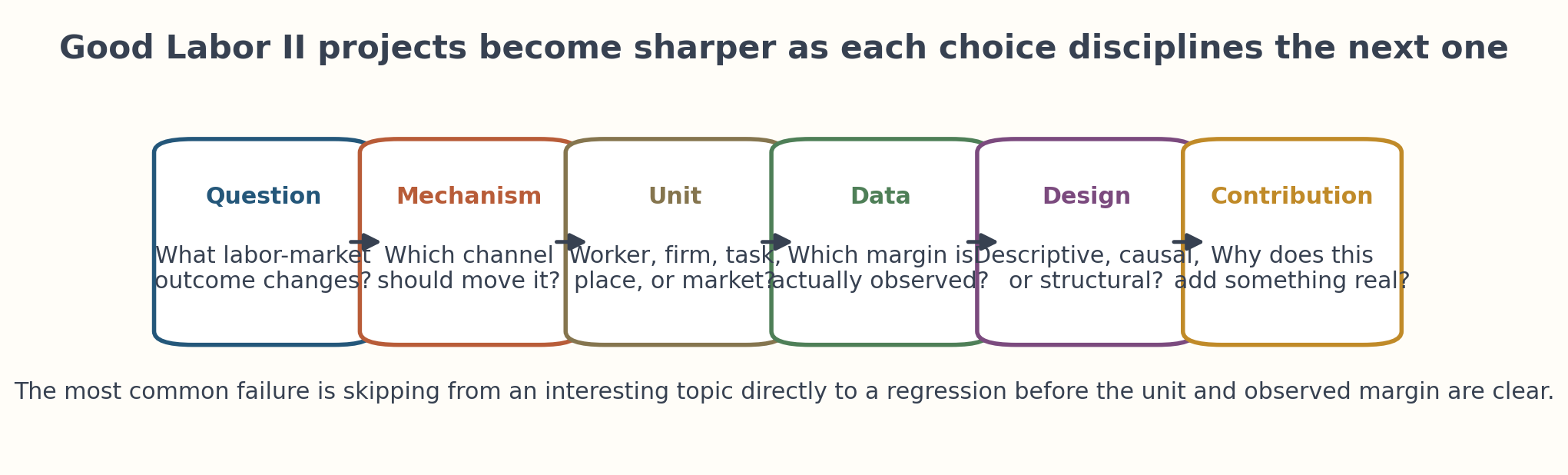
Figure 2:The research pipeline in Labor II should run from question to mechanism, then to unit, data, design, equilibrium scope, and contribution. Good projects become clearer as each choice disciplines the next one.
The basic unit framework is:
Worker: use when the mechanism is about earnings, employment, search, mobility, learning, or welfare distribution across people.
Firm or establishment: use when the mechanism is about labor demand, organization, wage-setting, adoption, or compliance inside production units.
Occupation or task: use when the object is exposure, job content, task substitution, or the measurement of work.
Region or local labor market: use when shocks or policies operate through place-based exposure, commuting zones, or regional spillovers.
Market or policy regime: use when the main object is institutional coverage, equilibrium incidence, or comparison across bargaining or regulatory systems.
Each unit does something well and leaves something offstage. Worker panels are strongest on individual trajectories but may miss general-equilibrium price and entry responses. Firm or establishment data are strong on direct adjustment but weaker on uncovered labor-market spillovers. Occupation or task cells are useful for measurement and exposure design but are often far from welfare objects. Regional designs identify place incidence well but do not, by themselves, identify the welfare of incumbent workers. Market-level comparisons clarify institutions but often aggregate away rich heterogeneity.
The class should therefore ask four questions every time the unit is chosen:
What is the unit of treatment?
What is the unit of observation?
What margin is actually observed?
Which equilibrium channels are offstage because of that choice?
A generic empirical object and what it does not guarantee
Much of the empirical literature can be summarized by
Equation (2) looks familiar, but its content changes dramatically with , , and .
If is a worker, then may be treatment exposure, a layoff event, a union contract, or a human-capital shock.
If is a firm or establishment, then may be a payroll-tax change, technology adoption, a merger, or enforcement intensity.
If is a local labor market, then may be import exposure, robot exposure, or regional policy intensity.
If is a market or policy regime, then may be bargaining coverage, a statutory wage floor, or an insurance rule.
The capstone lesson is that the equation is never the main intellectual contribution. The main contribution comes from the match between question, mechanism, unit, variation, and claim.
Descriptive, reduced-form, and structural approaches are choice problems
The semester should leave students with a clear framework for choosing among three broad approaches.
Descriptive or decomposition work: best when the first-order contribution is measurement, classification, trend decomposition, exposure construction, or a new empirical object.
Reduced-form causal work: best when a policy or shock is well defined, the treatment object is clear, and the observed margin is closely aligned with the question.
Structural or equilibrium work: best when the question requires counterfactual welfare analysis, equilibrium spillovers, dynamic adjustment, or policy simulations outside the support of the observed variation.
This is not a status hierarchy. Descriptive work is enough when the field lacks a clean measure. Reduced-form work is enough when the policy or shock is sharp and the claim is local. Structural work becomes necessary when the question itself is about equilibrium propagation, welfare, or counterfactual policy combinations Saez et al., 2019Kim & Vogel, 2021.
Comparative synthesis I: wage-setting and labor market power
Weeks 1 through 8 can be reread as one large wage-setting block. Labor demand sets the value of labor to firms; search and matching generate frictions; bargaining and posting determine how surplus is split; monopsony determines the elasticity of labor supply to the firm; unions and collective bargaining create institutional voice; and wage floors or labor standards alter the outside-option and coverage environment Hicks, 1932Mortensen & Pissarides, 1994Hall & Milgrom, 2008Yeh et al., 2022Jäger et al., 2024.
The unifying question is not “which model is correct?” It is “which wage-setting margin is doing the work here?” The answer differs across designs.
In a labor-demand setting, wages matter because they shift cost and scale decisions.
In a search-and-bargaining setting, wages depend on nonemployment values, outside offers, and surplus division.
In a modern monopsony setting, wages depend on labor supply to the firm, mobility frictions, and rents.
In an institutional setting, wages also depend on coverage, bargaining coordination, legal standards, and enforcement.
Saez et al., 2019 is useful here because it makes incidence, labor demand, and rent sharing interact rather than treating them as separate literatures. Yeh et al., 2022 clarifies that concentration, markdowns, and mobility are related but not identical objects. Jäger et al., 2024 shows that bargaining institutions reshape the wage structure in ways that cannot be reduced to one competitive benchmark.
The big synthesis point is that labor market power is not an optional add-on to wage-setting. It is one of the mechanisms that determines how wages, employment, pass-through, and policy incidence are translated into observed outcomes.
Comparative synthesis II: institutions and regulation
The institution block is easiest to understand when students stop asking whether a policy “works” in the abstract and instead ask four narrower questions.
What margin is directly targeted?
Who is directly covered?
Where do spillovers go?
Which outcome object is being observed, and which welfare object remains offstage?
Minimum wages, bargaining systems, labor law, enforcement, insurance, and transparency policies all differ along these dimensions Cengiz et al., 2019Jäger et al., 2024MacLeod, 2011. A minimum wage directly targets the lower tail of the wage distribution, but its incidence also runs through employment, hours, prices, turnover, composition, compliance, and spillovers. Collective bargaining changes wages and worker voice, but it also changes coverage, compression, coordination, and the translation of productivity into pay. Labor law and enforcement are not separable because rights without compliance capacity are weak treatments.
The capstone lesson is that institutions change the mapping from micro behavior to equilibrium outcomes. That is why policy evaluation in Labor II is rarely only about a treated worker or a treated firm. It is about coverage, uncovered margins, and equilibrium response.
Comparative synthesis III: macro, technology, and trade shocks
The shock block of Labor II is best taught comparatively. Macro fluctuations, technology, and trade are not the same shock, but they all raise the same discipline questions: what is exposed, which margin adjusts first, what horizon is being measured, and what kind of equilibrium object is needed to interpret the result Shimer, 2005Acemoglu & Restrepo, 2020Autor et al., 2013Kim & Vogel, 2021.
Macro shocks highlight vacancies, unemployment, job-finding, separations, wage cyclicality, and matching efficiency. Technology shocks highlight tasks, firm adoption, worker learning, and local reallocation. Trade shocks highlight import competition, export exposure, offshoring, local incidence, and slow worker or place adjustment. The bridge across all three is that short-run observed outcomes and long-run welfare interpretations are rarely the same object.
This is why the course should always distinguish:
worker adjustment from place adjustment;
short-run incidence from long-run reallocation;
direct exposure from indirect spillovers;
observed outcomes from counterfactual welfare objects.
Policies versus shocks are analytically different objects
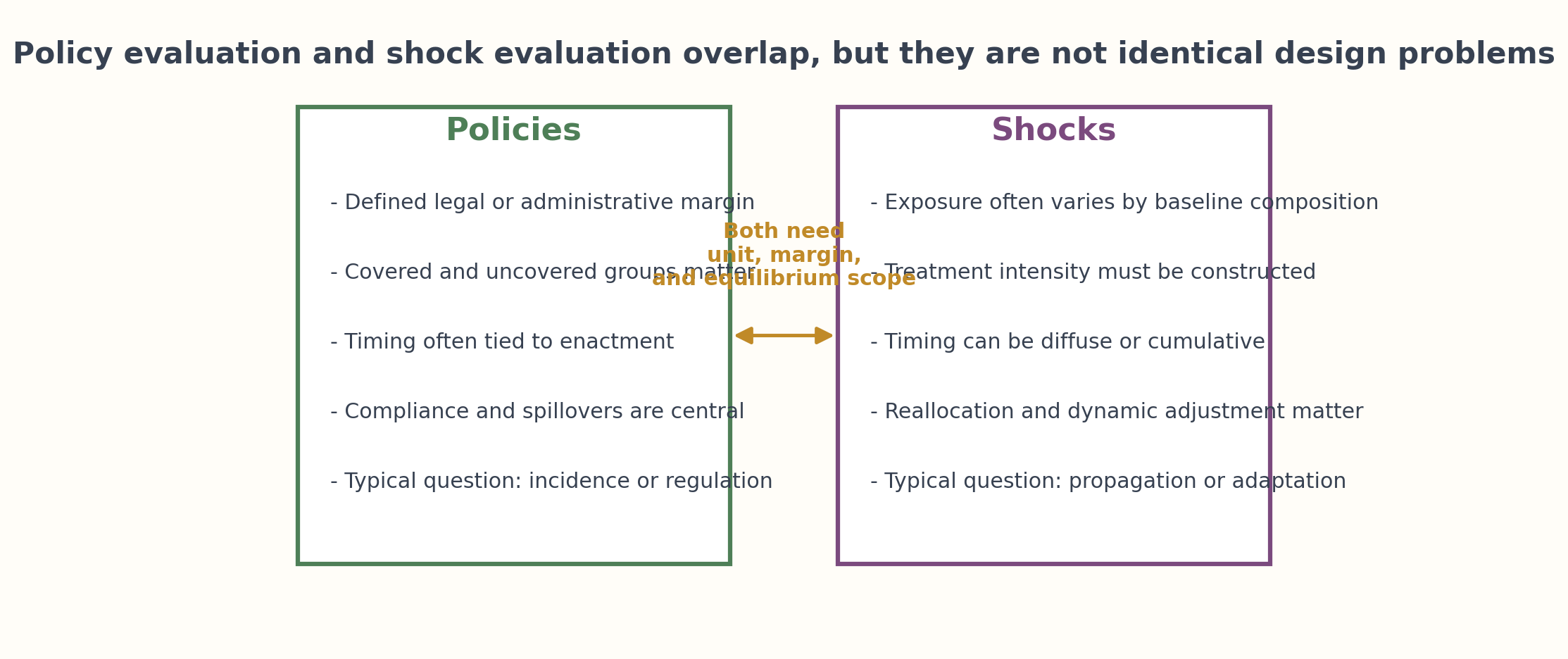
Figure 3:Policies and shocks both move labor markets, but they differ in timing, treatment assignment, equilibrium propagation, and the counterfactual questions they invite. Keeping those differences visible improves both empirical design and interpretation.
Policies and shocks should not be thrown into one generic “treatment effects” bucket.
A policy usually has a legal or administrative margin, a covered population, and a natural implementation date.
A shock usually changes prices, exposure, technology, or demand conditions without clean coverage boundaries.
Policy evaluation often centers on compliance, incidence, and spillovers from a rule.
Shock evaluation often centers on exposure mapping, transmission channels, and dynamic adjustment.
The difference matters for design. A minimum-wage study can often define the treated jurisdiction and the statutory timing. A robot or trade-exposure study often needs a model of how sectoral change maps into local treatment intensity. The equilibrium challenge also differs. Policies typically invite questions about avoidance, uncovered sectors, prices, and legal enforcement. Shocks typically invite questions about reallocation, migration, entry, sectoral shifts, and dynamic propagation.
Partial equilibrium, equilibrium reasoning, and welfare caution
One of the most important habits Labor II should leave behind is resistance to over-claiming. A coefficient on wages, employment, or transitions is not yet a welfare statement.
Equation (3) is a warning label. Without additional assumptions on spillovers, incidence, adjustment, and distributional weights, a reduced-form estimate does not map mechanically into welfare. The main cases where students must slow down are familiar.
Place-level losses do not automatically equal incumbent-worker welfare losses.
Short-run employment declines do not settle long-run adjustment questions.
Treated-firm effects do not equal market-wide incidence.
Measured wages or employment do not exhaust nonwage amenities, insurance, or worker voice.
The practical takeaway is not that reduced-form evidence is weak. It is that reduced-form evidence is strongest when the question is local and the claim is disciplined. The moment the paper’s conclusion depends on uncovered margins, equilibrium spillovers, or welfare aggregation, more structure is needed.
When is a design “enough”?
The capstone should help students avoid both overreach and needless escalation.
A descriptive design is enough when the field lacks a clean object, exposure measure, decomposition, or measurement frame.
A reduced-form design is enough when the mechanism and observed margin line up well enough to answer a bounded causal question.
A structural design is needed when the contribution requires equilibrium propagation, welfare, dynamic transition paths, or policy counterfactuals beyond the observed variation.
The phrase “enough” is doing real work here. The point is not to upgrade every good question into a structural dissertation. The point is to match the design to the claim.
From question to mechanism to contribution
The capstone research template for Labor II is:
question;
mechanism;
unit;
data;
design;
counterfactual scope;
contribution.
Table 2:Research-design template for Week 13
| Step | Question the student must answer | Good sign | Common failure mode |
|---|---|---|---|
| Question | What labor-market outcome or mechanism am I trying to explain? | narrow, labor-focused, mechanism-aware question | vague “effect of X on labor market” |
| Mechanism | Through what channel should the effect operate? | one or two disciplined channels | treating all observed gaps as the same mechanism |
| Unit | What is the correct unit of treatment and observation? | worker, firm, place, or market chosen deliberately | unit of treatment and unit of outcome silently differ |
| Data | What data actually observe the margin I care about? | outcome and treatment are both observable or plausibly measured | data are convenient but do not match the mechanism |
| Design | Is this descriptive, reduced-form, or structural? | method matches the claim | over-claiming from a weak design |
| Equilibrium scope | What spillovers or uncovered margins matter? | explicit statement of what is offstage | treating direct effects as full market outcomes |
| Contribution | What does the paper add relative to existing work? | clean gap, new margin, new setting, or new method | novelty defined only by “new data” |
| Extension | What bounded next step would deepen the contribution? | feasible follow-on design or robustness path | extension is really a new dissertation |
Table Table 2 is the practical template for research design memos. It is meant to convert broad curiosity into a bounded first project.
The common successful paths look different from one another.
A worker-side extension may ask whether an established place-level shock also changes mobility, job ladders, or within-worker wage growth.
A firm-side extension may ask whether a known policy or shock works differently through organizational design, compliance capacity, or pass-through.
A task or occupation extension may improve measurement rather than estimate a new causal effect.
A market-level extension may ask whether an institution changes spillovers, coordination, or equilibrium adjustment rather than only direct treatment effects.
What these successful paths share is not the same method. It is that the contribution is clear before the specification is.
Common failure modes
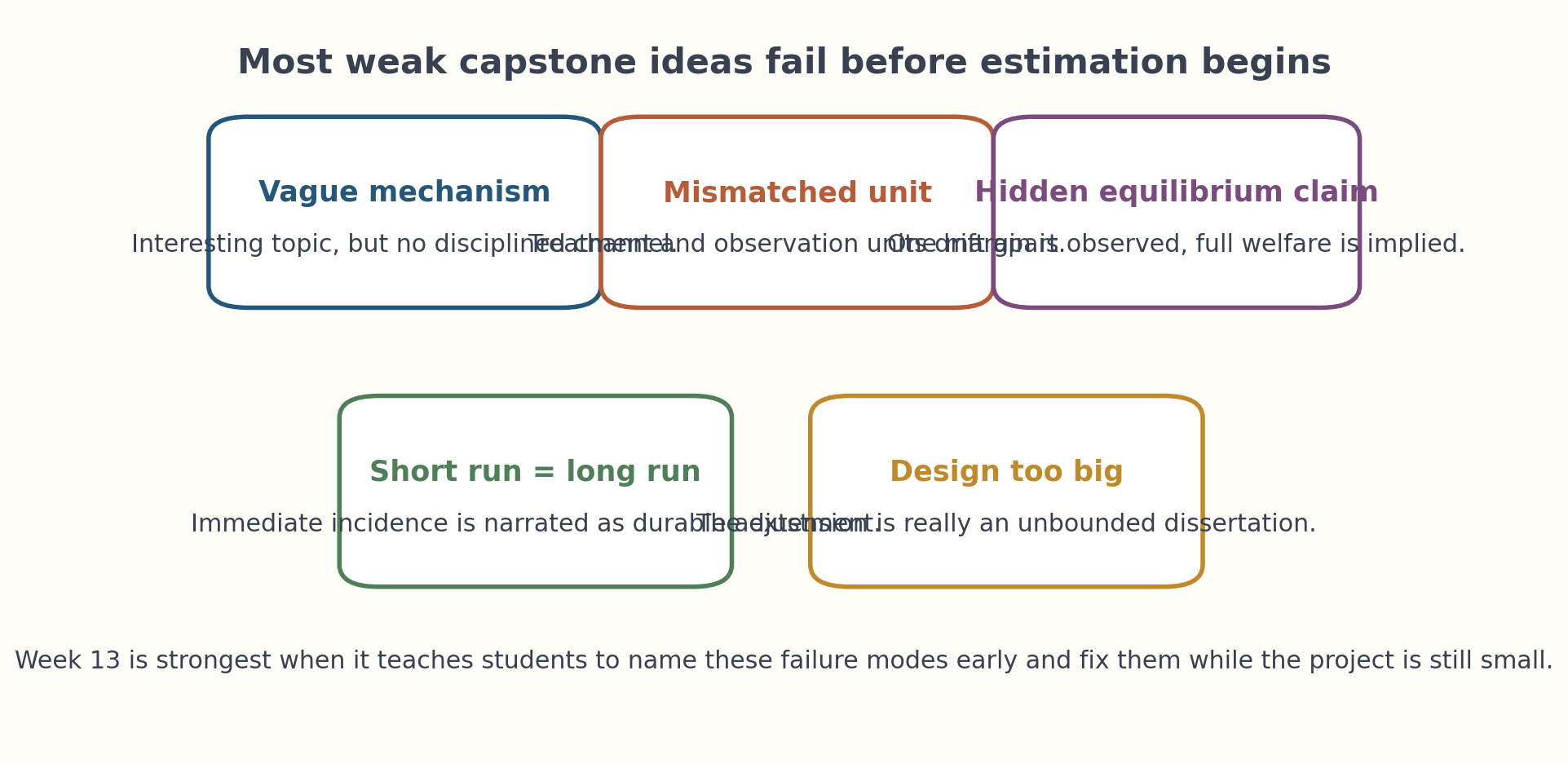
Figure 4:The most common Week 13 mistakes are conceptual before they are econometric: vague mechanisms, mismatched units, hidden equilibrium claims, and over-interpretation of one observed margin.
The recurring mistakes in labor-market research design are predictable.
confusing gaps with mechanisms;
letting the unit of treatment and unit of observation drift apart without explanation;
narrating a short-run coefficient as if it were a long-run equilibrium result;
treating a place effect as if it were automatically a worker-welfare statement;
using “equilibrium” language without naming the equilibrium object;
claiming policy relevance without saying who is covered and where spillovers go.
The reason to make these mistakes explicit is supportive rather than punitive. Most weak early-stage projects fail here, not because the student lacks technique, but because the empirical object and the conceptual claim were never fully matched.
Frontier directions and bridge beyond Labor II
Table 3:Frontier directions and bridges for Week 13
| Frontier theme | Why it matters now | Natural bridge from Labor II | Candidate data / design directions |
|---|---|---|---|
| Worker power and antitrust | labor market power is measured more credibly and connected to policy | Weeks 5--8: wage-setting, monopsony, unions | matched worker-firm data, merger shocks, vacancy data, bargaining institutions |
| AI, algorithmic management, and worker voice | technology is changing both firm control and worker adaptation | Weeks 3, 5, 11 | personnel data, randomized firm rollouts, task text, policy variation |
| Enforcement, informality, and compliance | formal rules matter only when enforced | Weeks 7--9 | inspections, complaints, transparency rules, linked administrative data |
| Long-run worker adjustment to shocks | short-run incidence often misses durable worker trajectories | Weeks 10--12 | panel earnings data, event studies, worker/place decompositions |
| Services trade and global labor-market exposure | globalization increasingly works through services and supply chains | Week 12 plus Week 11 technology | worker task data, firm trade links, occupation exposure measures |
| Comparative institutions and political economy | institutions mediate how labor-market mechanisms operate | Weeks 8--9 and future institutions course | cross-country institutional panels, legal changes, historical reforms |
| Dissertation-ready field-paper ideas | students need bounded but meaningful projects | entire sequence | anchor-paper extension, quasi-experimental add-on, measurement project, structural counterfactual |
Table Table 3 maps the next step outward from the core course. The point of the frontier section is not to declare a trend list. It is to show how a bounded Labor II design can connect to later field courses and dissertation questions.
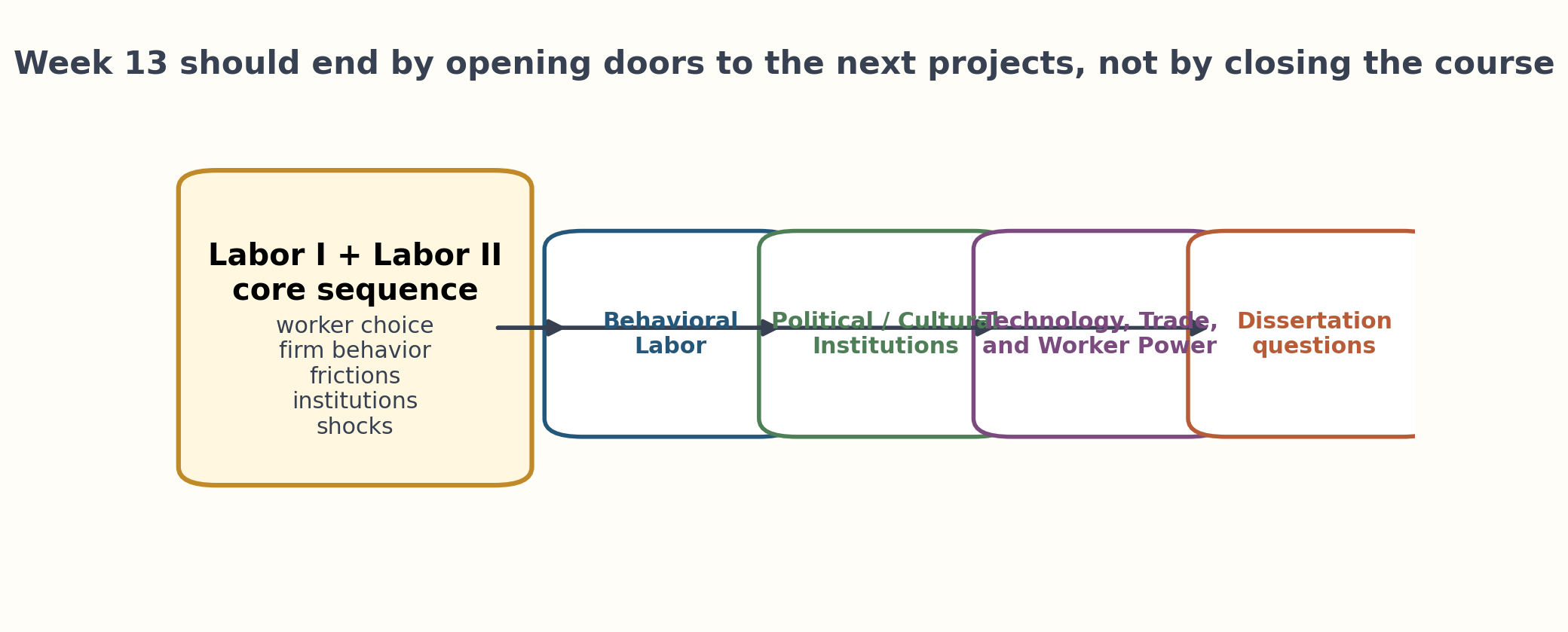
Figure 5:Week 13 should end with a bridge, not a summary. Labor II provides the market-side backbone for later work on behavioral frictions, political and cultural institutions, worker power, technology, globalization, and dissertation-scale labor questions.
Three outward bridges are especially important.
Back to Labor I: the next research step may revisit worker heterogeneity, human capital, family constraints, inequality, discrimination, or mobility with better market-side discipline.
Toward Behavioral Labor: search behavior, application technology, worker beliefs, firm evaluation, and bounded rationality become more interesting once search frictions, wage-setting, and institutions are already onstage.
Toward Labor Markets and Political/Cultural Institutions: bargaining systems, enforcement, informality, norms, identity, and state capacity can be studied as labor-market objects rather than as detached political-economy background.
At the dissertation level, the strongest Week 13 projects are usually modest in scale but sharp in mechanism. A student does not need the field’s grand unified model. The student needs a labor-market question with a credible unit, observable margin, and honest statement about what remains offstage.
Research Lab
The Week 13 lab is a capstone studio rather than a standard single-paper replication. Its logic is Diagnose -> Compare -> Design.
Students should choose one anchor paper, or one tightly related pair, from the required capstone menu:
For the chosen anchor, the lab requires students to identify:
the central labor-market mechanism;
the unit of treatment and observation;
the observed margin;
the key equilibrium concern;
one plausible extension or transfer design.
The local handout lives at lab.md. The bounded local path generates a memo-ready artifact rather than a full estimation exercise, but it still produces a concrete research-design document that can be discussed, revised, and smoke-tested.
Methods Box
Keep these distinctions explicit throughout the capstone.
Worker-level, firm-level, establishment-level, occupation/task-level, place-level, and market-level objects answer different questions.
Policies and shocks are different treatment families and should not be interpreted with identical logic.
Partial-equilibrium effects and equilibrium effects are distinct objects even when they use similar notation.
Short-run adjustment and long-run adjustment can move in opposite directions.
Descriptive decomposition, reduced-form identification, and structural counterfactual analysis support different claims.
Outcome variables such as wages, employment, unemployment, or transitions are not automatically welfare objects.
Direct treatment effects and spillovers must be separated whenever coverage or reallocation matters.
A design is only as credible as its definition of treatment, observed margin, and offstage equilibrium channels.
Reading Ladder And References
Ladder A. Architecture and classic foundations
Hicks, 1932
Hamermesh, 1993
Ladder B. Wage-setting, power, and institutions
Ladder C. Shocks and adjustment
Ladder D. Capstone studio and frontier directions
one paper from the wage-setting or labor-power block
one paper from the institution or regulation block
one paper from the macro-adjustment block
one paper from the technology or trade block
Exercises And Discussion Prompts
Pick one result from Labor I and one result from Labor II that seem to conflict. Is the tension about mechanism, unit, horizon, or equilibrium scope?
Take one famous policy paper and one famous shock paper from the course. Compare their treatment object, observed margin, and main offstage equilibrium channel.
Choose a student research idea and state the smallest design that would be enough to support its central claim. Then state what stronger claim would require structural or equilibrium machinery.
Compare a worker-level extension and a place-level extension of the same anchor paper. Which one is more informative for mechanism, and which one is more informative for welfare?
Reproducibility And Code Lab Note
Week 13’s bounded lab path is memo-first by design. The local script builds an anchor-paper menu and a structured research-design memo scaffold rather than a full replication package. That is deliberate: the pedagogical goal is to make students diagnose, compare, and design with discipline before they scale up to data-heavy work.
Slide Companion Note
The slide companion for this week lives at 13
Bridge Forward
Use this closing bridge to carry the module’s labor object, mechanism, and evidence into the next course step or research-design exercise.
- Hicks, J. R. (1932). The Theory of Wages. Macmillan.
- Hamermesh, D. S. (1993). Labor Demand. Princeton University Press.
- Mortensen, D. T., & Pissarides, C. A. (1994). Job Creation and Job Destruction in the Theory of Unemployment. Review of Economic Studies, 61(3), 397–415. 10.2307/2297896
- Saez, E., Schoefer, B., & Seim, D. (2019). Payroll Taxes, Firm Behavior, and Rent Sharing: Evidence from a Young Workers’ Tax Cut in Sweden. American Economic Review, 109(5), 1717–1763. 10.1257/aer.20171937
- Kim, R., & Vogel, J. (2021). Trade Shocks and Labor Market Adjustment. American Economic Review: Insights, 3(1), 115–130. 10.1257/aeri.20200101
- Hall, R. E., & Milgrom, P. R. (2008). The Limited Influence of Unemployment on the Wage Bargain. American Economic Review, 98(4), 1653–1674. 10.1257/aer.98.4.1653
- Yeh, C., Macaluso, C., & Hershbein, B. (2022). Monopsony in the U.S. Labor Market. American Economic Review, 112(7), 2099–2138. 10.1257/aer.20200025
- Jäger, S., Naidu, S., & Schoefer, B. (2024). Collective Bargaining, Unions, and the Wage Structure: An International Perspective (Working Paper No. 33267). National Bureau of Economic Research. 10.3386/w33267
- Cengiz, D., Dube, A., Lindner, A., & Zipperer, B. (2019). The Effect of Minimum Wages on Low-Wage Jobs. Quarterly Journal of Economics, 134(3), 1405–1454. 10.1093/qje/qjz014
- MacLeod, W. B. (2011). Great Expectations: Law, Employment Contracts, and Labor Market Performance. In O. Ashenfelter & D. Card (Eds.), Handbook of Labor Economics (Vol. 4B, pp. 1591–1697). Elsevier.
- Shimer, R. (2005). The Cyclical Behavior of Equilibrium Unemployment and Vacancies. American Economic Review, 95(1), 25–49. 10.1257/0002828053828572
- Acemoglu, D., & Restrepo, P. (2020). Robots and Jobs: Evidence from US Labor Markets. Journal of Political Economy, 128(6), 2188–2244. 10.1086/705716
- Autor, D. H., Dorn, D., & Hanson, G. H. (2013). The China Syndrome: Local Labor Market Effects of Import Competition in the United States. American Economic Review, 103(6), 2121–2168. 10.1257/aer.103.6.2121