Synthesis, Student Research Designs, and the Bridge to Labor II
Learning Objectives
By the end of Week 13, students should be able to:
explain how the main worker-side topics of Labor I fit together as one field rather than as a sequence of disconnected lectures;
distinguish a labor topic, a descriptive pattern, a mechanism, and a research question;
write down a compact worker-side framework that nests labor supply, human capital, amenities, household constraints, mobility, policy, and behavioral wedges;
state a clean labor object of interest and match it to an appropriate empirical design or model discipline;
identify when a project remains partial equilibrium and when firms, search, wage-setting, or institutions must be modeled explicitly;
diagnose common proposal failure modes and improve a weak labor idea into a feasible first project;
use Week 13’s research-design studio to draft a concrete 2--3 page labor research memo;
explain how Labor I becomes Labor II once worker-side choices are embedded in firms, frictions, and market adjustment;
leave the first semester with a research agenda rather than with a stack of disconnected notes.
Opening Orientation
The economic question for the week is cumulative: how do the worker-side pieces of labor economics fit together inside modern labor economics, and how can a student turn those pieces into a clean research design that naturally opens into Labor II? This final week is not a loose review session. It is a capstone and a research-design studio.
Bridge
Labor I has built the worker side of labor economics. Week 1 defined the objects the field measures. Weeks 2 and 3 modeled labor supply over static and dynamic horizons. Week 4 added human-capital accumulation. Week 5 connected skills, wages, and sorting. Week 6 showed that households and care constraints reshape worker choices. Week 7 added amenities and total job value. Weeks 8 and 9 turned individual choices into inequality, discrimination, and misallocation. Week 10 studied reallocation across jobs, places, and generations. Week 11 brought in policy, incentives, and insurance. Week 12 asked what happens when workers or organizations are behaviorally bounded. Week 13 makes those pieces legible as one research program.
The unifying claim is simple. Labor I studies how workers choose, invest, sort, and respond. Those choices generate observed outcomes such as participation, hours, wages, earnings, job quality, mobility, and inequality. But the worker side is indispensable and incomplete. The same worker-side question changes once firms choose wages, vacancies, schedules, training, and workplace design; once search frictions shape matching; once institutions constrain contracting; or once aggregate shocks alter opportunity sets Acemoglu & Autor, 2011Mortensen & Pissarides, 1994Manning, 2003.
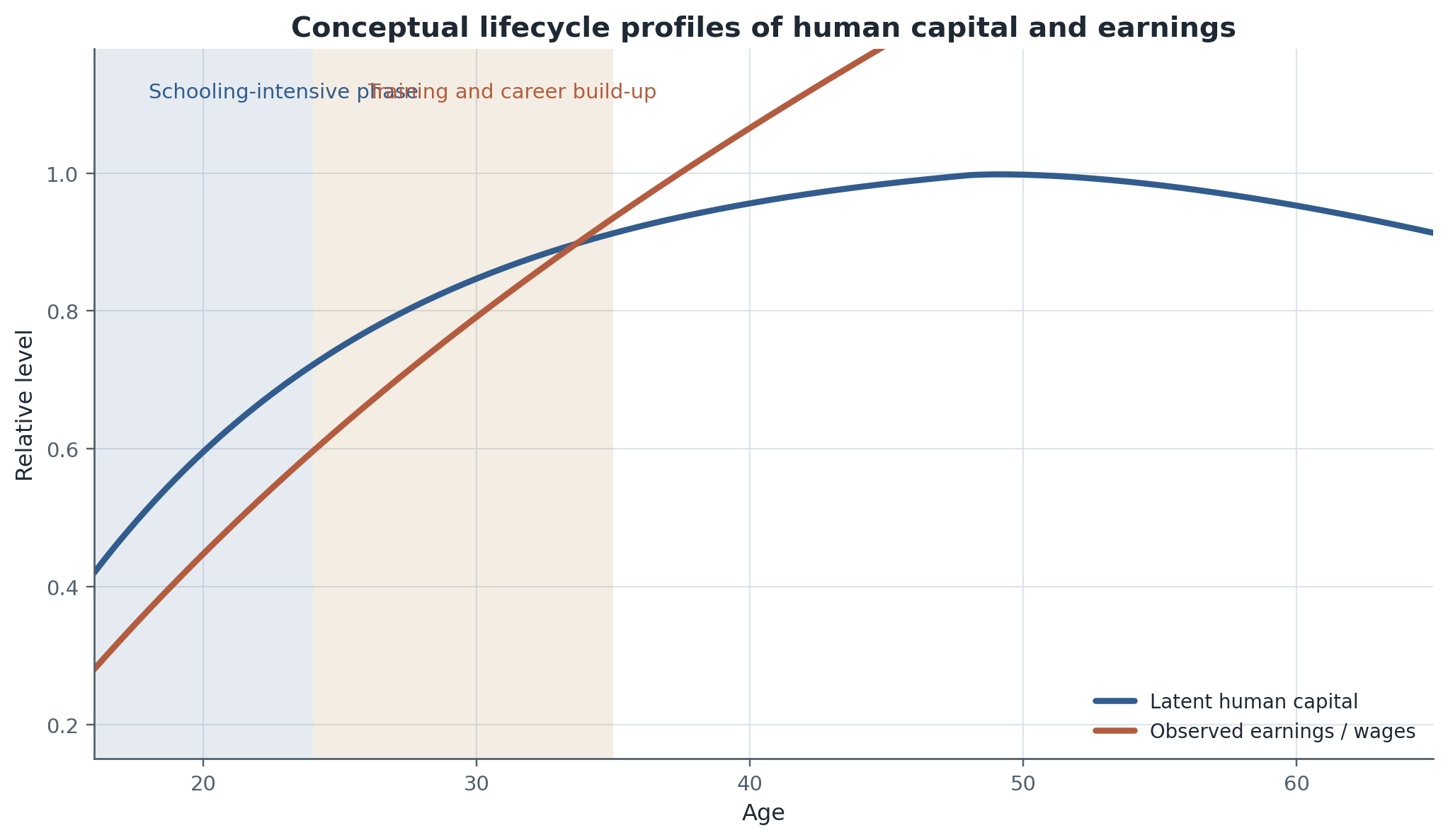
Figure 1:Human-capital accumulation gives Labor I its dynamic backbone: current choices about schooling, training, and work shape future wage offers, job ladders, and inequality.
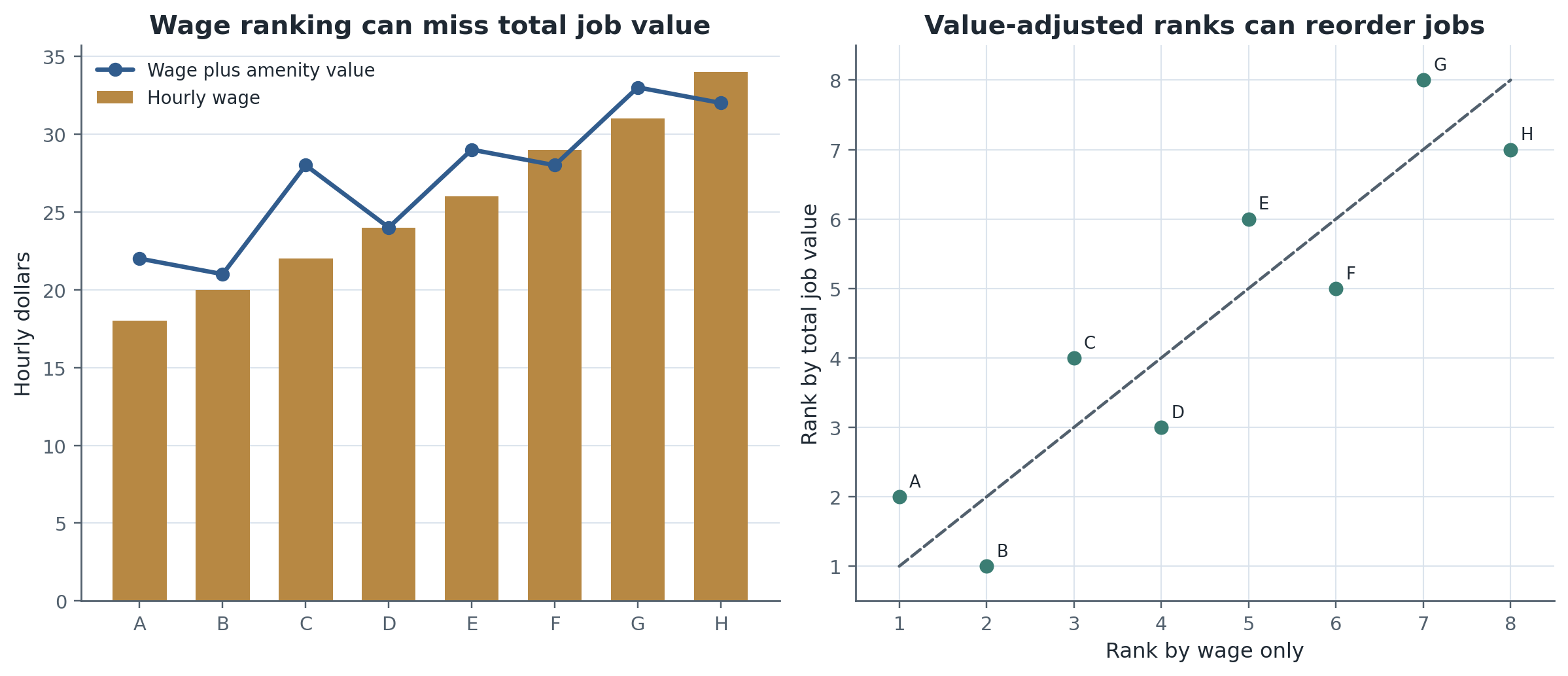
Figure 2:Worker-side labor economics is not only about wages. Total job value combines pay with amenities, schedule quality, flexibility, risk, and other nonwage characteristics.
Figure Figure 1 captures why the first semester is cumulative rather than episodic: labor supply, schooling, household constraints, and policy exposure all affect the dynamic path of skills and earnings. Figure Figure 2 adds the Week 7 lesson that wages alone are not the object. A serious labor field course must track the broader utility-relevant bundle that workers face.
Field Core
The unified worker-side framework
The semester can be written as one compact worker problem:
subject to worker-side constraints generated by wages, taxes and transfers, household commitments, care needs, discrimination, information, and behavioral wedges. Equation (1) nests most of Labor I. Hours capture labor supply and effort. Skill investment captures schooling and training. Job choice captures wages and amenities. Mobility captures job-to-job moves, migration, and reallocation. Policy and behavioral wedges affect both the feasible set and the mapping from true opportunities into perceived opportunities.
The dynamic human-capital object then becomes
which reminds us that current worker choices shape future opportunity sets Becker, 1964Ben-Porath, 1967. This is why Weeks 2 through 5 are inseparable: labor supply today changes experience, training, and future wages; human-capital investments change later participation margins; and policy evaluation is often dynamic rather than static Blundell & MaCurdy, 1999Card, 1999.
The job-value object is equally compact:
where is pay, is the amenity bundle, and collects worker-specific costs such as commuting, schedule incompatibility, care conflicts, or migration cost. Equation (3) organizes Week 7 and also helps reinterpret Weeks 5, 8, and 10. Wage dispersion and mobility are often misread when the relevant object is total job value rather than wage alone Rosen, 1986Mas & Pallais, 2017Sorkin, 2018.
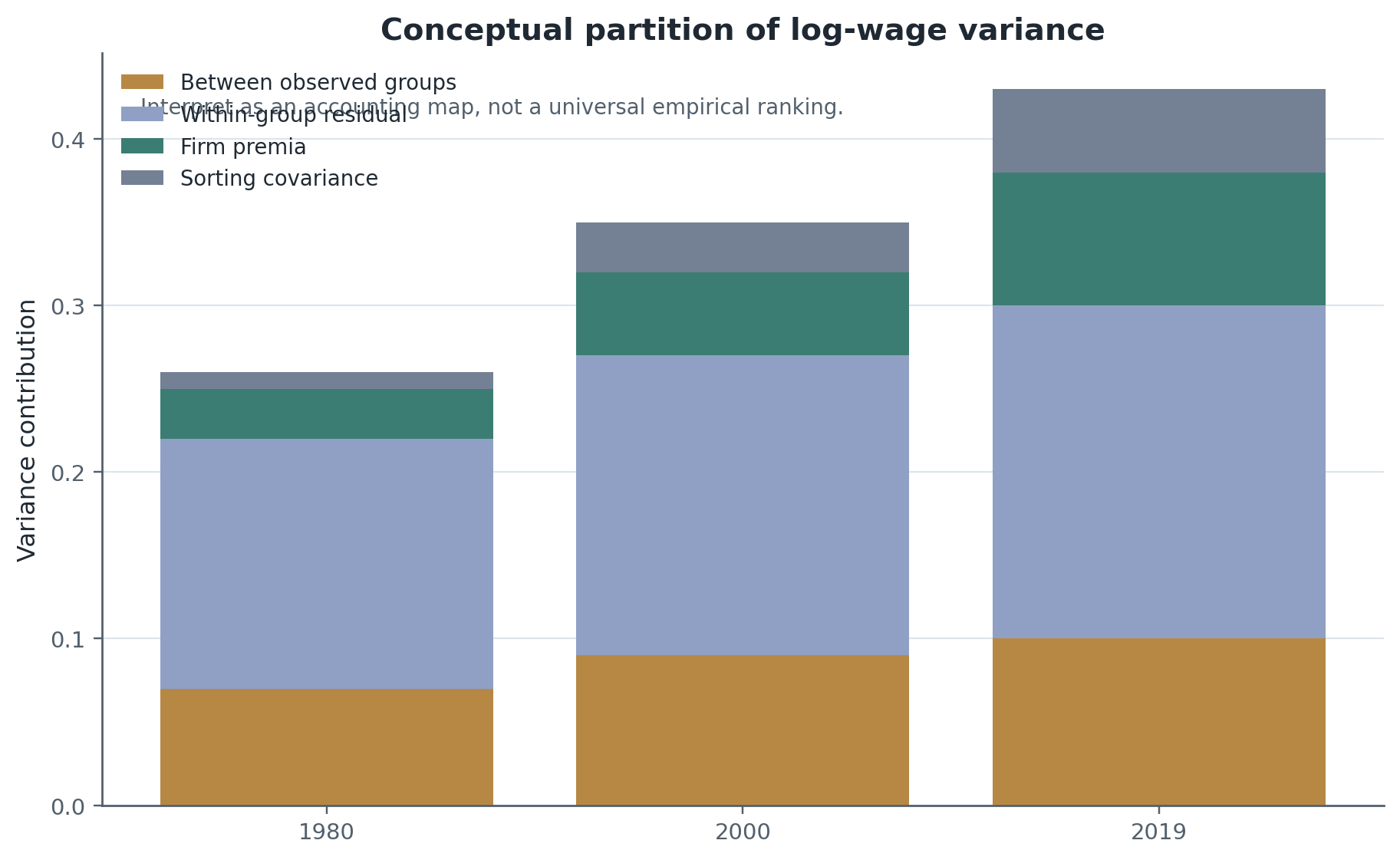
Figure 3:Worker-side choices aggregate into dispersion through several channels at once: skills, jobs, households, policy, and sorting all contribute to measured inequality.
Figure Figure 3 is the Week 8 reminder that inequality is not one mechanism. It is an outcome of accumulated worker-side choices, differential opportunity sets, and assignment across jobs and firms Autor et al., 2008. That is why Week 13 is necessarily synthetic. Labor I has spent the semester building the components that produce inequality, not merely describing the outcome.
From topics to research questions
A topic is not yet a question. “Discrimination,” “mobility,” and “human capital” are field labels. A research question specifies an object, a mechanism, a margin, and a population. “How does schedule unpredictability affect labor-force attachment among low-wage parents?” is a question. “How do workers misperceive the returns to training, and does that misperception attenuate take-up?” is a question. “How much of local earnings inequality reflects worker skill versus assignment to firms with different wage premia?” is a question Card et al., 2018Song et al., 2019.
A descriptive fact is not yet a mechanism. Rising upper-tail inequality, education wage premia, child penalties, amenity valuation, or group gaps all discipline theory, but they do not by themselves tell us whether the channel is labor supply, human capital, sorting, household bargaining, employer behavior, or institutions Kleven et al., 2019Neumark, 2018. A mechanism is a story about how one margin moves and why. An identification strategy is then the separate question of how we learn whether that mechanism is causal.
Every good labor project therefore needs a well-defined object of interest. A compact causal object is
or a more targeted variant such as an event-study path, a complier estimand, or a wage-premium decomposition. Equation (4) is intentionally plain. Week 13 is not about preferring one econometric style. It is about refusing to proceed without a clear estimand.
Table 1:Research idea template for Week 13
| Element | What students must specify | Typical weak version | Stronger version |
|---|---|---|---|
| Topic | Broad area from Labor I | “inequality” | “how childcare-cost shocks affect hours at the lower tail of the wage distribution” |
| Mechanism | Behavioral or economic channel | “policy matters” | “childcare costs relax a household time constraint on the extensive margin” |
| Object | Outcome / estimand | “employment” | “participation, hours, and earnings in the first two years after policy exposure” |
| Data | Data source and unit | “administrative data” | “state UI-linked earnings records with household identifiers” |
| Design | Credible variation | “before/after” | “staggered policy timing with event-study diagnostics” |
| Contribution | Why this matters in labor | “important issue” | “connects family constraints to labor supply and identifies heterogeneity by prior wage rank” |
| Labor II bridge | Does the idea need firms or equilibrium? | omitted | “firm-side schedule flexibility may mediate the effect; motivates Labor II extension” |
Table Table 1 provides the week’s core discipline device. A labor idea becomes credible only when the topic is converted into a mechanism, object, data source, design, contribution, and explicit statement about whether firms or equilibrium matter.
Mechanism, data, design, and contribution
The research-design pipeline in labor economics has five linked steps.
Name the object. Is the project about participation, hours, effort, skill investment, wages, amenities, mobility, job finding, take-up, or inequality?
Name the mechanism. Is the project about incentives, information, care constraints, discrimination, sorting, search, bargaining, firm wage-setting, or behavioral wedges?
Name the data. Which unit matters: worker, household, job, establishment, worker--firm match, or place?
Name the design. Which variation, model discipline, or measurement strategy isolates the mechanism from standard alternatives?
Name the contribution. Which labor literature changes if the result is true?
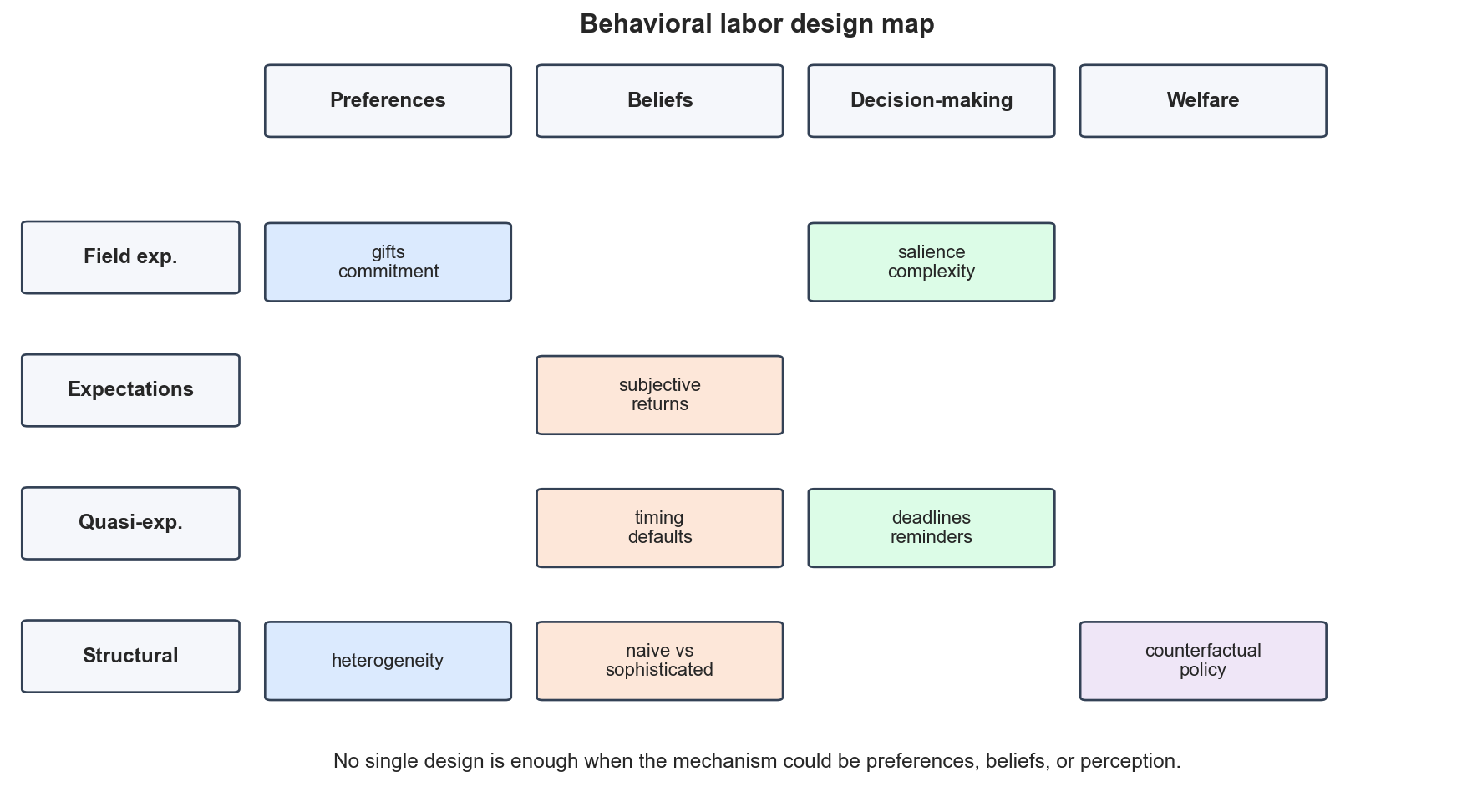
Figure 4:The research-design problem is a matching problem: the object, the mechanism, the data, and the design have to fit each other. Weak fit is one of the most common reasons student ideas fail.
Figure Figure 4 comes from Week 12, but it is useful here because it generalizes. The same design discipline applies whether the mechanism is present bias, childcare constraints, discrimination, job amenities, or search frictions. One does not begin with a favorite estimator and then search for a labor topic. One begins with a labor object and asks which empirical design is informative for that object.
Table 2:Common Week 13 proposal failure modes and fixes
| Failure mode | Symptom | Fix |
|---|---|---|
| Topic without a question | “I want to study migration” | State a precise margin, population, and outcome |
| Mechanism without design | Story is plausible but not testable | Specify variation that isolates the mechanism |
| Design without labor contribution | Nice identification but generic | Explain why the question changes labor theory, policy, or allocation |
| Too many outcomes | Project reads like a dashboard | Choose one primary estimand and a small set of complements |
| Hidden equilibrium issue | Worker-side design ignores firms or prices | State whether the project is partial equilibrium or needs Labor II tools |
| Literature survey posing as idea | Memo lists papers but no contribution | Add one sentence that starts with “This paper asks...” |
Table Table 2 summarizes the mistakes that most often weaken a Week 13 proposal. The hidden equilibrium issue is especially important. A project can start as a clean worker-side exercise and still become incomplete once the treatment changes wages, vacancies, schedules, or firm composition.
Assignment, sorting, and the point where Labor II enters
Many worker outcomes are assignment outcomes. A compact sorting object is
where worker characteristics and interact with job wages , job amenities , and bilateral frictions . Equation (5) makes explicit why Weeks 5, 7, 8, 9, and 10 are deeply connected. Wage determination, amenities, discrimination, mobility, and inequality all depend on who matches to which jobs and places Roy, 1951Diamond, 2016Card et al., 2013.
Once firm heterogeneity or labor-market power becomes central, a bridge-to-Labor-II object is unavoidable:
or, in search language, a matching object such as . Equation (6) is the cleanest reminder that modern labor economics is not only about worker heterogeneity. Firm effects, matching frictions, and wage-setting rules shape the observed wage distribution, mobility patterns, and policy incidence Abowd et al., 1999Mortensen & Pissarides, 1994Burdett & Mortensen, 1998Manning, 2003.
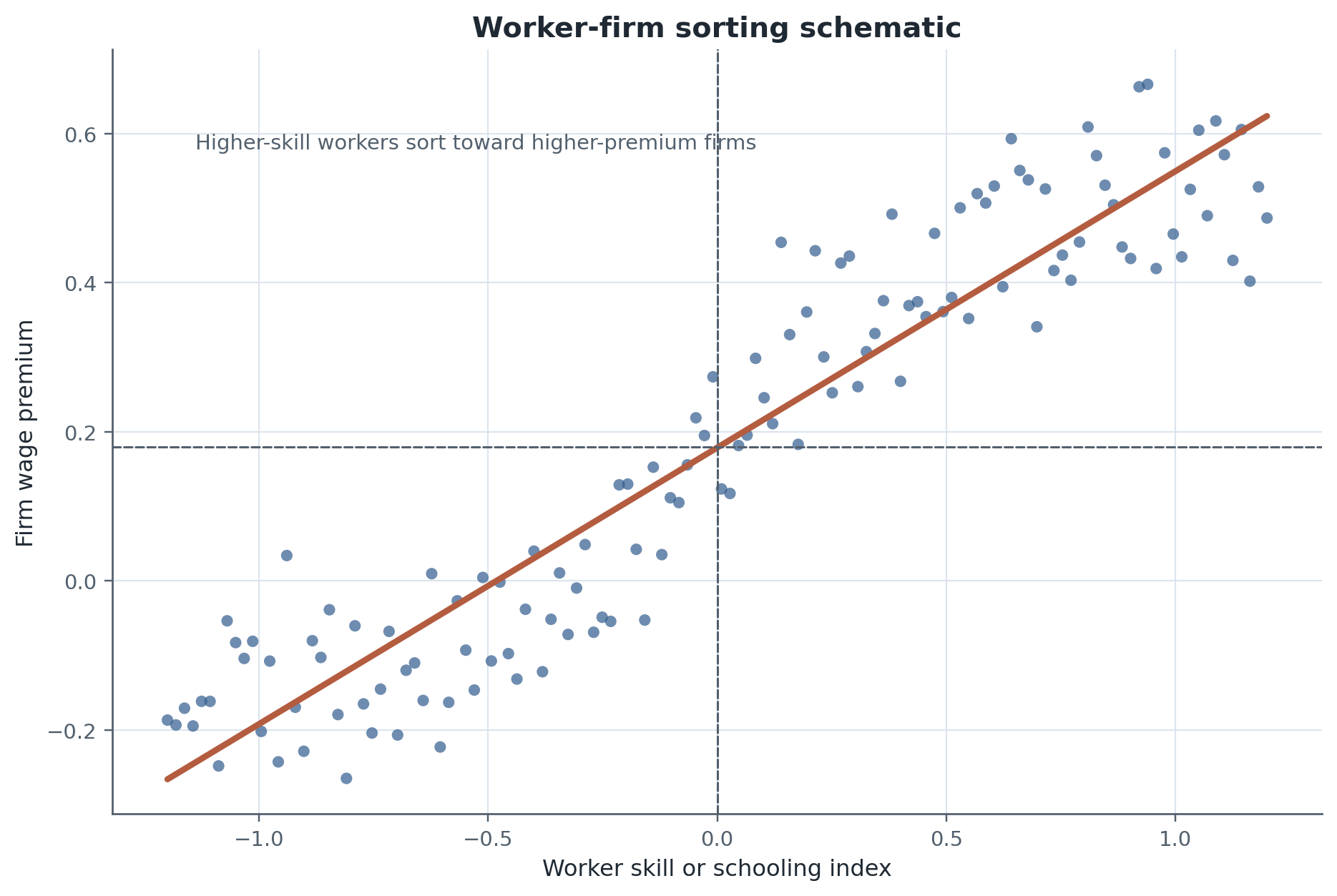
Figure 5:The bridge into Labor II begins when worker-side heterogeneity is embedded in firm heterogeneity, matching frictions, wage-setting, and job ladders.
Figure Figure 5 is where the first semester opens into the second. A worker-side estimate of returns, amenities, discrimination, or mobility is often only the beginning. Labor II asks how firms generate, price, or respond to those worker-side margins.
Table 3:Where Labor I ends and Labor II begins
| Labor I worker-side question | Natural Labor II extension |
|---|---|
| How elastic is labor supply? | How do firms set schedules, wages, and hiring margins when labor supply is elastic? |
| How do workers value amenities? | How do firms provide, price, and compete over amenities in equilibrium? |
| How do workers acquire skill? | How do firms shape training, task assignment, and internal mobility? |
| How does inequality arise across workers? | How much comes from firm heterogeneity, wage-setting, and labor-market power? |
| How does discrimination affect worker outcomes? | How do firms, occupations, search, and institutions propagate or attenuate discrimination? |
| How do workers respond to policy? | How do firms, vacancies, and wages adjust when policy changes worker incentives? |
| How do behavioral frictions distort worker choices? | How do employers design contracts or exploit / offset those frictions? |
Table Table 3 should be read as a boundary map. It tells students when a project can remain partial equilibrium and when it becomes misleading to ignore firm-side adjustment, search, or institutions.
What makes a strong labor research question?
A strong labor question has four properties.
It is about a recognizably labor object. The project should change how we understand work, wages, skill, job quality, mobility, discrimination, or policy.
It has one central mechanism. If the proposal requires five channels to work, it is usually too broad for a first project.
It has a feasible empirical or theoretical discipline device. Good labor questions respect the available data and the variation needed to learn from them.
It knows where it sits relative to firms and equilibrium. Partial equilibrium can be a strength when it is explicit. It is a weakness only when it is hidden.
Weak questions fail one or more of these tests. Some are too broad and read like literature surveys. Some have a nice design but no labor contribution. Some have a plausible mechanism but no observable object. Some are really Labor II questions hiding inside Labor I language. Week 13 is about learning to tell the difference early.
Research templates drawn from Labor I
The point of a template is not to give students prepackaged papers. The point is to show what a disciplined first move looks like.
Labor supply and constraints: ask how schedule volatility, benefit design, or information about net wages changes participation or hours at a clearly defined margin; use public panel, tax, or administrative data where timing variation is observable; stay worker-side if prices and schedules are taken as given, but move into Labor II if firms endogenously redesign hours.
Human capital and training: ask whether training take-up is limited by beliefs, liquidity, or timing of returns; use linked worker-course or education-administrative records when available; a reduced-form training question can remain in Labor I, but the project becomes Labor II once employer training policy or task assignment is central Becker, 1964Acemoglu & Pischke, 1999.
Wage determination and sorting: ask whether a return-to-skill estimate changes once workers sort into firms or occupations with different premia; use matched worker--firm or occupation-level data when possible; the worker-side estimand is feasible in Labor I, but the interpretation increasingly requires firm heterogeneity and wage-setting Card et al., 2018Song et al., 2019.
Households and care: ask how care shocks, childcare cost, or leave policy affects hours, earnings, and dynamic attachment; use household-linked administrative or survey panels with event timing; the project remains worker-side if the focus is household constraint relaxation, but Labor II enters once employer schedule flexibility or leave policy design drives treatment intensity Chiappori, 1992Kleven et al., 2019.
Job quality and amenities: ask how workers value flexibility, remote work, risk, or schedule control and how that valuation differs across groups; use survey-experimental or matched vacancy-worker data; a compensating-differentials exercise can start in Labor I, but amenity provision and competition quickly pull the project into Labor II Rosen, 1986Mas & Pallais, 2017.
Inequality and discrimination: ask whether group gaps or wage dispersion reflect differential skill accumulation, differential assignment, unequal treatment, or different firm exposure; the cleanest designs often combine descriptive decomposition with quasi-experimental or audit evidence; these questions often begin in Labor I and then require Labor II once firm sorting or wage-setting becomes the key propagation mechanism Autor et al., 2008Neumark, 2018.
Mobility and reallocation: ask which workers move, why they move, and whether mobility changes earnings, match quality, or intergenerational opportunity; use linked panel, migration, or matched employer-employee data; the worker-side part concerns opportunity and cost, but Labor II begins once vacancy creation, local labor demand, or firm wage premia shape the reallocation margin Kennan & Walker, 2011Jia et al., 2023.
Behavioral wedges in labor: ask whether low response to a policy, job, or training opportunity reflects true preferences, distorted beliefs, or decision frictions; combine reduced-form contrasts with expectation or design variation when possible; a worker-side behavioral idea is legitimate in Labor I, but contract design and employer response immediately open into Behavioral Labor and Labor II DellaVigna, 2009DellaVigna, 2018.
Table Table 4 turns those templates into a bounded studio menu. The anchor papers are deliberately heterogeneous. Some are causal-return papers. Some are descriptive architecture papers. Some are already worker--firm bridge papers. That variety is a feature, because it shows that “good labor design” is not identical to one empirical style.
Research Lab
Week 13’s lab is a research-design studio rather than a heavy new replication. The bounded path uses a menu of anchor papers from earlier weeks and a deterministic local packet that helps students move from topic to mechanism, data, design, and contribution. The lab follows the course’s standard Reproduce -> Diagnose -> Propose workflow.
Student research memo studio
The required deliverable is a 2--3 page memo. Students should submit one clean idea, not a literature survey. A good memo contains:
one sentence that begins, “This paper asks...”;
one paragraph defining the object and the population;
one paragraph stating the mechanism and the strongest standard alternative;
one paragraph on data and feasible measurement;
one paragraph on the design, estimand, or model discipline;
one paragraph on the labor contribution;
one paragraph stating whether the project is partial equilibrium or already needs Labor II tools.
The memo should be feasible as a first project. The goal is not to solve all of labor economics in one proposal. The goal is to show that the student can name a margin, isolate a mechanism, and locate the project inside the field.
Where Labor I ends and Labor II begins
Labor I is the worker-side half of the field. It gives the primitives for modern labor economics: preferences, constraints, human-capital accumulation, household structure, job value, discrimination, mobility, policy response, and behavioral wedges. Labor II begins when those worker-side margins are embedded in firms, search, wage-setting, organizations, and institutions. The right way to read the bridge is therefore not as a handoff between unrelated courses. It is the move from worker-side primitives to market equilibrium and organizational response Acemoglu & Autor, 2011Manning, 2003.
In-class workshop prompts
Take one Week 13 anchor paper and identify the single sentence that states its true object of interest.
Rewrite a broad topic such as “migration” or “discrimination” into a precise labor question with one margin and one target population.
State one way in which a clean worker-side design could fail once firms adjust wages, schedules, or vacancies.
Explain why the same empirical result can have a different interpretation under human-capital, sorting, household, or behavioral mechanisms.
Methods Box
Methods Box 1: design choice must match the labor object
Descriptive decomposition is appropriate when the question is how much of an outcome is accounted for by observable or latent components. Quasi-experimental variation is appropriate when the question is a causal policy or treatment effect. Event studies are appropriate when the timing path is substantively central. Audit and field experiments are especially useful when discrimination, information, incentives, or reciprocity are the mechanism. Matched worker--firm data become essential when assignment and firm heterogeneity are central. Structural or equilibrium models become more attractive once reduced-form contrasts cannot recover the object of interest or once policy counterfactuals depend on market adjustment Autor et al., 2008Neumark, 2018DellaVigna, 2018.
Methods Box 2: partial equilibrium is not a flaw when it is explicit
A student proposal does not need to solve general equilibrium on day one. Partial equilibrium is a problem only when equilibrium responses are first-order for the interpretation and are ignored. A careful Week 13 memo should name that boundary directly. If the treatment plausibly changes firm wage policies, vacancy posting, or amenity provision, the student should say so and frame that as the next step into Labor II rather than as an omitted afterthought.
Methods Box 3: the assignment margin is often the hidden object
Many labor projects appear to be about wages or participation, but are really about who matches to which jobs, firms, occupations, or places. That is why sorting and selection problems recur across returns to schooling, job amenities, discrimination, migration, and inequality Roy, 1951Card et al., 2013. A strong Week 13 design names the assignment process rather than leaving it implicit.
Methods Box 4: contribution is a field statement, not a moral statement
“This matters because inequality is important” is not a contribution. A contribution states what labor economists would understand differently if the result were true. Does the project change how we think about labor supply elasticities, human-capital formation, compensating differentials, firm wage premia, policy targeting, behavioral response, or the transmission of discrimination? That is the standard for a good proposal.
Reading Ladder And References
Semester synthesis
Blundell and MaCurdy remains the best broad guide to worker-side labor supply, dynamic response, and the role of constraints Blundell & MaCurdy, 1999.
Becker and Ben-Porath provide the classic human-capital backbone for thinking dynamically about worker investment Becker, 1964Ben-Porath, 1967.
Card is the canonical reminder that even standard-looking returns questions depend on object definition and identification discipline Card, 1999.
Inequality, sorting, and the worker--firm bridge
Autor, Katz, and Kearney is the core descriptive architecture reading for modern wage inequality Autor et al., 2008.
Card, Cardoso, Heining, and Kline and Song et al. are the cleanest bridge readings from worker heterogeneity to firm heterogeneity and wage-setting Card et al., 2018Song et al., 2019.
Discrimination, design, and behavioral wedges
Neumark provides a rigorous map of discrimination designs and interpretation Neumark, 2018.
DellaVigna’s survey and structural chapter remain the best short path from worker-side frictions to research design and welfare discipline DellaVigna, 2009DellaVigna, 2018.
Bridge to Labor II
Acemoglu and Autor is a broad bridge reading for where worker-side analysis meets tasks, technology, and labor demand Acemoglu & Autor, 2011.
Mortensen and Pissarides, Burdett and Mortensen, and Manning are the canonical starting points for matching, wage-setting, and labor-market power Mortensen & Pissarides, 1994Burdett & Mortensen, 1998Manning, 2003.
Exercises And Discussion Prompts
Write one paragraph explaining why a strong labor research question must distinguish the object of interest from the mechanism.
Choose one anchor paper from Table Table 4 and explain which of the six formal objects in this chapter it relies on most heavily.
Take a Week 6 or Week 7 style worker-side question and state the precise moment at which firm-side schedule setting or amenity provision makes Labor II tools necessary.
Propose one project that stays deliberately partial equilibrium and one project that requires worker--firm matched data from the start. Explain why.
Explain why a nice design without a labor contribution is just as weak as a plausible mechanism without a design.
Reproducibility And Code Lab Note
The Week 13 lab lives in books
cd books/labor-i/labs/13-synthesis-and-research-designs
ENV_NAME=research bash smoke.sh
This is not a substitute for a full replication package. It is a studio that teaches how to move from a labor topic to a proposal with one estimand, one mechanism, and one explicit statement about the Labor I to Labor II boundary.
Slide Companion Note
The companion deck is books
Bridge Forward
Use this closing bridge to carry the module’s labor object, mechanism, and evidence into the next course step or research-design exercise.
- Acemoglu, D., & Autor, D. H. (2011). Skills, Tasks and Technologies: Implications for Employment and Earnings. In O. Ashenfelter & D. Card (Eds.), Handbook of Labor Economics (Vol. 4B, pp. 1043–1171). Elsevier. 10.1016/S0169-7218(11)02410-5
- Mortensen, D. T., & Pissarides, C. A. (1994). Job Creation and Job Destruction in the Theory of Unemployment. Review of Economic Studies, 61(3), 397–415. 10.2307/2297896
- Manning, A. (2003). Monopsony in Motion: Imperfect Competition in Labor Markets. Princeton University Press.
- Becker, G. S. (1964). Human Capital: A Theoretical and Empirical Analysis, with Special Reference to Education. University of Chicago Press.
- Ben-Porath, Y. (1967). The Production of Human Capital and the Life Cycle of Earnings. Journal of Political Economy, 75(4, Part 1), 352–365.
- Blundell, R., & MaCurdy, T. (1999). Labor Supply: A Review of Alternative Approaches. In O. Ashenfelter & D. Card (Eds.), Handbook of Labor Economics (Vol. 3A, pp. 1559–1695). Elsevier. 10.1016/S1573-4463(99)03008-4
- Card, D. (1999). The Causal Effect of Education on Earnings. In O. Ashenfelter & D. Card (Eds.), Handbook of Labor Economics (Vol. 3A, pp. 1801–1863). Elsevier. 10.1016/S1573-4463(99)03011-4
- Rosen, S. (1986). The Theory of Equalizing Differences. In O. C. Ashenfelter & R. Layard (Eds.), Handbook of Labor Economics (Vol. 1, pp. 641–692). Elsevier. 10.1016/S1573-4463(86)01015-5
- Mas, A., & Pallais, A. (2017). Valuing Alternative Work Arrangements. American Economic Review, 107(12), 3722–3759. 10.1257/aer.20161500
- Sorkin, I. (2018). Ranking Firms Using Revealed Preference. Quarterly Journal of Economics, 133(3), 1331–1393. 10.1093/qje/qjy001
- Autor, D. H., Katz, L. F., & Kearney, M. S. (2008). Trends in U.S. Wage Inequality: Revising the Revisionists. The Review of Economics and Statistics, 90(2), 300–323. 10.1162/rest.90.2.300
- Card, D., Cardoso, A. R., Heining, J., & Kline, P. (2018). Firms and Labor Market Inequality: Evidence and Some Theory. Journal of Labor Economics, 36(S1), S13–S70. 10.1086/694153
- Song, J., Price, D. J., Guvenen, F., Bloom, N., & von Wachter, T. (2019). Firming Up Inequality. Quarterly Journal of Economics, 134(1), 1–50. 10.1093/qje/qjy025
- Kleven, H., Landais, C., & Søgaard, J. E. (2019). Children and Gender Inequality: Evidence from Denmark. American Economic Journal: Applied Economics, 11(4), 181–209. 10.1257/app.20180010
- Neumark, D. (2018). Experimental Research on Labor Market Discrimination. Journal of Economic Literature, 56(3), 799–866. 10.1257/jel.20161309