Households, Family, Fertility, and Time Allocation
Learning Objectives
By the end of Week 6, students should be able to:
distinguish individual labor-supply problems from household labor-allocation problems;
write a compact time-allocation object that includes market work, home production or care, and leisure;
explain why childcare, schooling, and household-service prices shift labor supply through household production rather than only through wage changes;
distinguish unitary, collective, and bargaining interpretations of household choice;
connect childbirth, fertility, and caregiving to dynamic labor-market shocks in hours, participation, occupation, and earnings;
interpret IVF-based fertility designs and first-birth event studies as different empirical objects;
map family policy into the margin it moves inside the household allocation problem;
explain why Week 7 amenities and Week 8 inequality cannot be interpreted cleanly without household structure.
Opening Orientation
The economic question for the week is direct: if Week 5 treated wages as market opportunities, how do households transform those opportunities into actual hours, earnings, and career paths once partners, children, and care demands enter the picture Becker, 1965Chiappori, 1992Cortés & Pan, 2023?
Bridge
Weeks 2 and 3 largely treated labor supply as an individual choice problem, and Weeks 4 and 5 connected skill accumulation to wage offers. Week 6 changes the unit of analysis. Observed person-level hours and earnings are often joint outcomes of household production, bargaining, fertility timing, and care constraints rather than pure individual responses to a wage Becker, 1965Gronau, 1977. The central labor-market fact is therefore not just that two workers can face different wages. It is that two workers with similar wage opportunities can make very different labor-market choices because their household states differ.
That shift matters for three reasons. First, children and care needs raise the shadow value of nonmarket time. Second, household production makes the labor-supply response depend on the availability and price of substitutes such as childcare, schooling, or household services. Third, childbirth creates dynamic shocks to earnings paths, promotion timing, occupation choice, and firm attachment, which means the relevant outcome is often a full post-birth trajectory rather than a one-period hours response Gelbach, 2002Kleven et al., 2019.
The week is therefore a hinge in the course. Week 5 asked how markets price skill. Week 6 asks how families convert priced opportunities into realized labor outcomes. Week 7 will add job amenities and compensating differentials, which further broadens the utility object. Week 8 will then ask how inequality evolves once wages, families, and career interruptions all interact.
A compact time-allocation benchmark
The shortest route into the week is a time constraint:
where denotes market work, denotes home production or care, and denotes leisure. Equation (1) is elementary, but it already tells students why children matter. A childbirth shock does not simply change preferences. It changes the feasible and optimal allocation of time because the demand for household production rises and the value of market substitutes becomes more salient Becker, 1965Gronau, 1977.
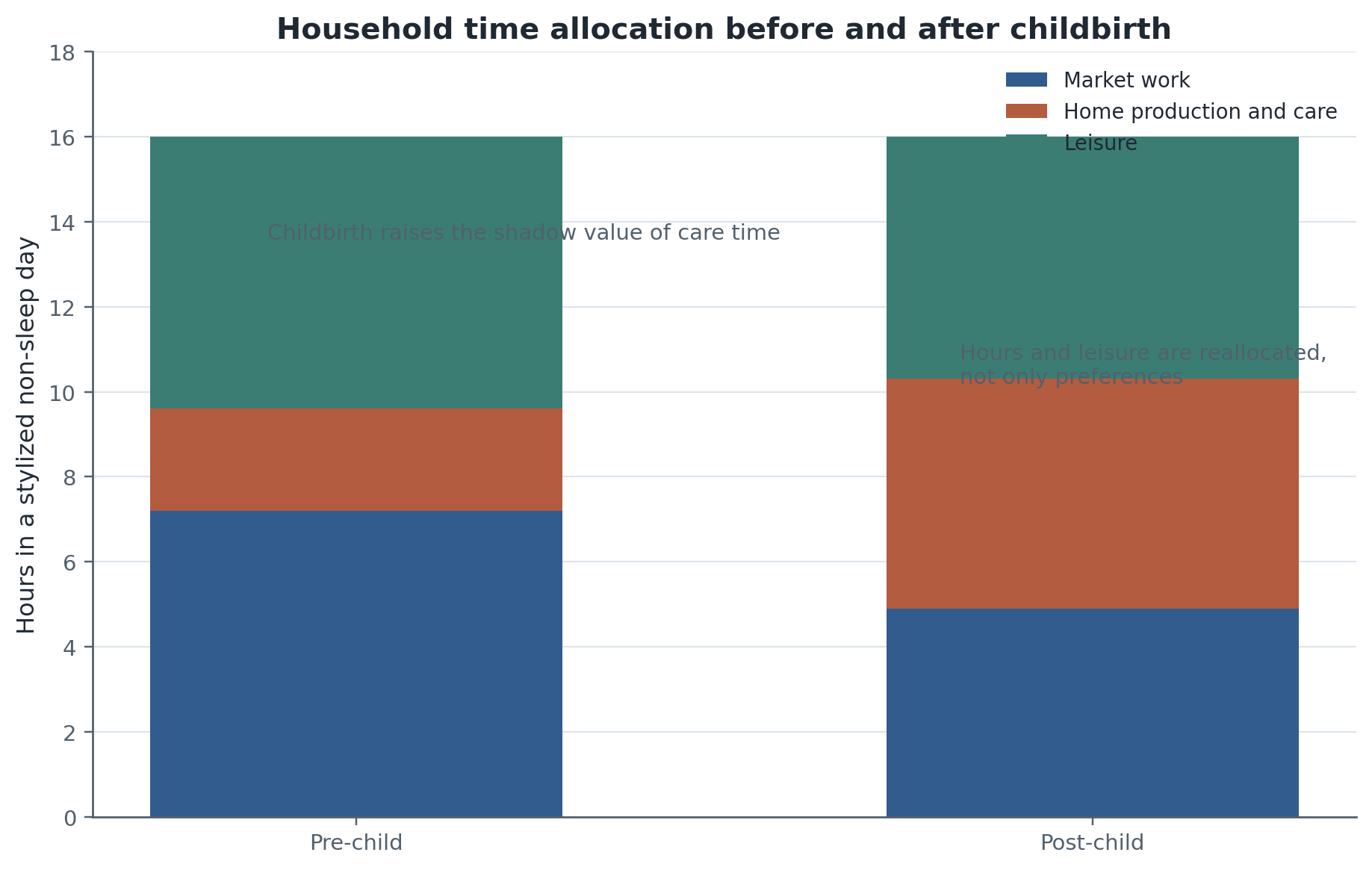
Figure 1:Stylized household time allocation before and after childbirth. The point is not that every family fits one schedule. The point is that childbirth reallocates time across market work, care, and leisure, so labor supply becomes a household-allocation problem rather than only an individual wage response.
Figure Figure 1 is the right opening picture because it makes clear that family formation changes the margin structure itself. The student should immediately see why household production belongs inside a labor field course rather than at its margins.
Field Core
Household production and the allocation of time
The natural next step is to embed Equation (1) in a household resource problem. A compact formulation is
Equation (2) says that family labor supply is linked to the production of a household good , where care time and can be complemented or substituted by market inputs . This is exactly why childcare and household-service prices matter. A fall in can raise market labor supply even when wages do not change, because cheaper substitutes reduce the opportunity cost of market work for the spouse whose time is most intensely used in home production Gronau, 1977Cortés & Tessada, 2011.
The economic intuition is labor-specific. Week 2 taught students to ask whether a wage increase moves people along an intensive or extensive margin. Week 6 adds a prior question: how much of the relevant time constraint is governed by home production? That is why the same wage opportunity can generate very different observed hours in households with preschool children, school-age children, or access to reliable market substitutes.
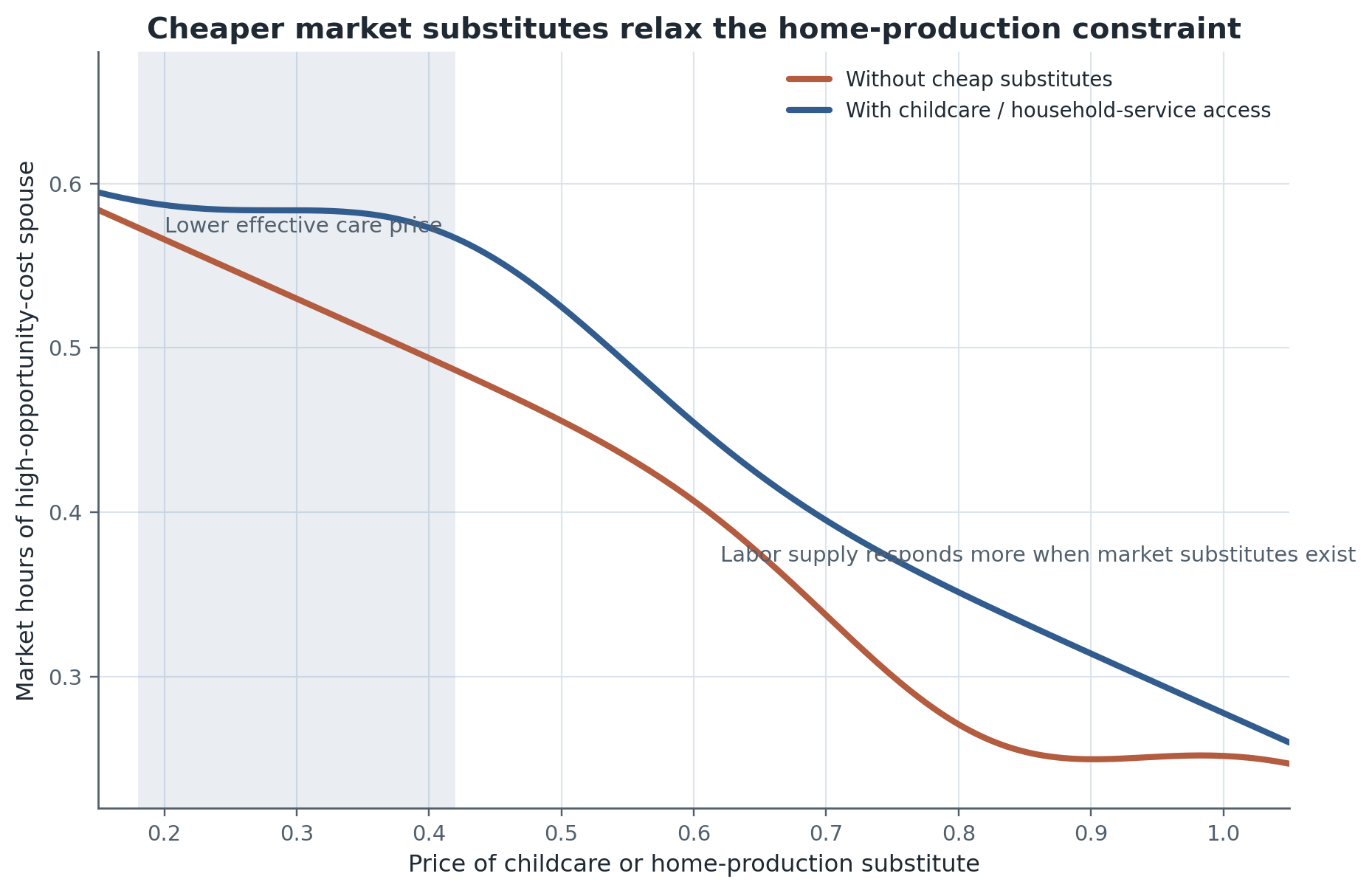
Figure 2:Conceptual labor-supply response to a lower price of childcare or household-service substitutes. The figure emphasizes that family labor supply can shift because the home-production technology changes, not because the market wage changes.
Figure Figure 2 makes the comparative static visual. Cheap childcare, public schooling, or outsourcing opportunities alter family labor supply by relaxing the household production constraint. Gelbach is the clean school-entry version of that logic, while Cort{'e}s and Tessada provide a labor-market substitute version through cheaper household services Gelbach, 2002Cortés & Tessada, 2011.
Unitary, collective, and bargaining models
The unitary benchmark treats the household as if it maximizes one stable objective with pooled resources. That benchmark is useful because it yields sharp comparative statics and income-pooling restrictions. But it is also easy to overuse. Once distribution factors or recipient-specific transfers matter, the pure pooling implication becomes too restrictive as a positive description of family behavior Lundberg et al., 1997.
The collective alternative keeps Pareto efficiency but allows distinct preferences and a sharing rule. A compact representation is
Equation (3) is deliberately spare. Its pedagogical use is that shifts in can change labor supply, expenditure patterns, and care allocation even when total household income is unchanged. Distribution factors matter because the same cash amount can have different labor-market incidence depending on who receives it and how bargaining weights move Chiappori, 1992Lundberg et al., 1997.
That distinction is not merely philosophical. Unitary, collective, fertility-IV, and child-event-study approaches are matched to different empirical objects. The right question in class is never only whether a model is elegant. It is what it lets us test and what kind of policy incidence it can rationalize.
Table 1:Household-model map for Week 6
| Model / design bucket | Core choice object | Typical identifying variation or test | What it is good for | Main caveat |
|---|---|---|---|---|
| Unitary household model | Joint utility with pooled resources | Restrictions implied by income pooling | Clean benchmark for family labor supply | Often too restrictive when distribution factors matter |
| Collective / bargaining model | Pareto-efficient allocation with sharing rule | Income-source shifts, distribution factors, policy incidence by recipient | Interpreting intrahousehold allocation and incidence | Requires stronger structure or richer data |
| Household production model | Market work, home production, leisure, and market substitutes | Variation in care prices, household-service prices, time prices | Understanding care constraints and outsourcing | Hard to measure home production and quality |
| Fertility-IV design | Causal effect of children on labor-market outcomes | IVF success or other plausibly exogenous fertility variation | Causal fertility effects on earnings, hours, career paths | Margin-specific and often externally narrow |
| Child-event-study design | Dynamic outcomes around first birth | Event-time variation around childbirth | Persistent child penalties and dynamic decomposition | Event-study patterns are not automatic policy counterfactuals |
| Family-policy design | Responses to childcare, school entry, leave, transfers | Reform timing, eligibility thresholds, regional access | Policy incidence on labor supply and earnings paths | Policies often shift multiple margins at once |
| Outsourcing / care-substitute design | Household reallocation when home-production substitutes get cheaper | Immigration, childcare-cost shocks, market-service availability | Linking household technology to labor supply | Local-equilibrium estimates can be context specific |
Table Table 1 is the chapter’s organizing map. The table works because it keeps the models and designs linked to identifiable labor-market uses: pooling tests, bargaining interpretation, care-price comparative statics, causal fertility margins, and dynamic post-birth paths.
Fertility, marriage, and caregiving as labor-market shocks
Marriage, fertility, and caregiving should be read as shocks to the household allocation problem, not as demographic background. A first birth can change the timing of labor supply, the value of flexible jobs, the return to career investments with long horizons, and the desirability of firms with more stable schedules. A spouse’s wage or job loss can matter both through standard income effects and through changes in specialization or bargaining positions. The key point is that the relevant response margin is often dynamic and multidimensional Blundell et al., 2016Cortés & Pan, 2023.
This is why the literature uses different empirical families. Fertility-IV designs ask for the effect of an additional child induced by plausibly exogenous fertility variation. Childcare and school-entry designs ask how care institutions move participation or hours. Event studies around first birth ask how the entire post-birth path diverges. These are related, but they are not interchangeable.
Lundborg, Plug, and Rasmussen are especially useful in a labor course because IVF success isolates a fertility margin without collapsing straight into descriptive parenthood gaps Lundborg et al., 2017. The design is labor-relevant precisely because the outcome is not merely whether a birth occurs. The outcome is how fertility shifts employment, earnings, and career continuity. That makes the paper a strong bridge between household theory and modern causal design.
Child penalties and dynamic earnings paths
The empirical center of the week is the child-penalty event-study object:
where denotes the timing of first birth and the coefficients trace the outcome path relative to the pre-birth normalization period. Equation (4) clarifies that the parameter of interest is not only a one-time level effect. It is the full dynamic profile after birth.
Kleven, Landais, and Sogaard show why this perspective changed the field. The earnings divergence after children is persistent and is tied not only to contemporaneous hours but also to career progression, occupation, and firm attachment Kleven et al., 2019. Cort{'e}s and Pan then place that logic inside the broader question of why children explain so much of the remaining gender gap in modern labor markets Cortés & Pan, 2023.
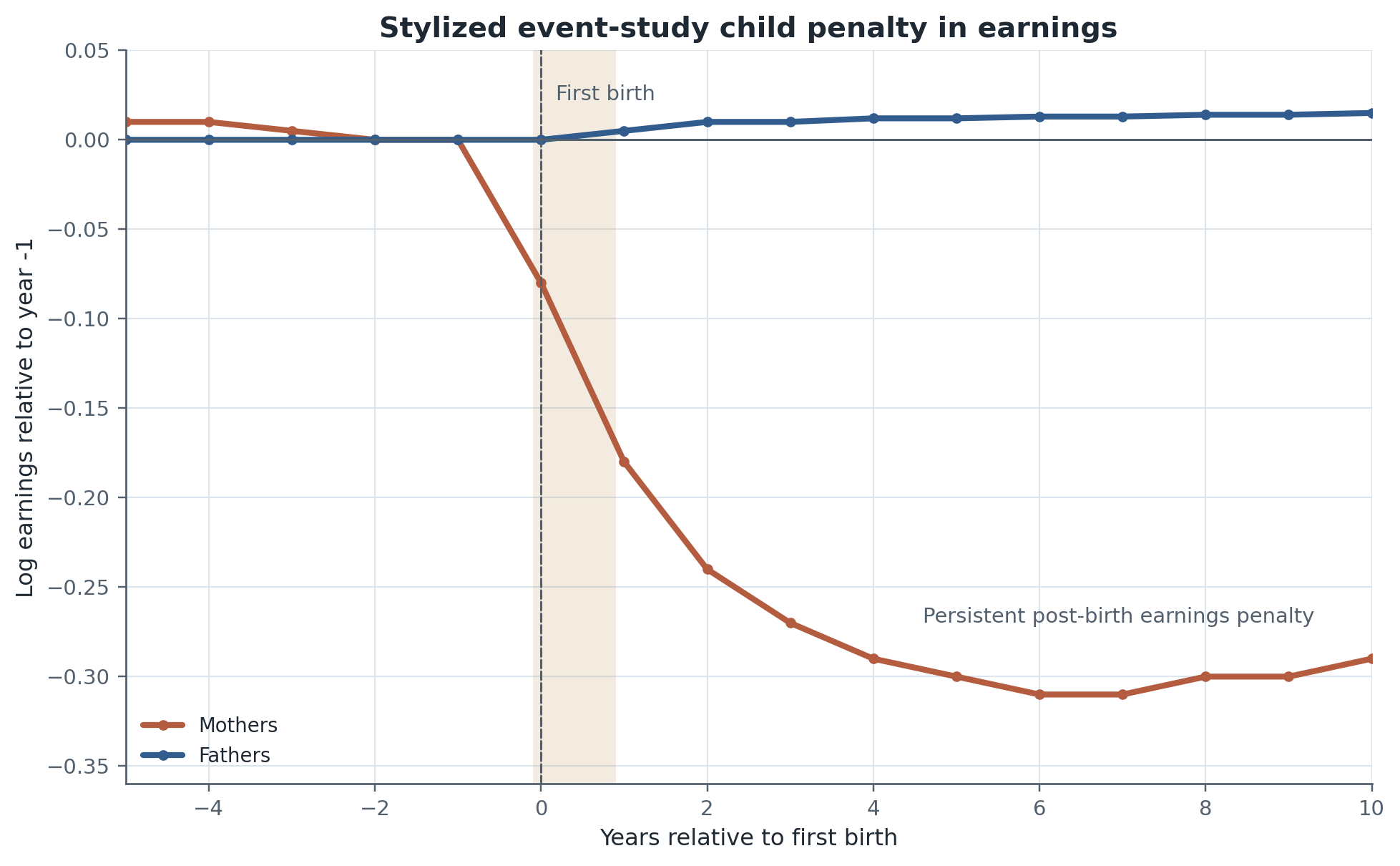
Figure 3:Stylized child-penalty event study in earnings. The purpose is to show dynamic divergence after first birth rather than a one-period motherhood effect. Persistent post-birth gaps are labor-market objects because they reflect hours, occupation, sector, firm continuity, and wage growth all at once.
Figure Figure 3 should be read alongside Equation (4). The event-study line is not itself a structural model, but it is exactly the right descriptive discipline for Week 6 because it shows persistence, timing, and asymmetry between mothers and fathers in one object.
Family policy, childcare, and market substitutes
The cleanest way to teach policy in Week 6 is by the margin it moves. Childcare access mostly targets participation and re-entry timing. Public school entry can free maternal time at a well-defined threshold. Parental leave often changes short-run attachment and can alter long-run earnings through career continuity. Household-service outsourcing shifts time allocation by changing the home-production technology itself. Transfers to one spouse test whether resource pooling is descriptive or whether bargaining weights matter Gelbach, 2002Cortés & Tessada, 2011Lundberg et al., 1997.
Table 2:Policy-margin map for family labor supply and time allocation
| Policy / shock / design | Primary labor margin | Secondary margin | Typical outcome variables | Representative use in Week 6 |
|---|---|---|---|---|
| Childbirth / fertility shock | Participation and hours | Wage growth, occupation, firm choice | Employment, annual earnings, hourly wages | Fertility-IV and child-penalty evidence |
| Childcare access or childcare price change | Participation | Hours and re-entry timing | Maternal employment, hours, childcare use | Childcare and school-start designs |
| Public schooling entry | Participation at school-age threshold | Timing of work and household production | Maternal labor supply, expenditures on care | Gelbach-style design |
| Parental leave reform | Short-run attachment | Long-run earnings path and firm continuity | Leave take-up, earnings dynamics, job retention | Family-policy extensions |
| Income transfer to one spouse | Intra-household allocation | Labor supply, expenditure shares | Hours, spending patterns, bargaining outcomes | Pooling vs bargaining tests |
| Cheaper household services / outsourcing | Intensive margin for high-opportunity-cost spouse | Leisure and housework reallocation | Hours worked, housework, childcare time | Cortés--Tessada-style outsourcing channel |
| Social norms or relative-income constraint | Labor supply and household specialization | Marriage, divorce, occupation choice | Hours, earnings shares, division of chores | Optional norms extension |
Table Table 2 disciplines those discussions. The point is not that one policy dominates everywhere. The point is that the same wage schedule can generate very different labor outcomes depending on which household margin is relaxed and on whether the response comes through participation, hours, occupation choice, or career continuity.
Why Week 6 is the bridge to amenities and inequality
Week 7 asks why jobs with flexibility, schedule stability, remote options, or safety differences may pay differently. Week 6 makes clear why those amenities are not peripheral. Once care constraints bind, flexibility itself becomes a household input. Week 8 will ask how inequality evolves. Week 6 implies that observed earnings inequality partly reflects household structure, fertility timing, and access to care substitutes rather than only worker skill or firm pay policies. A labor field course that skipped this week would misread both amenities and inequality.
Research Lab
The frontier issue is no longer whether family structure matters. It is which empirical object is appropriate for the family-labor question at hand. IVF-based fertility designs recover local causal fertility margins. First-birth event studies recover dynamic post-birth paths. Childcare and schooling reforms recover institutional relaxations of the household production constraint. Collective models recover structure on how resources are shared or bargained over Lundborg et al., 2017Kleven et al., 2019Blundell et al., 2016.
That plurality is a feature, not a weakness. Labor economists need different designs because childbirth affects multiple margins at once: participation, hours, occupation, commuting tolerance, job flexibility, promotion timing, and future wage growth. The research challenge is therefore to keep causal language matched to the design and to avoid turning every family-labor paper into a generic statement about “women versus men.”
The bounded Week 6 lab reflects that discipline. Students first reproduce a synthetic IVF-style fertility design in the spirit of Lundborg et al., 2017, diagnose the resulting local birth effect on employment, hours, and earnings, and then transfer the workflow to a synthetic child-penalty event study in the spirit of Kleven et al., 2019. An optional extension note asks how school entry, childcare, outsourcing, or long-run family policy could move the same family-allocation problem using Gelbach, 2002, Cortés & Tessada, 2011, or Kleven et al., 2024.
Open research questions should remain visible:
How portable are IVF-based fertility effects across institutional settings and across different fertility margins?
How much of the child penalty operates through hours, occupations, sectors, firms, or employer responses to flexibility demands?
Which family policies change short-run attachment and which change long-run earnings trajectories?
When do bargaining and norms matter separately from household technology and market substitutes?
How should inequality decompositions change once family structure is treated as endogenous labor-market allocation rather than background demographics?
Methods Box
Week 6 adds one discipline to the worker-side models from Weeks 2--5: always state whether the relevant object is individual choice, household production, bargaining incidence, or a dynamic post-birth path.
Start with Equation (1) and ask where time can be reallocated.
Use Equation (2) to identify whether market substitutes or care prices change the relevant shadow value.
Use Equation (3) to ask whether the recipient of income or policy transfers should matter.
Use Equation (4) to separate dynamic child penalties from one-period fertility effects.
Before interpreting an observed earnings gap as a pure wage-market outcome, ask what portion is generated inside the family allocation problem.
Reading Ladder And References
Bridge
Becker on time allocation as the primitive behind labor supply and home production Becker, 1965
Gronau on leisure, work, and household production Gronau, 1977
Lundberg, Pollak, and Wales on why income pooling is an empirical question rather than an axiom Lundberg et al., 1997
Field Core
Chiappori on collective labor supply and welfare Chiappori, 1992
Blundell, Pistaferri, and Saporta-Eksten on family labor supply and consumption inequality Blundell et al., 2016
Lundborg, Plug, and Rasmussen on IVF-based fertility effects on careers Lundborg et al., 2017
Kleven, Landais, and Sogaard on children and dynamic gender inequality Kleven et al., 2019
Cort{'e}s and Pan on children and the remaining gender gaps in labor markets Cortés & Pan, 2023
Research Lab
Gelbach on public schooling and maternal labor supply Gelbach, 2002
Cort{'e}s and Tessada on household-service substitutes and high-skill women’s labor supply Cortés & Tessada, 2011
Bertrand, Kamenica, and Pan on relative income and household specialization Bertrand et al., 2015
Kleven, Landais, Posch, Steinhauer, and Zweim{"u}ller on long-run family-policy experimentation Kleven et al., 2024
Exercises And Discussion Prompts
Use Equation (1) to explain why childcare expansions can shift labor supply even when wages are unchanged.
In Equation (2), which comparative static captures the effect of a fall in the price of market substitutes , and which spouse is most likely to adjust on the market-work margin?
Why does Equation (3) imply that transfer incidence may depend on the recipient even when total household income is fixed?
Compare a fertility-IV design with the child-penalty event study in Equation (4). Which one is better suited to causal fertility effects, and which one is better suited to dynamic inequality accounting?
Use Table Table 2 to explain why a childcare policy and a parental-leave policy can move different labor margins even if both are “family policy.”
Figure Figure 3 shows a persistent post-birth earnings gap. Give two mechanisms inside the household allocation problem and two mechanisms inside the labor market that could generate that persistence.
Why is Week 6 a necessary bridge from wage determination in Week 5 to job amenities in Week 7 and inequality in Week 8?
Reproducibility And Code Lab Note
The Week 6 lab is organized around a bounded Reproduce -> Diagnose -> Transfer path that runs fully locally. Students reproduce one synthetic IVF-style fertility design in the spirit of Lundborg et al., 2017, diagnose what the resulting first stage and Wald object do and do not identify about family labor supply, and then transfer the workflow to a synthetic first-birth event study in the spirit of Kleven et al., 2019. An optional extension asks how school entry, household-service outsourcing, or broad family-policy reform changes the same time-allocation problem. The bounded workflow is documented in lab.md.
Slide Companion Note
The Week 6 deck should isolate the move from individual labor supply to household allocation, the time-allocation and household-production objects, unitary versus collective models, fertility and childbirth as labor-market shocks, the child-penalty event-study figure, the two Week 6 tables, and the bridges to Week 7 amenities and Week 8 inequality rather than reproducing the chapter. The canonical source is 06
Bridge Forward
Use this closing bridge to carry the module’s labor object, mechanism, and evidence into the next course step or research-design exercise.
- Becker, G. S. (1965). A Theory of the Allocation of Time. The Economic Journal, 75(299), 493–517. 10.2307/2228949
- Chiappori, P.-A. (1992). Collective Labor Supply and Welfare. Journal of Political Economy, 100(3), 437–467. 10.1086/261825
- Cortés, P., & Pan, J. (2023). Children and the Remaining Gender Gaps in the Labor Market. Journal of Economic Literature, 61(4), 1359–1409. 10.1257/jel.20221549
- Gronau, R. (1977). Leisure, Home Production, and Work—The Theory of the Allocation of Time Revisited. Journal of Political Economy, 85(6), 1099–1123. 10.1086/260629
- Gelbach, J. B. (2002). Public Schooling for Young Children and Maternal Labor Supply. American Economic Review, 92(1), 307–322. 10.1257/000282802760015748
- Kleven, H., Landais, C., & Søgaard, J. E. (2019). Children and Gender Inequality: Evidence from Denmark. American Economic Journal: Applied Economics, 11(4), 181–209. 10.1257/app.20180010
- Bertrand, M., Kamenica, E., & Pan, J. (2015). Gender Identity and Relative Income within Households. The Quarterly Journal of Economics, 130(2), 571–614. 10.1093/qje/qjv001
- Kleven, H., Landais, C., Posch, J., Steinhauer, A., & Zweimüller, J. (2024). Do Family Policies Reduce Gender Inequality? Evidence from 60 Years of Policy Experimentation. American Economic Journal: Economic Policy, 16(2), 110–149. 10.1257/pol.20210346
- Cortés, P., & Tessada, J. (2011). Low-Skilled Immigration and the Labor Supply of Highly Skilled Women. American Economic Journal: Applied Economics, 3(3), 88–123. 10.1257/app.3.3.88
- Lundberg, S. J., Pollak, R. A., & Wales, T. J. (1997). Do Husbands and Wives Pool Their Resources? Evidence from the United Kingdom Child Benefit. Journal of Human Resources, 32(3), 463–480.
- Blundell, R., Pistaferri, L., & Saporta-Eksten, I. (2016). Consumption Inequality and Family Labor Supply. American Economic Review, 106(2), 387–435. 10.1257/aer.20121417
- Lundborg, P., Plug, E., & Rasmussen, A. W. (2017). Can Women Have Children and a Career? IV Evidence from IVF Treatments. American Economic Review, 107(6), 1611–1637. 10.1257/aer.20141467