What Is Behavioral Labor?
Learning Objectives
By the end of Week 1, students should be able to:
define Behavioral Labor relative to the benchmark worker and firm models from Labor I and Labor II;
classify labor-market deviations into nonstandard preferences, nonstandard beliefs, nonstandard decision-making, and firm/market/policy responses;
distinguish a reduced-form behavioral effect from a structural behavioral model, a welfare claim, and an equilibrium response;
match empirical designs to the behavioral object and labor margin they identify;
explain why Behavioral Labor is a labor field rather than general behavioral economics with workplace examples.
Opening Orientation
Behavioral Labor starts from a familiar labor question: how do people choose work, search, effort, training, jobs, and program participation? The course changes the object by asking when the answer depends on self-control, reference points, social meaning, mistaken beliefs, limited attention, complexity, or organizational design. Labor is a natural domain for this move because labor decisions are repeated, high-stakes, dynamic, social, mediated by firms, and often implemented through policy rules that workers must notice and understand.
Bridge
Labor I supplied the worker-side architecture: labor supply, human capital, job amenities, household allocation, policy exposure, and an introductory Week 12 bridge on behavioral frictions. Labor II supplied the firm and market architecture: labor demand, search frictions, contracts, wage setting, institutions, shocks, and equilibrium adjustment. Behavioral Labor reorganizes both around behavioral wedges and design.
The standard labor model remains the starting point. A worker chooses an action from a feasible set, trades off payoffs and costs, and responds to prices, constraints, and information. A firm offers jobs, contracts, schedules, or policies while anticipating worker response. The behavioral move is not to abandon optimization; it is to ask whether the problem the worker solves is the same problem the analyst writes down.
That distinction is especially important in labor markets. A worker can face a repeated decision with short-run costs and delayed gains, such as training or exercise. A job seeker can have noisy feedback and mistaken beliefs about job-finding probabilities. A household can make labor choices under gender norms or identity costs. A worker can respond to a tax, benefit, default, or application rule only if it is salient enough to enter the perceived choice set. A firm can then design incentives, screening, reminders, commitment devices, monitoring, or contracts around those predictable responses.
This is why Behavioral Labor is not simply general behavioral economics applied to jobs. The labor objects are not decorative examples. The field is organized around labor margins: hours, effort, search, training, take-up, job choice, household allocation, contract response, and wage-setting environments.
Field Core
The Benchmark Labor-Choice Object
A compact benchmark is:
Here can be hours, effort, search intensity, training, application behavior, job choice, or program take-up. The vector summarizes standard preference parameters, summarizes prices and policy rules, and maps actions into consumption, wages, employment, or other payoff-relevant objects.
Behavioral Labor asks when the relevant problem is instead:
The notation is deliberately modular. Parameters such as , , and can represent present bias, reference dependence, reciprocity, social preferences, or identity. The object summarizes beliefs and subjective expectations. The parameter captures attention, salience, complexity, or limited consideration. The environment may differ from the statutory or contractual environment because workers perceive incentives imperfectly, firms redesign contracts, or policy delivery changes effective exposure.
The observed gap is:
This gap is not yet a welfare loss. It is a diagnostic object. The same observed response could reflect true constraints, standard heterogeneity, low returns, belief errors, present bias, attention limits, or employer response.
Taxonomy: From DellaVigna To Labor Wedges
DellaVigna’s field taxonomy gives the opening map: nonstandard preferences, nonstandard beliefs, and nonstandard decision-making, with market and policy responses becoming essential once behavioral regularities are predictable DellaVigna, 2009DellaVigna, 2018. The labor translation is narrower and more demanding. For each paper, ask four questions:
What is the labor benchmark?
Which behavioral wedge changes the prediction?
Which margin is identified?
What do firms, markets, households, or policies do in response?
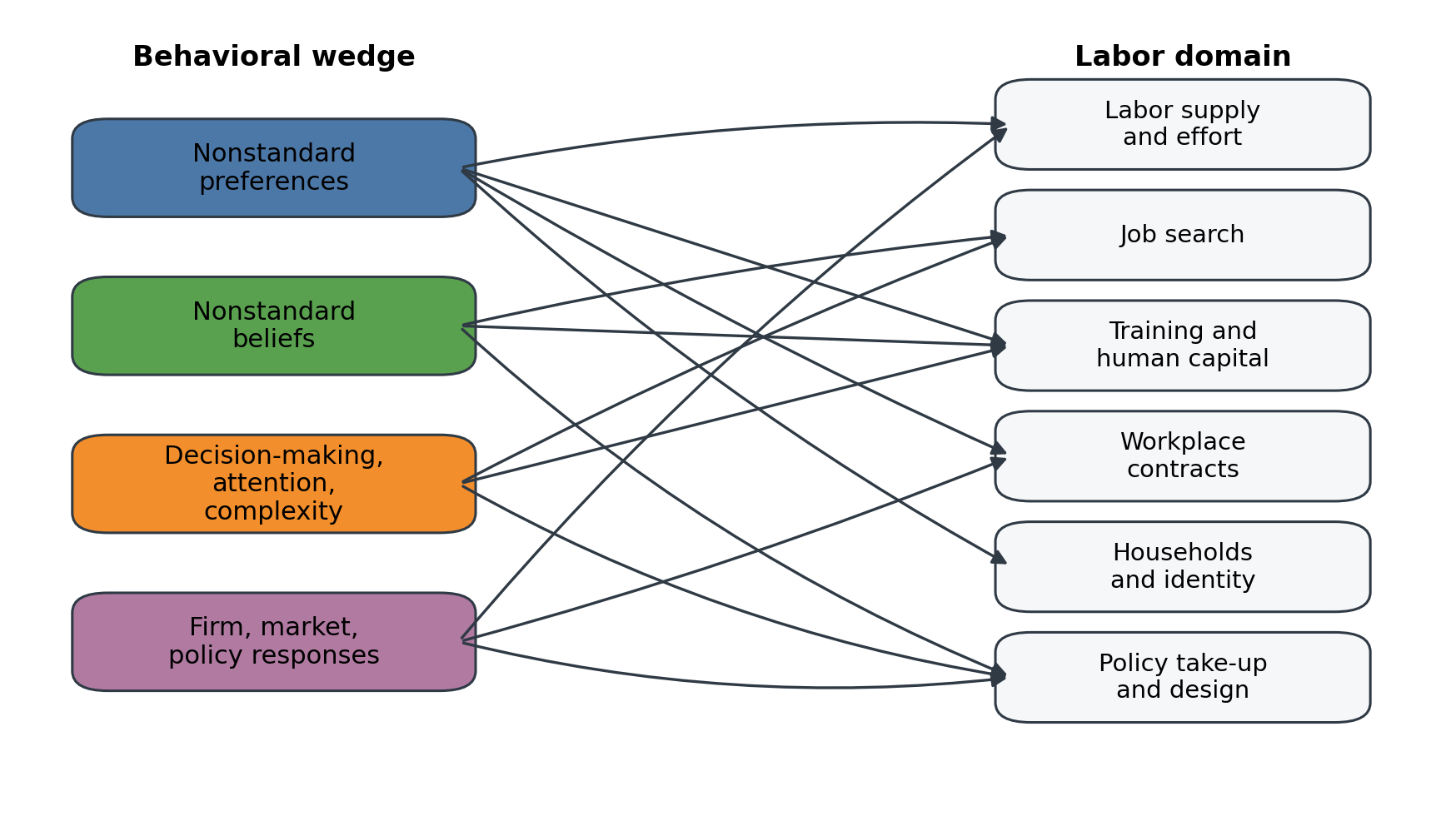
Figure 1:Behavioral Labor maps preference, belief, attention, and response wedges into labor supply, search, training, contracts, households, and policy design.
Table 1:Behavioral Labor taxonomy for Week 1
| Behavioral object | Canonical wedge | Labor margins where it matters | Representative anchors |
|---|---|---|---|
| Nonstandard preferences | Present bias, reference dependence, social preferences, identity | Hours, effort, training, savings, attendance, intra-household labor supply | Royer et al., 2015; Bertrand et al., 2015; Akerlof & Kranton, 2000 |
| Nonstandard beliefs | Biased expectations, over/under-confidence, mistaken returns, distorted duration beliefs | Job search, wage expectations, schooling/training, policy take-up | Altmann et al., 2018; DellaVigna & Paserman, 2005 |
| Nonstandard decision-making | Inattention, salience, complexity, limited consideration | Application choices, benefit take-up, default sensitivity, contract response | Chetty, 2015; Altmann et al., 2018 |
| Firm / market / policy responses | Contract redesign, screening, nudges, simplified policy, equilibrium response | Compensation, workplace monitoring, recruiting, program design, market outcomes | Chetty, 2015; DellaVigna, 2018 |
Where Behavioral Wedges Matter In Labor
Labor supply and effort are repeated dynamic decisions. Present bias can make costly current effort too low relative to a long-run plan, while reference points can make workers respond sharply around earnings targets or perceived fair wages. Job search is a belief-intensive activity: workers choose search intensity and reservation behavior under uncertainty about offer arrival, wage distributions, duration dependence, and their own future motivation. Training and human capital involve immediate costs and delayed returns, so low take-up can reflect true low returns, credit constraints, inaccurate beliefs, or self-control problems.
Inside firms, contracts and workplace relationships create behavioral objects that standard spot-market models often compress. Workers interpret bonuses, gifts, monitoring, deadlines, and fairness signals. Managers may deliberately simplify incentives, frame rewards, screen for motivation, or exploit naivete. Households add another layer: relative income, gender identity, social norms, and bargaining can alter labor supply and occupational sorting Bertrand et al., 2015Akerlof & Kranton, 2000. Worker-facing public policy adds salience and take-up margins because statutory incentives only matter when workers encounter and understand them Chetty, 2015.
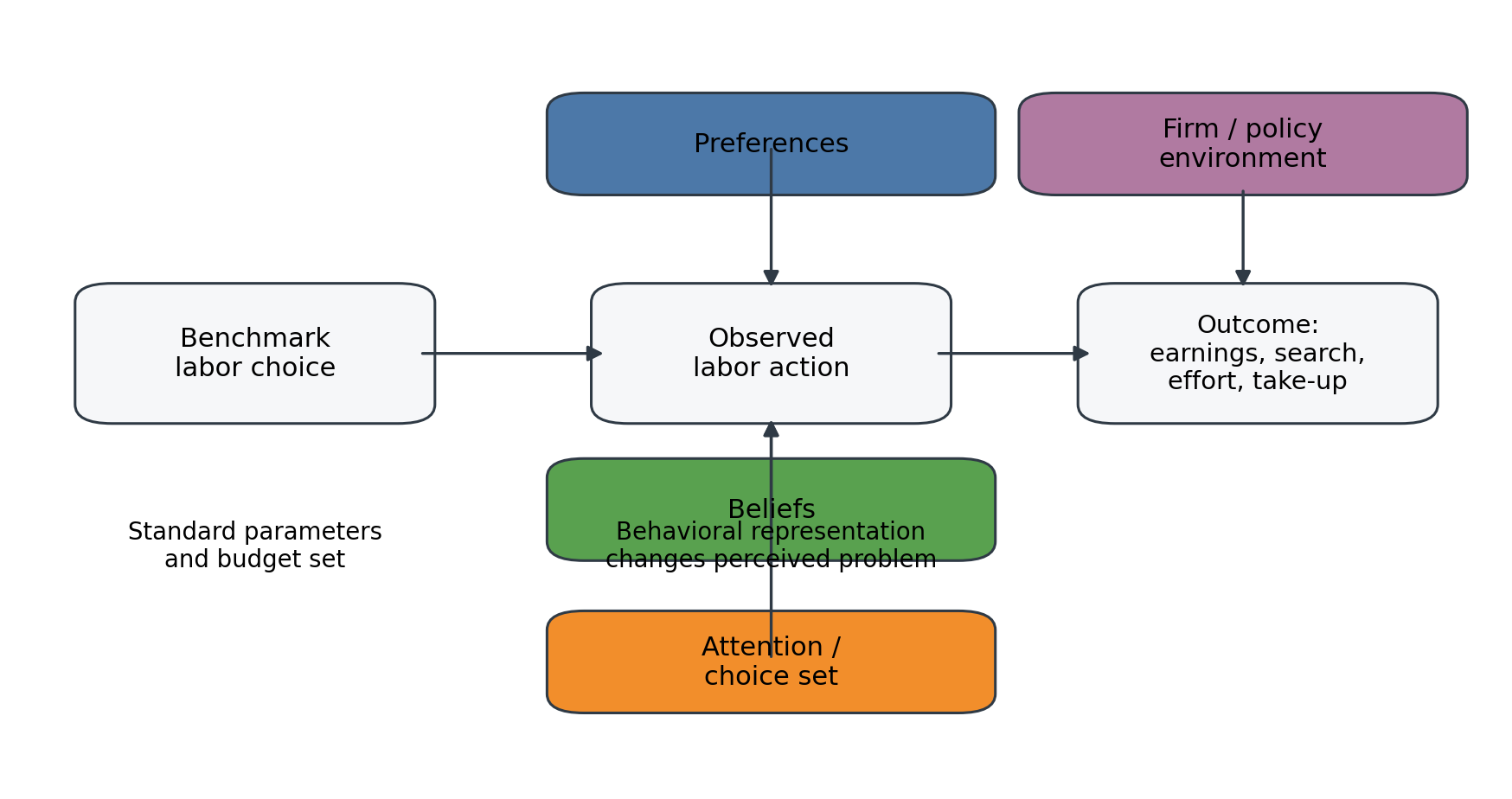
Figure 2:Behavioral wedges enter the worker problem before the observed action and may also enter through firms or policy environments.
Table 2:Labor domains where behavioral wedges naturally arise
| Labor domain | Why behavior matters here | Example research questions |
|---|---|---|
| Labor supply and effort | Repeated work choices, self-control problems, dynamic incentives | Do incentives create durable work habits or only temporary effort? |
| Job search and unemployment | Search is uncertain, feedback is noisy, discouragement is common | How do beliefs and motivation affect search intensity and job finding? |
| Training and human capital | Costs are immediate, gains are delayed, information is incomplete | Why do workers underinvest in training even when returns are high? |
| Workplace contracts and reciprocity | Employment relationships are social and relational, not purely anonymous | When do gift exchange, reciprocity, and fairness shape productivity? |
| Households and identity | Relative income and norms shape labor-market allocation inside the household | How do gender norms alter labor supply, specialization, and bargaining? |
| Worker-facing public policy | Complexity, salience, and take-up shape policy effectiveness | When do workers fail to respond to programs because they do not understand or notice them? |
Evidence, Models, Welfare, And Equilibrium Are Different Claims
Week 1 sets a discipline that will return throughout the course.
A reduced-form behavioral effect says that an intervention changed a labor outcome on a specific margin. For example, a commitment contract can raise exercise attendance or a search message can raise applications. The estimand is a causal effect of a design feature on a behavior.
A structural behavioral model interprets behavior through a parameterized choice problem, such as present bias, mistaken beliefs, social preferences, or limited attention. This can support counterfactuals, but only after the model separates behavioral mechanisms from constraints and heterogeneity DellaVigna, 2018.
A welfare claim needs a normative benchmark. If the worker’s decision utility differs from experienced or long-run utility, the analyst must say whose preferences count, whether the worker is sophisticated, and whether the intervention helps the worker reach a welfare-relevant choice Chetty, 2015.
An equilibrium response asks how firms, markets, households, and policy systems adapt. A firm may exploit inattention, offset self-control problems through commitment devices, or redesign contracts to make incentives salient. Equilibrium can mask a behavioral wedge, amplify it, or shift its incidence.
where is the welfare-relevant utility representation and is the action the analyst treats as normatively relevant. The internality is hard to measure because is not usually observed and may differ across workers.
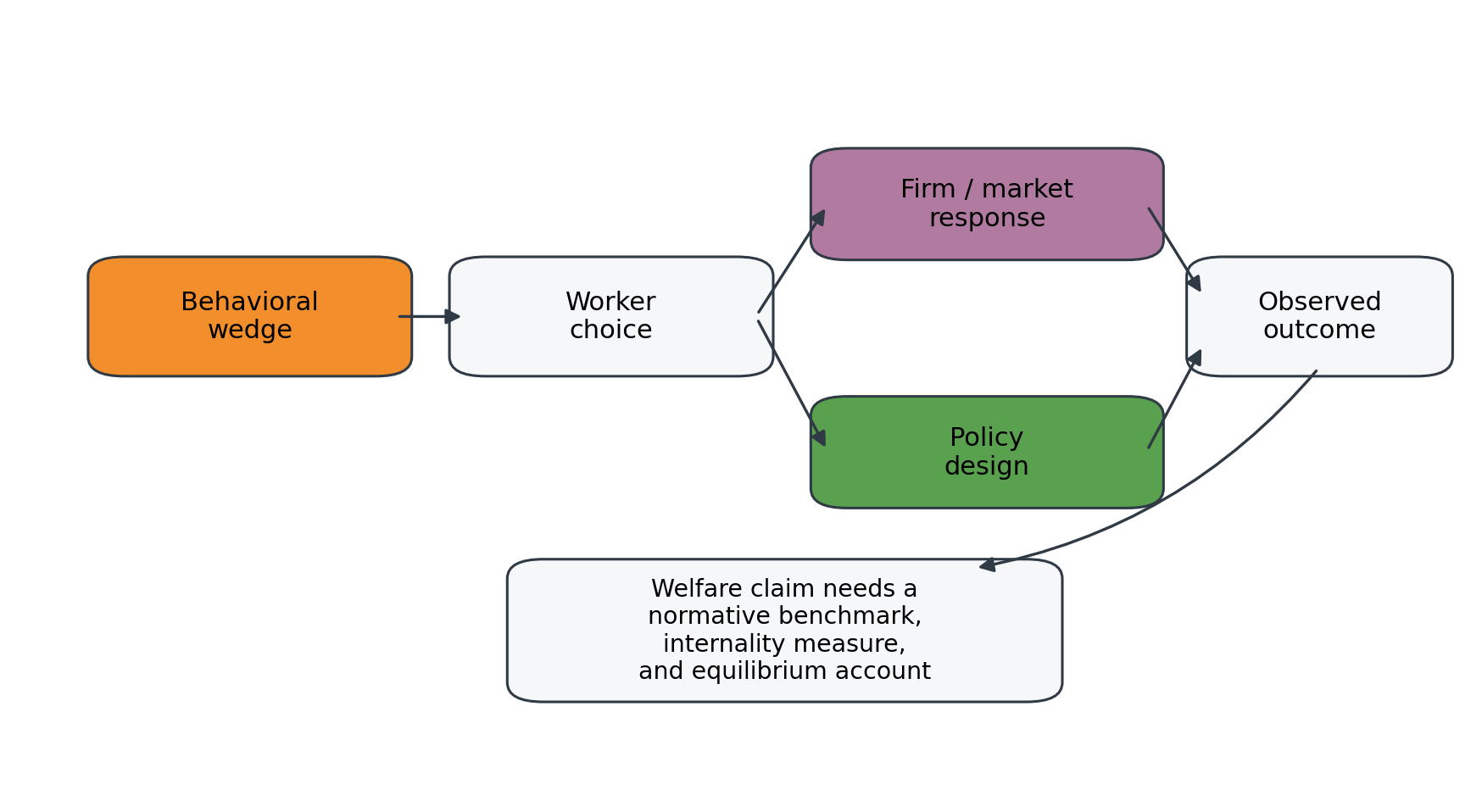
Figure 3:A behavioral effect becomes a welfare statement only after specifying the normative benchmark and the relevant firm, market, or policy response.
Research Lab
The opening research lab uses Royer et al., 2015 as the primary anchor because it is labor-facing, experimentally grounded, and useful for teaching the distinction between incentives, commitment, and habit formation. Workers in a real firm setting face exercise incentives and commitment opportunities. The design lets students ask whether short-run incentives raise participation, whether workers demand commitment against their own future behavior, and whether temporary intervention generates durable habit formation.
The challenge anchor is Altmann et al., 2018, which moves the course toward beliefs, information, and motivation in job search. Students should see that the same framework can classify what is identified: a message may change beliefs, attention, or motivation, and the labor margin is search behavior and job finding. The optional frontier anchor is Bertrand et al., 2015, which shows how identity and norms can shape household labor allocation and gendered labor-market outcomes.
The lab workflow is Reproduce -> Diagnose -> Transfer:
Reproduce: Build and analyze a bounded synthetic worker wellness experiment in the spirit of Royer et al., 2015. The smoke path estimates treatment-arm differences in participation, commitment take-up, and post-incentive persistence.
Diagnose: State the margin identified and the behavioral object inferred. Separate incentive response from commitment demand and habit formation.
Transfer: Apply the same classification logic to a synthetic job-search information intervention inspired by Altmann et al., 2018.
The bounded path does not use confidential employer microdata. Its purpose is pedagogical: students learn how to classify a behavioral labor design before moving to richer empirical work.
Methods Box
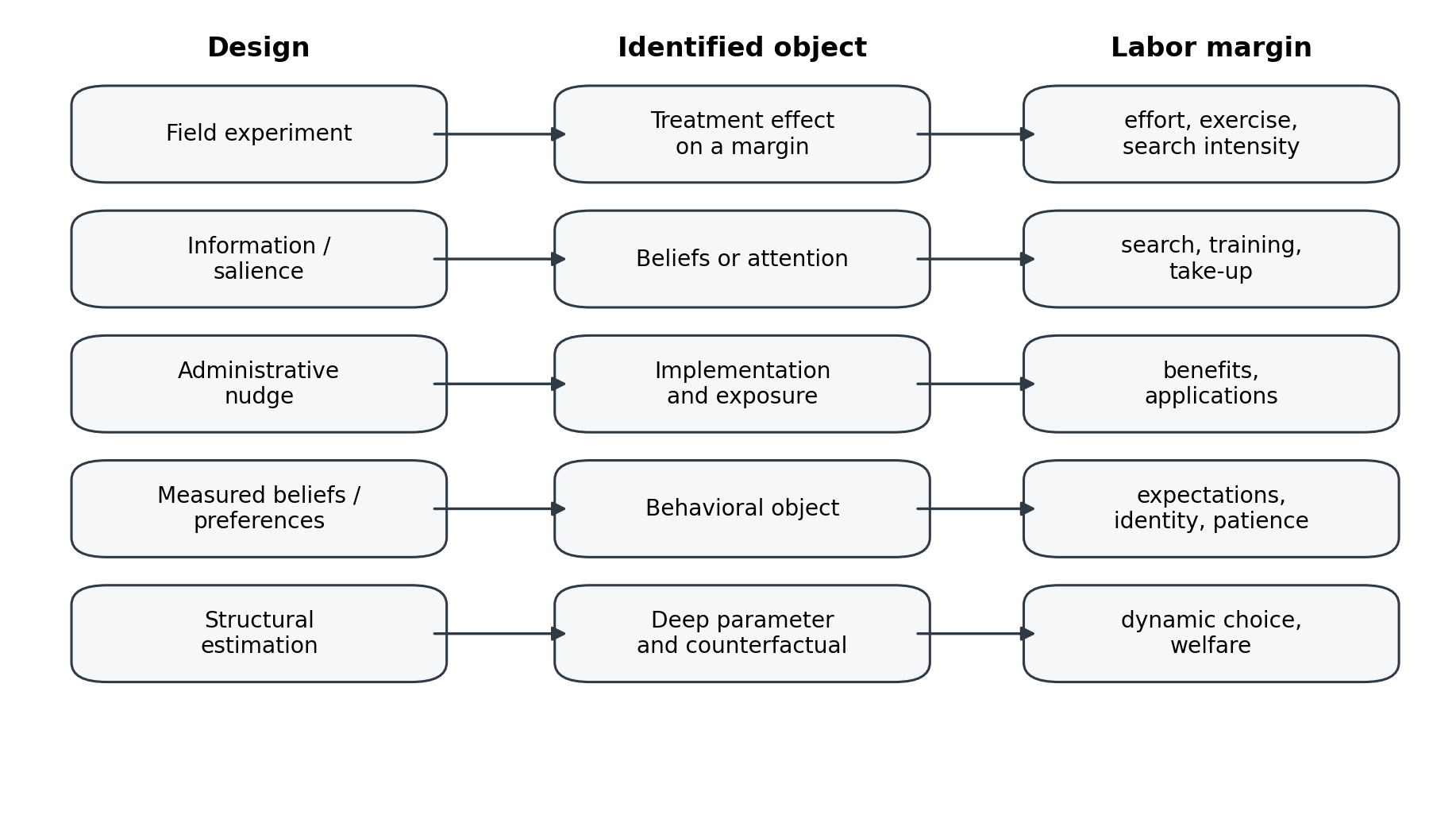
Figure 4:Behavioral labor evidence must map the design to the identified object and the labor margin.
Table 3:Methods and welfare map for Behavioral Labor Week 1
| Design / method | What it can identify | Typical labor use | Main welfare caution |
|---|---|---|---|
| Field experiment | Causal treatment effect on a specific behavioral margin | Incentives, information, search assistance, workplace interventions | Treatment effects do not automatically reveal deep parameters |
| Information / salience intervention | Role of knowledge, attention, or complexity | Job search, take-up, application behavior, worker policy | Improved decisions may reflect both information and motivation |
| Observational design with behavioral measures | Correlation between beliefs/preferences and labor outcomes | Search behavior, training, retirement, labor supply | Selection and measurement error may remain central |
| Structural behavioral estimation | Parameters of a specific behavioral model | Present bias, search behavior, dynamic choice, policy counterfactuals | Welfare and counterfactuals depend on strong modeling choices |
| Reduced-form policy evaluation | Average response to a policy feature | Nudges, simplification, default rules, incentives | Need a clear normative benchmark before claiming welfare gains |
Field experiments and framed field experiments identify causal effects of incentives, commitment offers, social signals, or information on labor behavior. They are powerful because they manipulate the environment directly, but the treatment effect is not automatically a deep parameter.
Information and salience interventions identify whether behavior changes when beliefs or attention are moved. They are central for job search, training, application behavior, and benefit take-up, but the interpretation must separate information from motivation and administrative support.
Administrative nudges and policy design experiments identify the role of reminders, defaults, simplification, timing, and friction costs in actual policy environments. They are often closest to implementation, but welfare depends on whether the nudge helps workers reach a better choice or merely increases a target outcome.
Observational designs with measured beliefs or preferences help connect heterogeneity in behavioral objects to outcomes, especially when randomization is infeasible. Their main burden is selection and measurement error.
Structural behavioral estimation is most useful when the question is mechanism, counterfactual policy, or welfare. The price is model dependence, so the estimated wedge must be disciplined by the labor margin and the design.
Reading Ladder And References
Core framing. Start with DellaVigna, 2009 for the field evidence map and DellaVigna, 2018 for the structural behavioral perspective. Read them as taxonomies, not as a list of curiosities.
Welfare and policy framing. Read Chetty, 2015 for a pragmatic account of how behavioral economics enters public policy and why welfare statements require a disciplined normative object.
Labor-facing anchor papers. Use DellaVigna & Paserman, 2005 for impatience and job search, Royer et al., 2015 for incentives, commitment, and habit formation among workers, Altmann et al., 2018 for job-search information and motivation, and Bertrand et al., 2015 for identity and household labor allocation.
Optional theoretical anchor. Use Akerlof & Kranton, 2000 to understand why identity can enter utility and why this matters for labor allocation rather than only for social psychology.
Exercises And Discussion Prompts
Take one labor margin from Labor I, such as hours, training, or benefit take-up. Write the benchmark choice problem, then add one preference wedge, one belief wedge, and one attention wedge. Which wedge would be easiest to identify?
Consider a field experiment that sends job seekers information about application returns. What margin is identified? What behavioral object is inferred? What standard explanations remain?
Suppose a firm observes that workers underrespond to a complex bonus. List one exploitative response, one welfare-improving response, and one response that makes the behavioral wedge harder to detect.
Pick one paper in the reading ladder. Classify it as primarily reduced-form evidence, structural modeling, welfare analysis, or equilibrium analysis. Defend the classification.
Reproducibility And Code Lab Note
The Week 1 lab lives at labs/01-what-is-behavioral-labor/. It is deliberately bounded and synthetic. Students run a local smoke path that creates a Royer-Stehr-Sydnor-style worker wellness dataset, reproduces a treatment-arm factbook, and transfers the logic to a job-search information design. The lab teaches classification and diagnosis rather than official replication with confidential employer data.
Slide Companion Note
The Week 1 slide deck lives at slides/week1/01-what-is-behavioral-labor.tex. The deck is a conceptual map, not a duplicate of this chapter: it defines the central question, locates Behavioral Labor relative to Labor I and Labor II, introduces the benchmark and taxonomy, and ends with methods, welfare, equilibrium cautions, and the bridge to Week 2 on nonstandard preferences.
Bridge Forward
Week 2 moves from the full taxonomy to the first major mechanism family: nonstandard preferences. The core questions become sharper. When does present bias change labor supply, effort, savings, search, or training? When do reference dependence, reciprocity, and identity change workplace behavior or household allocation? And when does the evidence identify a preference wedge rather than constraints, beliefs, or organizational design?
- DellaVigna, S. (2009). Psychology and Economics: Evidence from the Field. Journal of Economic Literature, 47(2), 315–372. 10.1257/jel.47.2.315
- DellaVigna, S. (2018). Structural Behavioral Economics. In Handbook of Behavioral Economics: Applications and Foundations 1 (Vol. 1, pp. 613–723). 10.1016/bs.hesbe.2018.07.005
- Royer, H., Stehr, M., & Sydnor, J. (2015). Incentives, Commitments, and Habit Formation in Exercise: Evidence from a Field Experiment with Workers at a Fortune-500 Company. American Economic Journal: Applied Economics, 7(3), 51–84. 10.1257/app.20130327
- Bertrand, M., Kamenica, E., & Pan, J. (2015). Gender Identity and Relative Income within Households. The Quarterly Journal of Economics, 130(2), 571–614. 10.1093/qje/qjv001
- Akerlof, G. A., & Kranton, R. E. (2000). Economics and Identity. Quarterly Journal of Economics, 115(3), 715–753. 10.1162/003355300554881
- Altmann, S., Falk, A., Jäger, S., & Zimmermann, F. (2018). Learning about Job Search: A Field Experiment with Job Seekers in Germany. Journal of Public Economics, 164, 33–49. 10.1016/j.jpubeco.2018.05.003
- DellaVigna, S., & Paserman, M. D. (2005). Job Search and Impatience. Journal of Labor Economics, 23(3), 527–588. 10.1086/430286
- Chetty, R. (2015). Behavioral Economics and Public Policy: A Pragmatic Perspective. American Economic Review, 105(5), 1–33. 10.1257/aer.p20151108